VOLTIXC / ENQUIRY
Request a Quote
Tell us what you need and we will review your enquiry.

By VoltixC Engineering Team · Last updated: 2026-09-28
Fast answer: Wire connector types fall into three jobs: terminals that land a wire on a stud or tab (ring, spade, disconnect, bullet, ferrule), splices that join wires (butt, closed-end, solder seal) and taps that branch a run. Identify the mating point first, then check the conductor range, insulation and crimp method before choosing a series.
A threaded stud takes a ring or fork terminal, a flat tab takes a quick disconnect, and a screw clamp takes a ferrule; two wire ends go into a butt or closed-end splice. VoltixC lists eight crimp and solder-seal families on its crimp connectors page, with RV ring terminals from 16–14 AWG and BV butt splices as large as 2 AWG.
One catalog sells a fork terminal as a spade and the next calls it a fork, so order by the stud or tab on your drawing. Use the ring terminal sizing tool to look up the listed RV and RNY series by wire size and insulation.
Terminals land on studs and tabs, splices join wires and taps branch a run; the table gives each type’s mating point and the wire range VoltixC lists.
| Connector type | Job and mating point | VoltixC wire range as listed | Reference point |
|---|---|---|---|
| Ring terminal | Terminal; the stud or screw passes through the ring | RV vinyl: 16–14 and 14–12 AWG; RNY nylon: 16–14, 12–10, 8 and 6 AWG | Stud size is read from the drawing; RV 22–16 and 12–10 AWG and RNY 22–16 AWG parts are not on the checked sheets, so ask before you specify |
| Spade (fork) terminal | Terminal; slides under a loosened screw head | SV vinyl: 22–16, 16–14, 14–12 and 12–10 AWG; SNY nylon: 22–16, 16–14 and 12–10 AWG | Stud size confirmed per order |
| Quick disconnect, flag included | Terminal; female receptacle pushed onto a male tab | FDD, FDFD, FDFN, FLDNY, MDD and MDFN series: 22–16, 16–14 and 12–10 AWG | UL 310 applies to quick-connect terminals, both connectors and tabs, with nominal widths of 2.8, 3.2, 4.8, 5.2 and 6.3 mm (0.110, 0.125, 0.187, 0.205 and 0.250 in) |
| Bullet connector | Terminal pair; round male pin into a female sleeve | FRD female and MPD male: 22–16, 16–14 and 12–10 AWG | Male and female halves ordered as a pair |
| Wire ferrule | Wire end; strands closed before a screw clamp | ENY nylon-collar ferrules from 26 AWG to 4/0 AWG and above; EN non-insulated ferrules listed alongside | Ferrule length and collar colour confirmed per order |
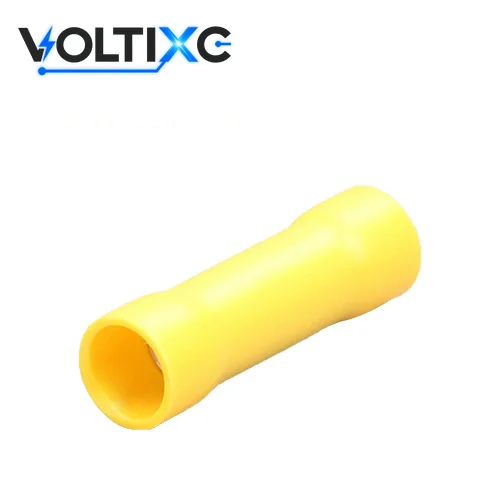
| Butt splice | Splice; one wire into each end | BV vinyl: 22–16, 16–14, 14–12 and 12–10 AWG, plus 8, 6, 4 and 2 AWG | Wire stop and barrel length confirmed per order |
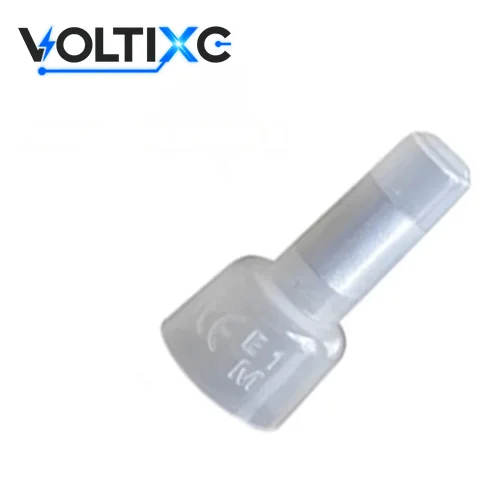
| Closed-end splice | Splice; several wires into one closed end | CE: 22–16, 16–14 and 12–10 AWG, plus 8 AWG | Wire count per size read from the maker’s chart |
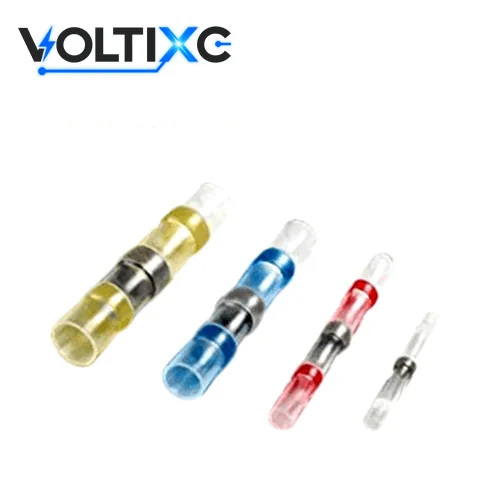
| Solder-seal splice | Splice; solder ring and sealing sleeve joined by heat | SST: 26–24, 22–18, 16–14, 12–10, 10–6 and 8–4 AWG | Heat source set by the sleeve maker |
| Heat-shrink crimp terminal | Terminal or splice with a shrink sleeve over the crimp | Not on the current list; ask before you specify | Sleeve type and heat setting agreed at enquiry |
| Tap (C-shaped compression) | Tap; branch wire pressed against an unbroken run | TC4008 C-shaped connectors on the C-tap page; wire range confirmed per order | Thomas & Betts places a C-tap over the main (run) conductor and inserts the branch (tap) conductor before compression |
| Insulation-piercing tap | Tap; teeth reach the run conductor through its insulation | Not on the current list; ask before you specify | IEC 61238-1-2 specifies copper conductor areas of 2.5–300 mm² and aluminium conductor areas of 16–500 mm² |
| Size window in UL 486E | Equipment wiring terminals | Copper from 30 AWG to 10 AWG solid and 30 AWG to 2,000 kcmil* stranded in specified Class B or Class C constructions | Metric sizes run from 0.5 to 1,000 mm2 in Classes 1, 2, 5 and 6, with AWG/kcmil* ratings mandatory and metric ratings optional |
Source: VoltixC wire ranges per supplier specification sheet; not individually re-tested; other rows from the sources cited below. *kcmil = thousand circular mils.
For a family with no listed range, send the wire size and a photo of the mating part with the enquiry; the part number is agreed before you order.
| Also asked as | Short answer | Covered in |
|---|---|---|
| types of wire connectors, different types of wire connectors, kinds of wire connectors, different kinds of wire connectors | Three jobs first (terminate, splice, tap), then the mating point: stud, tab, socket, clamp or a second wire | What are the three jobs a wire connector does? |
| electrical wire connectors types and uses, electric wire connectors types, types of electrical wire connectors, types of electric wire connectors | Each type with its job, its mating point and the wire range VoltixC lists | The table above |
| electrical connector types, types of electrical connectors, different types of electrical connectors, electric connector types, types of electric connectors | Selection starts at the mating hardware; the type then sets the crimp count and the spec-sheet fields to read | Which fields on a connector spec sheet decide the fit? |
| electrical connector types chart | Each terminal type against what it mates to, whether it comes off without removing the fastener, and its VoltixC page | Which terminal types are there? |
| what are the 3 types of connectors | Terminals, splices and taps | What are the three jobs a wire connector does? |
| crimp terminal wire connector types, types of wire ends | Ring, fork, disconnect, bullet and ferrule terminals, sorted by what the wire end lands on | Which terminal types are there? |
| types of wire splice connectors, wire splice connector types, wire splices types, kinds of wire splices, electrical splice connector types | Butt, step-down, closed-end, solder-seal, and 3-way or 4-way splices | What types of wire splices are there? |
| wiring connector types, different types of wiring connectors, types of connectors for wires | Each type with its product page and listed wire bands | Where does each wire connector type live on this site? |
A wire connector does one of three jobs: it terminates a wire on a stud or tab, splices two or more wires, or taps a branch off a run.
| Problem | What to do | Check |
|---|---|---|
| The wire has to end on a screw, stud or tab | Pick a terminal: a ring or fork for a stud, a disconnect for a tab, a ferrule for a screw clamp | The mating hardware is named on the drawing before the part is chosen |
| Two wire ends have to become one conductor | Pick a splice: a butt splice for an inline joint, a closed-end connector for a pigtail | Each wire lands inside the band printed on the splice |
| A branch circuit, such as a light, has to leave a run that must stay unbroken | Pick a tap. On Thomas & Betts parts, a C-tap is placed over the main (run) conductor and the branch (tap) conductor is inserted before compression | The run conductor stays whole under the tap |
| The catalog uses a word the drawing does not | Match the part by method. Electrical Engineering Portal lists soldered, wire-wrapping, crimp, compression, and loop or eye connections as common cable termination types | The method on the part matches the method on the drawing |
| A buyer wants the certification category for the part | Read the category name. UL Solutions says its wire-connector certification services cover terminal connectors, splicing wire connectors, insulating caps or covers, soldering lugs, wire-connector adapters, sealed systems, uninsulated equipment-wiring terminals, ferrules, and sealed twist-on-style splicing connectors | The category on the enquiry matches the job of the part |
| A splice standard is quoted for a quick-connect terminal | Check the scope first: UL 486C does not apply to terminal wire connectors, flat quick-connect terminals or soldering lugs, and quick-connect terminals come under UL 310 | The standard named for each part matches its job |
| The tap has to pierce insulation instead of stripping it | Treat it as a separate type with its own standard: IEC 61238-1-2 covers insulation-piercing connectors for power cables up to 1 kV (Um = 1.2 kV) tested on insulated conductors | The cable voltage class sits inside that scope |
Naming a standard here describes the part type; it is not a claim that any VoltixC series holds that certificate. Insulation-piercing taps are shown for scope only and are not on the current list, so ask before you specify one.
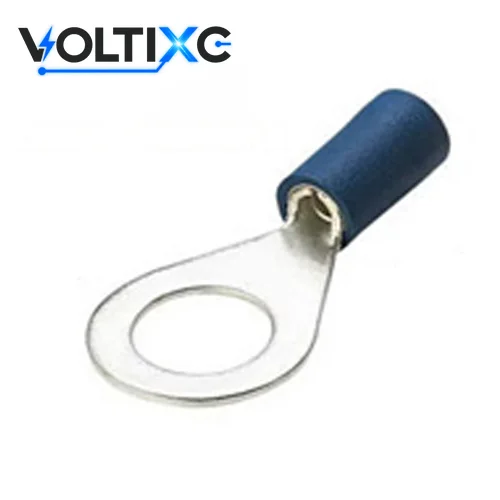
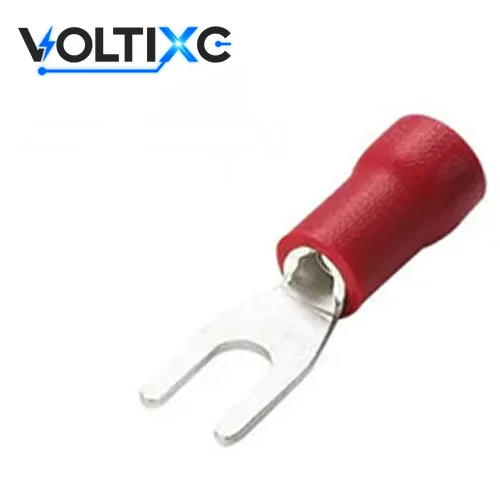
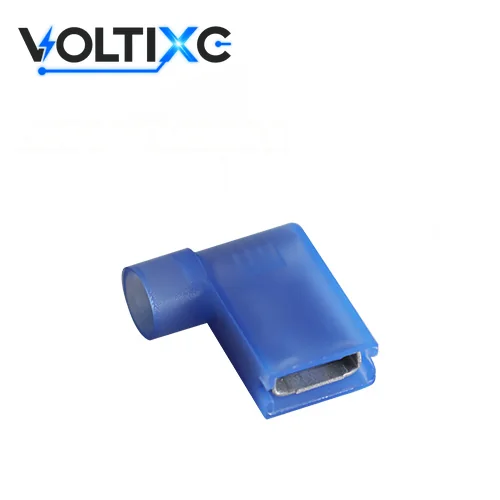
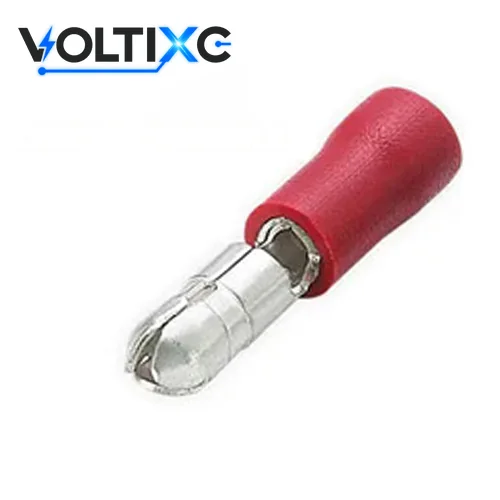
Choose the terminal by what it lands on: a ring or fork for a stud, a quick disconnect for a flat tab, a bullet for a round socket and a ferrule or pin for a screw clamp.
| Terminal type | Mates to | Comes off without removing the fastener? | What the source says | VoltixC page |
|---|---|---|---|---|
| Ring | Stud or screw through the ring | No; the fastener has to be loosened or removed | Wiltronics says a ring terminal is chosen where the fastener passes through it, so the connection cannot be removed without loosening or removing the fastener | ring terminals |
| Ring, as a screw-terminal eye | Screw terminal on equipment | No | Loop or eye connections at screw terminals are inexpensive and are used where the connection would be infrequently disconnected, per Electrical Engineering Portal | ring terminals |
| Fork (spade) | Stud or screw, open end | Yes; the screw is loosened, not taken out | In the ABB Thomas & Betts Sta-Kon catalogue, fork terminals can be installed without completely removing the mounting screw | spade terminals |
| Hook | Screw, open on one side | Yes | No VoltixC series; not on the current list, so ask before you specify | — |
| Female quick disconnect | Male blade or tab | Yes; it pulls off the tab | Burndy‘s sheet describes a female quick disconnect as having a receptacle front end that slides onto and off a male blade | quick disconnect terminals |
| Flag disconnect | Male tab, entered from the side | Yes | The receptacle sits at a right angle to the barrel; VoltixC lists the FLDNY nylon series for 22–16, 16–14 and 12–10 AWG | FLDNY flag disconnects |
| Bullet | Round female sleeve; the male pin plugs into it | Yes | Burndy offers its bullet-style connectors as male and female versions with vinyl, nylon, nylon-grip or heat-shrink insulation | bullet connectors |
| Ferrule (wire end) | Screw or spring clamp | Yes; the clamp opens | TE Connectivity describes a crimp ferrule as a soft metal tube crimped onto the end of a stripped wire to protect strands from fraying | wire ferrules |
| Pin | Clamp or socket that takes a solid pin | Yes | No VoltixC pin terminal series; not on the current list, so ask before you specify | — |
One word, two parts: A seller’s “spade” can be a fork that sits under a screw head or a female push-on that slides onto a blade. If the drawing shows a screw, it’s a fork; a tab means a push-on.
Disconnect tabs come in set widths. UL 310 applies to quick-connect terminals, both connectors and tabs, with nominal widths of 2.8, 3.2, 4.8, 5.2 and 6.3 mm (0.110, 0.125, 0.187, 0.205 and 0.250 in). UL Standards & Engagement gives UL 486A-486B as the standard for single-polarity connectors used with copper, aluminum, or copper-clad aluminum conductors in installations governed by the Canadian Electrical Code, NFPA 70, or NOM-001-SEDE.
A terminal built into the equipment follows another document. UL 486E applies to equipment wiring terminals used with all alloys of copper, aluminum, or copper-clad aluminum conductors under NFPA 70. Ring, fork and disconnect parts from this page land on those terminals.
Use a butt splice for two wires end to end, a step-down butt when the two sizes differ, a closed-end connector when several wires meet in one pigtail, and a 3-way or 4-way splice to split a run.
| Splice type | Wire entry | Crimps | Wire combinations and notes | VoltixC listing |
|---|---|---|---|---|
| Butt splice | One wire into each end | One per end | 3M gives its vinyl-insulated seamless butt connectors chamfered barrel ends for easier wire insertion and a built-in wire stop for correct positioning | BV series on the butt connectors page |
| Step-down butt splice | A larger wire in one end, a smaller wire in the other | One per end, each in its own die nest | Each end carries its own band, so both wire sizes go on the enquiry | Not on the current list; ask before you specify |
| Closed-end connector | All wires into the same open end | One | 3M describes a closed-end connector as a crimp sleeve connector with a copper insert used to splice copper conductors | CE series, 22–16 to 12–10 AWG plus 8 AWG |
| Closed-end, loading | Stripped and twisted bundle | One | The 3M S11-A data sheet gives the sequence: strip all wires ½ inch, pre-twist the wires, insert them into the connector and crimp | Strip length for CE parts confirmed per order |
| Several wires in one barrel | Two or more wires combined in one end | Per part | On TE Connectivity’s PIDG parts, wires can be combined in terminals and splices as long as total circular mil area and insulation diameter stay within specification | Combinations confirmed per part number |
| Solder-seal splice | One wire into each end, then heat | None; heat does the joining | TE’s Raychem wire termination products are housed in transparent heat-shrinkable sleeves that allow inspection and can provide environmental protection | SST series on the solder seal wire connectors page |
| 3-way or 4-way splice | One wire in, two or three out | One per branch | Branch count and sizes decide the part; no source figure is given here | Not on the current list; ask before you specify |
The standard behind these parts is UL 486C, which applies to single-polarity, hand- or tool-applied splicing wire and cable connectors for copper, aluminum or copper-clad aluminum conductors under CSA C22.1, NFPA 70 or NOM-001-SEDE. A butt splice keeps the two wires in line, while a closed-end part leaves a stub that has to be folded back or taped out of the way. Two sizes that fall inside one printed band can share a single butt splice. The butt connector guide covers the crimp on each end.
Pick vinyl for basic protection at the lowest cost, nylon when the part has to take a double crimp, heat shrink when the joint must be sealed, and bare metal only where no extra protection is needed.
| Insulation | Crimps required | Seals the joint? | Suits | VoltixC series |
|---|---|---|---|---|
| Non-insulated | One on the bare barrel | No | According to Waytek, non-insulated terminals should only be used where no additional electrical protection is necessary | EN ferrules on the wire ferrules page; bare copper splices on the non insulated butt connectors page |
| Vinyl (PVC) | Set by the part design; read it on the data sheet | No | Waytek calls vinyl insulation the most economical option and credits it with basic protection against accidental contact | RV, SV, FDD, FDFD, MDD, FRD, MPD and BV |
| Nylon | Double crimp on many designs | No | Many nylon-insulated terminals are designed for double crimping, which adds strain relief and tensile strength (Waytek) | RNY, SNY, FDFN, FLDNY, MDFN and ENY |
| Heat shrink | Crimp first, then heat the sleeve | Yes, when heated properly | For heat-shrink insulated terminals, Waytek notes a tight seal when heated properly, giving moisture resistance and corrosion protection | Not on the current list; ask before you specify (heat shrink butt connectors) |
| Heat shrink, dual wall | Crimp, then heat | Yes | Waytek adds that many heat-shrink terminals add an adhesive lining (dual wall) for further durability and protection | Not on the current list; ask before you specify |
| Separate heat-shrink tubing | Applied over a finished joint | Yes | TE Connectivity lists electrical insulation, mechanical protection, environmental sealing, and strain relief among what heat-shrink tubing provides | Not supplied by VoltixC |
Insulated terminals carry two barrels, and TE Connectivity’s crimping guide gives each its own job: the wire barrel provides the electrical and mechanical connection, while the insulation barrel provides strain relief and requires a more relaxed crimp without providing an electrical connection. Check the crimp before you heat a sealed sleeve, since the sleeve hides it.
Read five columns before anything else: body material, plating, insulation, the conductor range in AWG and mm², and the barrel inside diameter, then check overall length and operating temperature.
| Field | What to read | Why it decides the fit | Where VoltixC lists it |
|---|---|---|---|
| Type | Ring, fork, disconnect, bullet, ferrule, butt, closed-end or solder seal | Sets the mating point and the crimp count | Product page title and series code |
| Body material | The metal of the barrel under the sleeve | Has to suit the conductor metal | Confirmed per order |
| Plating | Tinned or bare | Set together with the body material | Confirmed per order |
| Insulation | Vinyl, nylon or none | Decides the crimp profile and the protection level | Series code (RV vinyl, RNY nylon, and so on) |
| Min–max conductor (AWG / mm²) | The printed band, for example 16–14 AWG | The wire has to sit inside it | Listed per series as supplier data |
| Barrel ID | Inside diameter of the wire barrel | Decides whether the stranded conductor goes in fully | Confirmed per order |
| Overall length | End-to-end length | Decides whether the part fits the housing or the gap | Confirmed per order |
| Max operating temperature | The temperature printed for the part | Has to match the insulated conductors around it | Confirmed per order; this page gives no figure for VoltixC parts |
| Point | What the data says | Source |
|---|---|---|
| Where UL 486E applies | Field-wired equipment wiring terminals integral to equipment or intended for specific equipment | UL Standards & Engagement, UL 486E |
| Aluminum sizes in UL 486E | 12 AWG and 10 AWG solid, and 12 AWG to 2,000 kcmil* stranded Class B concentric, compressed, or compact | UL 486E |
| Copper sizes in UL 486E | 30 AWG to 10 AWG solid and 30 AWG to 2,000 kcmil* stranded in specified Class B or Class C constructions | UL 486E |
| Metric sizes in UL 486E | Rigid solid or stranded metric wire sizes in Classes 1, 2, 5, and 6 from 0.5 to 1,000 mm2, with AWG/kcmil* ratings mandatory and metric ratings optional | UL 486E |
| Current and temperature | Equipment wiring terminals are intended for currents no greater than the ampacity of 75 °C or 90 °C insulated conductors according to the terminal rating | UL 486E |
| Tap conductor areas | Copper conductor areas of 2.5–300 mm² and aluminium conductor areas of 16–500 mm² | IEC 61238-1-2 preview |
Source: field list after the structure of connector maker data sheets; VoltixC columns are supplier data as listed; standard rows from the sources cited below. *kcmil = thousand circular mils.
Worked example: A 14 AWG stranded copper wire sits in the 16–14 AWG band that VoltixC lists for its RV ring, SV spade and FDD disconnect series. Once the band matches, measure the insulation outside diameter and compare it with the barrel ID on the data sheet; if the wire will not go in to the stop, ask for a part with a larger insulation barrel.
Where a sheet leaves a field blank, put the question on the enquiry and it is confirmed per order. Work from the AWG band unless the cable is specified in mm².
Check five things before you order: what the part mates to, the conductor range, the insulation, the crimp tool and the pack quantity.
| Problem | What to do | Check |
|---|---|---|
| The part was sized from the cable’s outside diameter | Size it from the conductor size printed on the cable. Wiltronics tells installers to size a connector from the conductor size printed on the cable, not from the cable’s outside diameter alone | The printed size falls inside the band on the part |
| A thick jacket will not enter the insulation barrel | Measure the outside diameter as well. According to TE Connectivity, insulation outside diameters vary among wires with the same AWG size, so the insulation barrel must accommodate the wire’s outside diameter and the crimp range must match it | The jacket slides into the insulation barrel without being forced |
| The order was placed by sleeve colour alone | Go by the printed range, since colour bands differ from maker to maker. ABB’s Spec-Kon guide shows insulated terminals using colour-coded insulators according to DIN cable sizes | The printed range and the measured conductor agree |
| The crimp tool was chosen after the parts arrived | Name the tool with the part. In Wiltronics’ guide, crimp tools for pre-insulated terminals produce a different crimp profile from tools for uninsulated lugs, bootlace ferrules and other connector systems | The die on hand is made for the insulation type ordered |
| A crimp moves in the pull test | Cut it off and redo it with a new terminal; a crimped terminal is not used twice (Wiltronics) | A fresh terminal holds a steady in-line pull |
| A loose crimp is about to go under heat-shrink | Recrimp first, since heat-shrinking a sleeve must not be used to conceal or compensate for a loose crimp, per Wiltronics | The crimp passes before any heat goes on |
| A store kit for home wiring was picked on price alone | Compare the printed band, insulation and mating point on each part before the price | Every part in the kit carries a printed range |
| “Waterproof” was read as suitable for every site | Pick a sealed part for damp or outdoor runs and name the site on the enquiry | The sealing type on the quote matches the site |
| Pack size and quantity were left off | Write both on the enquiry next to each part number | Pack quantity is confirmed per order |
| The joint failed with the right part | Review the other inputs: TE Connectivity ties a quality crimp to correct tooling for the terminal and wire, the correct terminal for the application, properly prepared wire, and a trained operator | All four are named before the batch starts |
Sleeve colour: Red, blue and yellow sleeves each mark a band on one maker’s chart, and another maker may draw the lines elsewhere. Read the printed range on the part itself.
Step-down butt splices and pin terminals have no listed range here. For those, send the drawing and the wire sizes, and the series is named from them.
Each insulated family has its own product page under crimp connectors, and the C-shaped tap sits with the copper connectors.
| Connector type | Product page | Series listed | Listed wire bands |
|---|---|---|---|
| Ring terminal | insulated ring terminals | RV vinyl, RNY nylon | RV 16–14 and 14–12 AWG; RNY 16–14, 12–10, 8 and 6 AWG |
| Spade (fork) terminal | insulated spade terminals | SV vinyl, SNY nylon | 22–16 to 12–10 AWG |
| Quick disconnect and flag | quick disconnects and flag terminals | FDD, FDFD, FDFN, FLDNY, MDD, MDFN | 22–16, 16–14, 12–10 AWG |
| Bullet connector | male and female bullet connectors | FRD female, MPD male | 22–16, 16–14, 12–10 AWG |
| Wire ferrule | insulated and non-insulated ferrules | ENY nylon collar, EN non-insulated | 26 AWG to 4/0 AWG and above |
| Butt and closed-end splice | butt splices and closed-end connectors | BV vinyl, CE closed-end | BV 22–16 to 2 AWG; CE 22–16 to 8 AWG |
| Solder-seal splice | solder-seal splices | SST | 26–24 to 8–4 AWG |
| C-shaped tap | C-tap connector | TC4008 | Confirmed per order |
| Heat-shrink crimp terminal | heat-shrink crimp terminals | General guide page; no series listed | Not on the current list; ask before you specify |
Source: VoltixC wire bands per supplier specification sheet; not individually re-tested.
For the crimp itself, the wire crimping guide walks through the tool and the pull check, and crimp connector types sorts the same parts by crimp design. Put the following on the enquiry so the series can be named from the first reply.
This guide classifies connector jobs but does not infer an unlisted VoltixC series from a colour or nickname.
Terminate, splice and tap. A terminal lands one wire on a stud, tab or clamp, a splice joins wires to each other, and a tap takes a branch off a run that stays whole.
No. Both get called “spade”, but a fork slides under a screw head and, per the ABB Thomas & Betts catalogue, can be installed without completely removing the mounting screw. A push-on female disconnect instead has a receptacle front end that slides onto and off a male blade, as Burndy describes it.
All the wires go into the same open end. 3M’s S11-A sheet gives the order: strip all wires ½ inch, pre-twist the wires, insert them into the connector and crimp. Check the maker’s chart for how many wires of each size one barrel takes.
It does not. Colour points to a band, yet two wires of the same AWG size can have different insulation outside diameters, which the insulation barrel has to accommodate (TE Connectivity). Read the printed range and measure the wire.
When the joint will flex or vibrate and the part is built for it. Many nylon-insulated terminals are designed for double crimping, which adds strain relief and tensile strength, according to Waytek. Vinyl stays the economical choice for a dry, still panel.
The mating hardware, the conductor range, the insulation need and the crimp tool. TE Connectivity links a quality crimp to correct tooling, the correct terminal for the application, properly prepared wire and a trained operator, so name the tool on the enquiry as well as the part. A photo of the mating part answers the naming question.
The fitted end is a termination, and the part on it is a terminal. Crimp is one route; Electrical Engineering Portal also lists soldered, wire-wrapping, compression, and loop or eye connections. A bare stranded end for a screw clamp takes a ferrule, which TE Connectivity describes as a soft metal tube that keeps the strands from fraying.
For two stranded wires in a permanent inline joint, crimp a butt splice sized to both of them with the matching tool. Where several wires meet, a closed-end connector does the same job side by side. If the joint needs a seal, pick a sealed splice and check the crimp before the heat goes on.
How this guide was written: the types and jobs come from UL Standards & Engagement scope pages, the IEC preview and the UL Solutions certification list. Connector data is from TE Connectivity, 3M, ABB, Burndy and Thomas & Betts, and installer guidance from Wiltronics, Waytek and Electrical Engineering Portal. VoltixC ran no tests for this guide, so it gives no current, temperature or pull-force values for VoltixC parts. Wire bands come from the supplier specification sheets for each VoltixC series and have not each been re-tested.
VoltixC is the brand of Guangzhou FuTeXin Technology Co., Ltd. It makes the insulated terminals, ferrules, splices and copper connectors that this guide sorts by job.