VOLTIXC / ENQUIRY
Request a Quote
Tell us what you need and we will review your enquiry.

Tin-plated copper battery lugs for battery-bank, inverter and power cable, listed in one AWG series from 8 AWG to 4/0 AWG.
Fast answer: Battery lugs are copper tube lugs that crimp onto battery cable and bolt to a stud. VoltixC lists one AWG series here: 36 part numbers from 8 AWG to 4/0 AWG, with stud hole, barrel and tongue sizes from the supplier specification sheet. Match your cable gauge and stud, then send the list for a quote.
The specification sheet pairs nine gauges, 8, 6, 4, 2 and 1 AWG, then 1/0, 2/0, 3/0 and 4/0 AWG, with stud holes from 5.1 mm to 13.1 mm, and lists a tin-plated copper body on every part. A gauge or hole that is not on the sheet is a special request; ask before you specify.
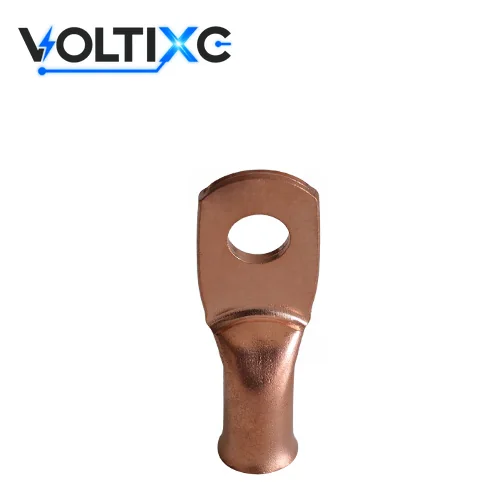
A battery lug is a copper barrel joined to a flat palm with a bolt hole. The stripped cable goes into the barrel and a die compresses the barrel onto the strands. The palm then bolts to a battery stud, busbar or terminal post. “Heavy-duty” is the supplier’s family name for this series and describes the lug form. It isn’t a current, temperature or pull rating.
For the joint to hold, the cable gauge, the barrel and the die have to be the same size. If a 4/0 barrel is crimped onto 2 AWG cable, air is left between the strands. A die one size too large leaves the barrel loose even on a cable that fits. Either fault can look fine on the bench and still fail later under load.
Strip the cable to the barrel depth and keep the strands clean and untwisted.
Push the conductor all the way into a barrel of the same AWG size.
Crimp with a tool and die made for that lug and cable size. According to West Marine, ABYC E-11.14.3.8 requires solderless crimp-on connectors to be crimped with a tool designed for the connector.
Bolt the palm to a stud of the same nominal size as the lug hole.
A wrong match fails at the lug and not along the cable. The checks that prevent it are about tooling and preparation:
The AWG heavy-duty series lists 36 battery lugs on its specification sheet: nine gauges from 8 AWG to 4/0 AWG, each with three to five stud-hole sizes. The table below shows 30 of them; the six others (8*10, 6*10, 8*1/2, 6*1/2, 4*1/2 and 2*1/2) are named in the size table in the next section.
Every value comes from that sheet: the part number as printed, the gauge, the mm² figure printed beside it, the stud hole diameter, the barrel inside and outside diameter, the overall length and the tongue width. All 36 parts have a copper body with tin plating.
| Part No. | AWG | mm² (as printed) | Stud hole Ø (mm) | Barrel ID d (mm) | Barrel OD D (mm) | Length L (mm) | Tongue width W (mm) |
|---|---|---|---|---|---|---|---|
| 8*1/4 | 8 AWG | 10 | 6.8 | 4.8 | 7.1 | 33.3 | 11.8 |
| 8*5/16 | 8 AWG | 10 | 8.3 | 4.8 | 7.1 | 33.3 | 11.8 |
| 8*3/8 | 8 AWG | 10 | 10.4 | 4.8 | 7.1 | 33.3 | 14.5 |
| 6*1/4 | 6 AWG | 16 | 6.8 | 5.9 | 8.1 | 37.3 | 13.7 |
| 6*5/16 | 6 AWG | 16 | 8.3 | 5.9 | 8.1 | 37.3 | 13.7 |
| 6*3/8 | 6 AWG | 16 | 10.4 | 5.9 | 8.1 | 37.3 | 13.7 |
| 4*1/4 | 4 AWG | 25 | 6.8 | 7.3 | 9.5 | 38.9 | 14.5 |
| 4*5/16 | 4 AWG | 25 | 8.3 | 7.3 | 9.5 | 38.9 | 14.5 |
| 4*3/8 | 4 AWG | 25 | 10.4 | 7.3 | 9.5 | 38.9 | 14.5 |
| 2*1/4 | 2 AWG | 35 | 6.8 | 8.5 | 11.1 | 41.1 | 16.5 |
| 2*5/16 | 2 AWG | 35 | 8.3 | 8.5 | 11.1 | 41.1 | 16.5 |
| 2*3/8 | 2 AWG | 35 | 10.4 | 8.5 | 11.1 | 41.1 | 16.5 |
| 1*1/4 | 1 AWG | 50 | 6.8 | 9.1 | 11.7 | 43.6 | 16.4 |
| 1*5/16 | 1 AWG | 50 | 8.3 | 9.1 | 11.7 | 43.6 | 16.4 |
| 1*3/8 | 1 AWG | 50 | 10.4 | 9.1 | 11.7 | 43.6 | 17.1 |
| 1*1/2 | 1 AWG | 50 | 13.1 | 9.1 | 11.7 | 43.6 | 19.1 |
| 1/0*1/4 | 1/0 AWG | 60 | 6.8 | 10.4 | 13 | 46.8 | 18.4 |
| 1/0*5/16 | 1/0 AWG | 60 | 8.3 | 10.4 | 13 | 46.8 | 18.4 |
| 1/0*3/8 | 1/0 AWG | 60 | 10.4 | 10.4 | 13 | 46.8 | 18.4 |
| 1/0*1/2 | 1/0 AWG | 60 | 13.1 | 10.4 | 13 | 46.8 | 21 |
| 2/0*1/4 | 2/0 AWG | 70 | 6.8 | 11.7 | 14.2 | 52.4 | 21 |
| 2/0*5/16 | 2/0 AWG | 70 | 8.3 | 11.7 | 14.2 | 52.4 | 21 |
| 2/0*3/8 | 2/0 AWG | 70 | 10.4 | 11.7 | 14.2 | 52.4 | 21 |
| 2/0*1/2 | 2/0 AWG | 70 | 13.1 | 11.7 | 14.2 | 52.4 | 21 |
| 3/0*5/16 | 3/0 AWG | 95 | 8.3 | 13 | 15.7 | 55.9 | 23.1 |
| 3/0*3/8 | 3/0 AWG | 95 | 10.4 | 13 | 15.7 | 55.9 | 23.1 |
| 3/0*1/2 | 3/0 AWG | 95 | 13.1 | 13 | 15.7 | 55.9 | 23.1 |
| 4/0*5/16 | 4/0 AWG | 120 | 8.3 | 14.2 | 17.2 | 60.5 | 25.8 |
| 4/0*3/8 | 4/0 AWG | 120 | 10.4 | 14.2 | 17.2 | 60.5 | 25.8 |
| 4/0*1/2 | 4/0 AWG | 120 | 13.1 | 14.2 | 17.2 | 60.5 | 25.8 |
Source: per supplier specification sheet (AWG Copper Tube Terminal, two tables); values as printed, not individually re-tested.
36 part numbers in the full specification table — request the complete list with your quote. Rows run from the smallest conductor to the largest: in AWG a lower number means a larger wire up to 1 AWG, and the aught sizes 1/0, 2/0, 3/0 and 4/0 keep getting larger after that. The mm² column repeats the figure printed beside each gauge on the sheet; it is a label, not a conversion.
Request a QuotePick the row that matches the AWG size printed on your cable jacket, then the part number whose hole fits your stud. The table lists all 36 part numbers by gauge, with the names buyers search under and the check that matters for each size.
| AWG (mm² as printed) | Part numbers on the sheet | Common names | Check before you order |
|---|---|---|---|
| 8 AWG (10 mm²) | 8*10, 8*1/4, 8*5/16, 8*3/8, 8*1/2 | 8 awg lug; 8 gauge lug | Only 8 AWG and 6 AWG have the 5.1 mm hole; confirm the cable is AWG, not SAE |
| 6 AWG (16 mm²) | 6*10, 6*1/4, 6*5/16, 6*3/8, 6*1/2 | 6 awg lug; 6 gauge lug | Five hole sizes; confirm the cable is AWG, not SAE |
| 4 AWG (25 mm²) | 4*1/4, 4*5/16, 4*3/8, 4*1/2 | 4 awg cable lugs; 4 gauge cable lugs | Strand class of the cable (standard or fine) |
| 2 AWG (35 mm²) | 2*1/4, 2*5/16, 2*3/8, 2*1/2 | 2 awg cable lugs; 2 gauge cable lugs | Strand class; stud size from the equipment drawing |
| 1 AWG (50 mm²) | 1*1/4, 1*5/16, 1*3/8, 1*1/2 | 1 awg lug; 1 gauge lug | Write 1 AWG, not 1/0 |
| 1/0 AWG (60 mm²) | 1/0*1/4, 1/0*5/16, 1/0*3/8, 1/0*1/2 | 1/0 lugs; 0 gauge lugs; 0 gauge wire lugs | Also written 0 AWG; do not swap it with 1 AWG |
| 2/0 AWG (70 mm²) | 2/0*1/4, 2/0*5/16, 2/0*3/8, 2/0*1/2 | 2/0 lugs; 2/0 awg cable lugs | Also written 00; die size for the barrel |
| 3/0 AWG (95 mm²) | 3/0*5/16, 3/0*3/8, 3/0*1/2 | 3/0 lugs; 3/0 cable lugs | Smallest hole is 8.3 mm; die size for the barrel |
| 4/0 AWG (120 mm²) | 4/0*5/16, 4/0*3/8, 4/0*1/2 | 4/0 lugs; 4/0 cable lugs | Smallest hole is 8.3 mm; how many lugs share the stud |
The 8 awg lug and the 6 awg lug are the two smallest gauges in the series and the only ones with a 5.1 mm hole. At these sizes the main risk is cable labeling: according to West Marine, SAE wire can be up to 12% smaller than AWG boat cable, so a larger gauge may be needed to meet voltage-drop limits. Check which system your cable follows before you match the barrel.
Buyers looking for 4 awg cable lugs or a 2 awg lug will find four hole sizes each, from 6.8 mm to 13.1 mm. Fine-strand flexible cable and standard-strand cable of the same gauge can differ in bundle diameter, so send the cable type with the size and compare it with the barrel inside diameter: 7.3 mm for 4 AWG and 8.5 mm for 2 AWG. A matching gauge alone does not prove that the barrel fits the cable.
These two gauges sit next to each other and are easy to mix up. 1/0 lugs take the larger cable; 1 AWG is one step smaller. Buyers searching for 1/0 cable lugs or 1/0 copper lugs want the parts that start with 1/0, such as 1/0*3/8. Write “1/0” or “0 AWG” on the enquiry rather than “1”, and give the stud size for each.
2/0 lugs, 3/0 and 4/0 lugs cover the heaviest battery and power leads in the series. The 2/0 cable lugs come in four hole sizes; the 3/0 and 4/0 parts start at 8.3 mm. According to West Marine, ring and captive-spade terminals should be the same nominal size as the stud under ABYC E-11.14.4.1.11. West Marine also reports that ABYC E-11.14.4.1.10 allows no more than four terminals on one stud, with extra connections moved to additional studs joined by jumpers or copper straps.
Spec note: the sheet gives a hole diameter, not a stud name. The 6.8 mm, 8.3 mm, 10.4 mm and 13.1 mm holes are on the parts whose numbers end in 1/4, 5/16, 3/8 and 1/2; check the hole against the stud on your equipment and write the stud size next to each gauge on your list.
Stay on this page when your cable is copper, sized in AWG between 8 AWG and 4/0 AWG, and ends on a single stud. Switch to another lug page when the drawing calls for metric sizing, a second bolt hole, an inspection hole, aluminum conductor or a cable-to-cable joint. The table sets each case against this series.
| If your job needs | Better page | How it differs from this AWG series |
|---|---|---|
| Metric cable ordered by mm², or a drawing that cites DIN 46235 | DIN 46235 copper lugs | Named by DIN item code (the number reads as mm²; cross-section confirmed per order); this series is named by AWG gauge |
| A sight hole to see the conductor reach the end of the barrel | copper tubular ring terminals | Tubular ring terminals with an inspection hole; no inspection hole is listed for this series |
| A wider choice of tube lug series in tinned copper | tinned copper lugs | Five tube lug series; this page carries one AWG series, tin-plated per its specification sheet |
| Two bolts to stop the lug turning on a busbar | two hole copper lugs | Built with two bolt holes; each part on this series’ sheet lists one stud hole |
| Aluminum conductor, or one-hole compression lugs in copper and aluminum | compression lugs | Includes an aluminum series; this series lists copper only |
| Joining two cables end to end, with no stud | copper butt connectors | A barrel on both ends; this series ends in a bolt palm |
Three situations point back to this page. The first is a US-market cable list written in AWG, where the gauge on the jacket should match the gauge on the lug without a metric conversion. The second is a battery lug order that runs across several sizes, from an 8 AWG charger lead to 4/0 AWG main cables, where one series keeps the lug form the same across the set. The third is a replacement for battery cable ends or battery terminal connectors where the original part was a heavy-duty copper lug and the stud size is known.
Clamp-style battery post terminals are a different product: they grip a tapered post instead of bolting to a stud, and they are not part of the VoltixC range. Insulated terminal connectors for small wire, such as insulated wire ring terminals, belong to the insulated terminal range, not this page. If you are not sure which lug form your equipment takes, the types of cable lugs guide shows the options, and the copper cable lugs hub lists every copper lug series in one place.
Heavy-duty battery lugs from this AWG series fit DC battery and power cable from 8 AWG to 4/0 AWG that ends on a stud. Each card names a cable job that follows from the lug form and the listed sizes, the condition it needs and the point to watch. None of them is a customer reference or a rating.
Conditions: copper battery cable in AWG sizes between the battery terminals of a bank, a fuse or busbar and an inverter or charger.
Watch: the crimp and the die. A thread on a DIY solar forum asks whether an improvised hammer crimp holds up in long-term or high-load use, where oxidation could compromise current flow.
Conditions: boat battery, starter and house-bank leads, where heavy duty battery lugs meet the stud on a switch, bus or battery.
Watch: the wire standard and the pull test. According to West Marine, ABYC pull-test ratings are 15 lb for 16 AWG connectors, 40 lb for 10 AWG terminals and 150 lb for 00 battery-cable terminals. West Marine also notes that ABYC restricts SAE wire in bilge or spray areas, in engine spaces without oil-resistant 75°C marking, in vibration or flexing applications and in 110-volt circuits.
Conditions: copper cable from 8 AWG to 4/0 AWG landing on a busbar, a grounding bar, a terminal post or an equipment stud inside a cabinet.
Watch: the stud size on the equipment drawing, which is confirmed per order, and the number of lugs stacked on each stud.
Conditions: a worn lug, or one lost to corrosion at the battery terminals, being replaced on an existing copper cable whose gauge is printed on the jacket.
Watch: re-strip to clean copper and match the new lug to the gauge, not to the old lug, because the old part may have been a different size.
This series lists copper only. For aluminum cable, use a lug made for aluminum conductor, such as the aluminum series on the compression lugs page.
According to West Marine, SAE J378, J1127 and J1128 wires are intended for surface vehicles and meet minimum boat standards only in limited circumstances. The lug does not change that; choose the cable first, then match the lug to its gauge.
A lug in this series bolts to a stud. A tapered battery post that needs a clamp terminal is outside this series and outside the VoltixC range.
The lug body is copper on all 36 part numbers, and the supplier specification sheet lists tin plating. The series photo shows a bare copper lug; VoltixC supplies bare or tin-plated copper to the buyer’s requirement, so state the finish on your enquiry.
| Item | What the supplier sheet lists | What you confirm per order |
|---|---|---|
| Body material | Copper, all 36 part numbers | Copper grade, if your drawing names one |
| Finish | Tin plating | Tin-plated or bare copper |
| Size reference | 8 AWG to 4/0 AWG, with an mm² figure printed beside each gauge | The gauge printed on your cable |
| Stud hole | 5.1 mm to 13.1 mm, one hole diameter per part | The hole that fits your stud |
| Barrel, length and tongue | Barrel ID and OD, length L and tongue width W per part | Dimensions checked against your drawing |
| Part number | Printed on the sheet, for example 2/0*3/8 | Quote it on each line of your list |
Tin plating and bare copper change the surface of the lug; neither changes the gauge or the die. Heat shrink tubing over the barrel is not part of the listed lug, so buyers looking for 2/0 gauge cable lugs with heat shrink tubing add the tubing as a separate line on the enquiry. If your market or installer asks for one finish on battery cable ends, write it next to each size so the quote covers the whole list in that finish.
CE covers the full VoltixC terminal range, these battery lugs included, under the Low Voltage Directive 2014/35/EU with EN 60947-7-1, EN 60947-7-2 and EN 60947-7-3 named. VoltixC is UL certified. RoHS test report available (SGS), covering lead, mercury, cadmium and hexavalent chromium. The holder on all three documents is Guangzhou FuTeXin Technology Co., Ltd.
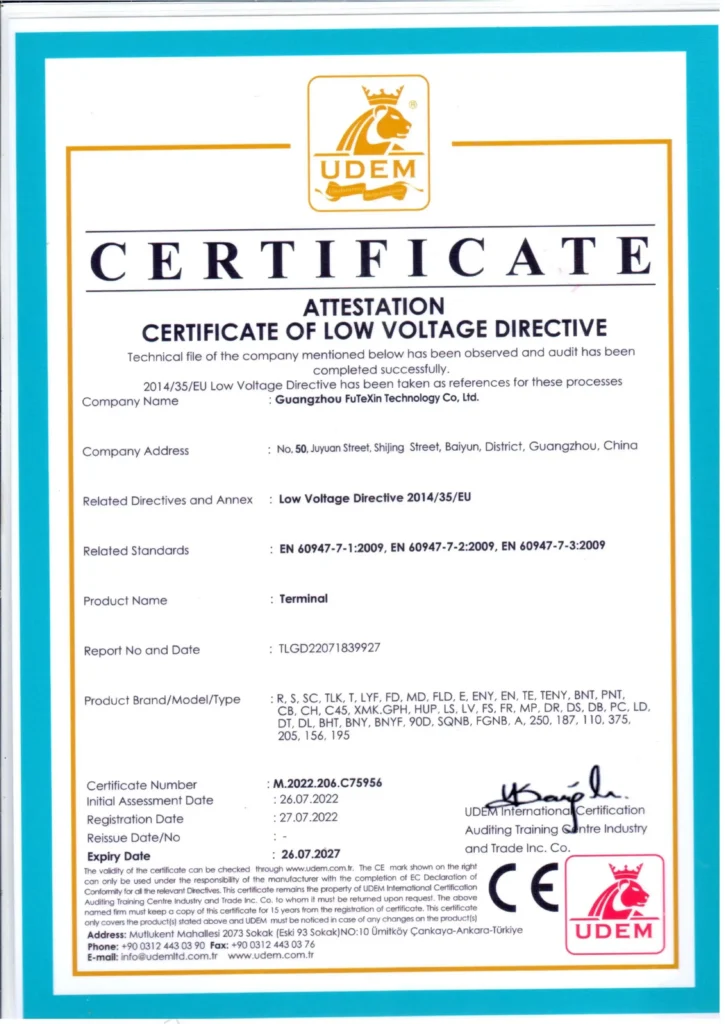
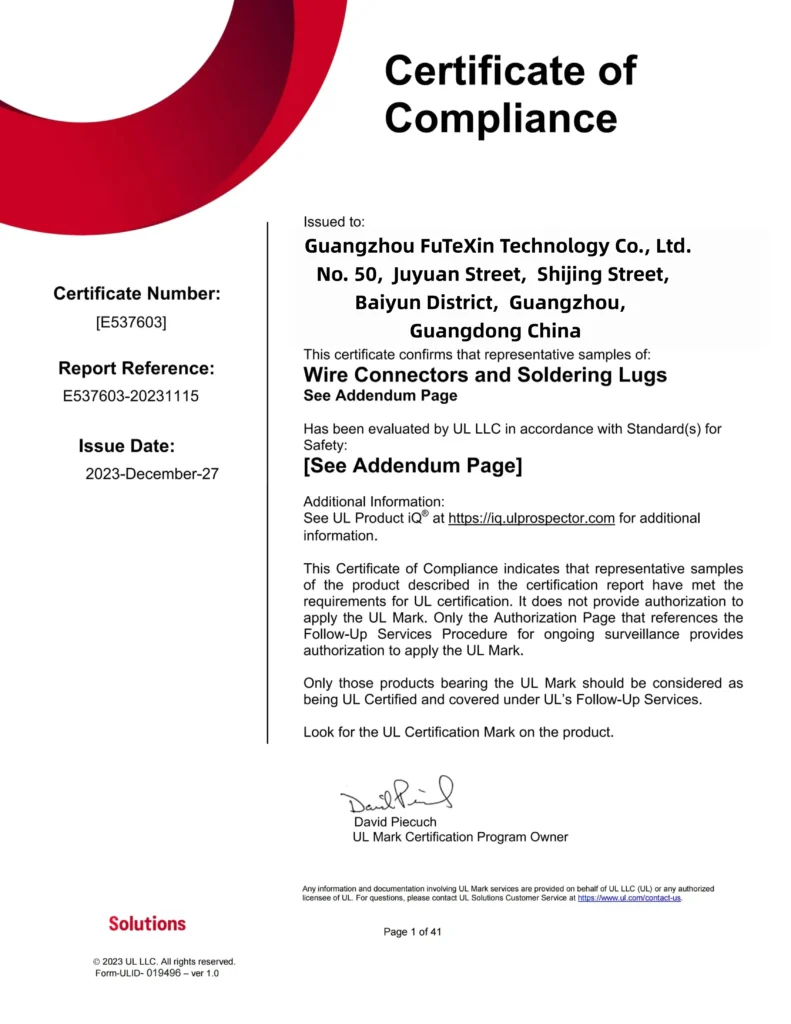
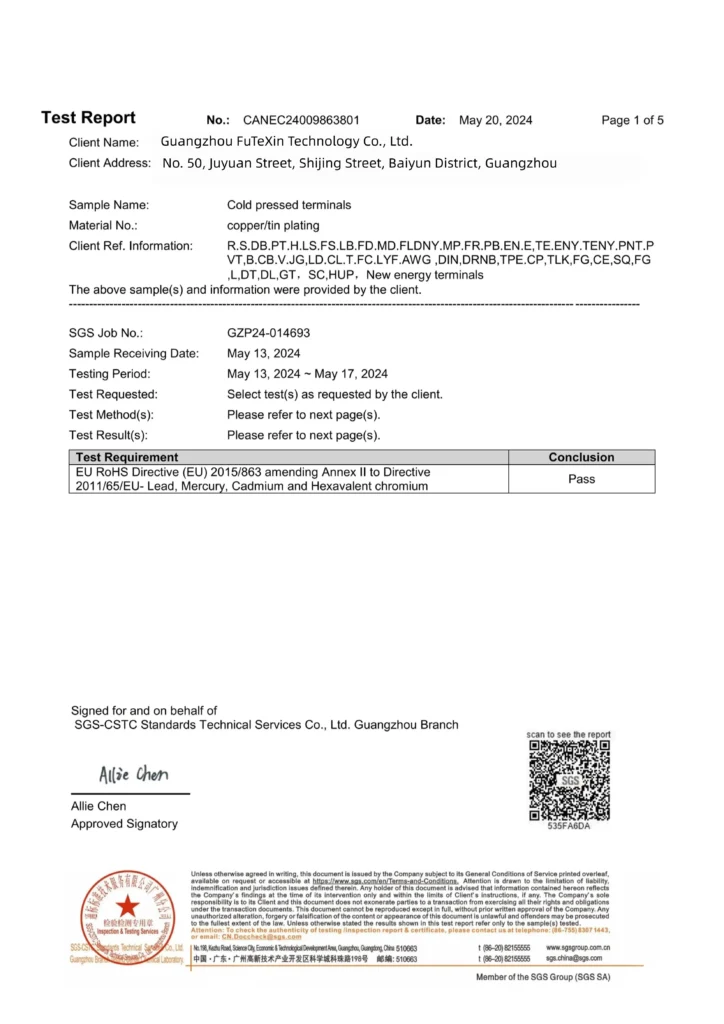
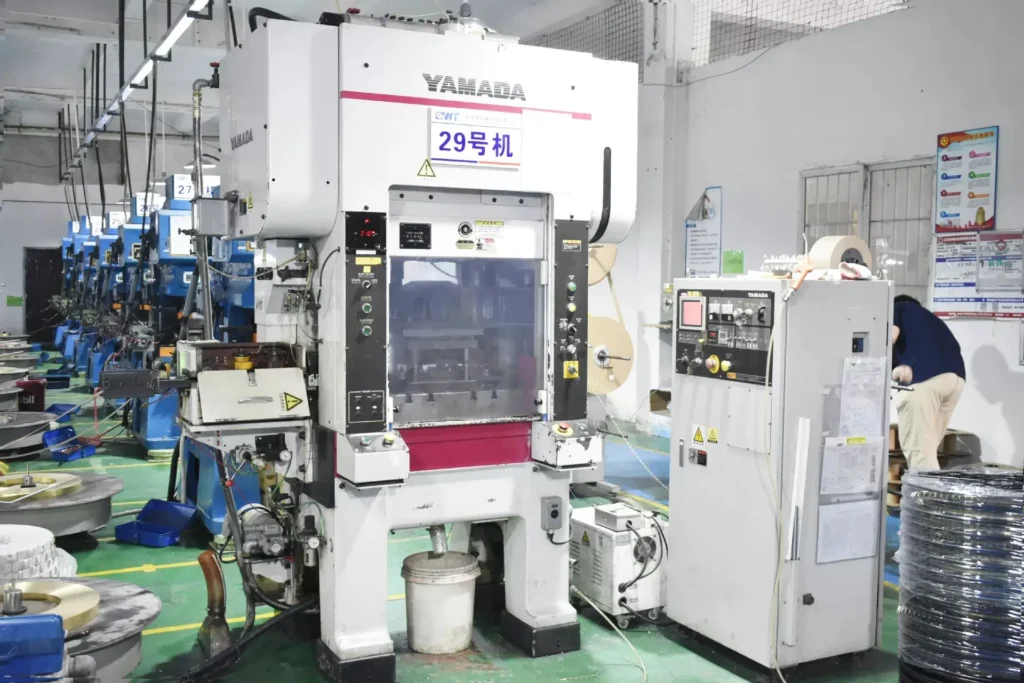
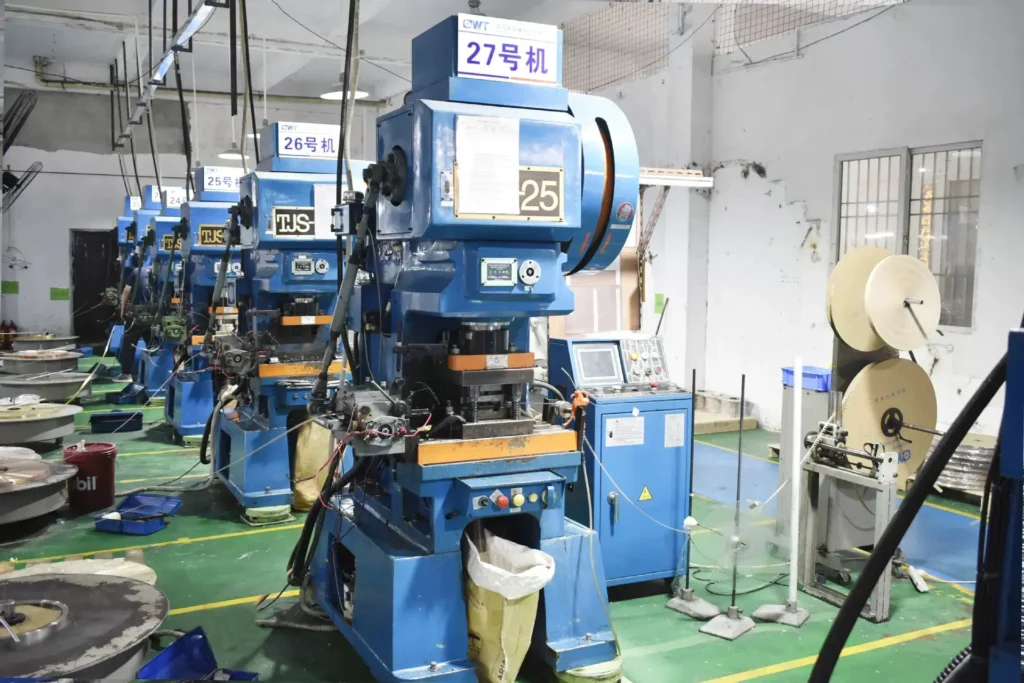
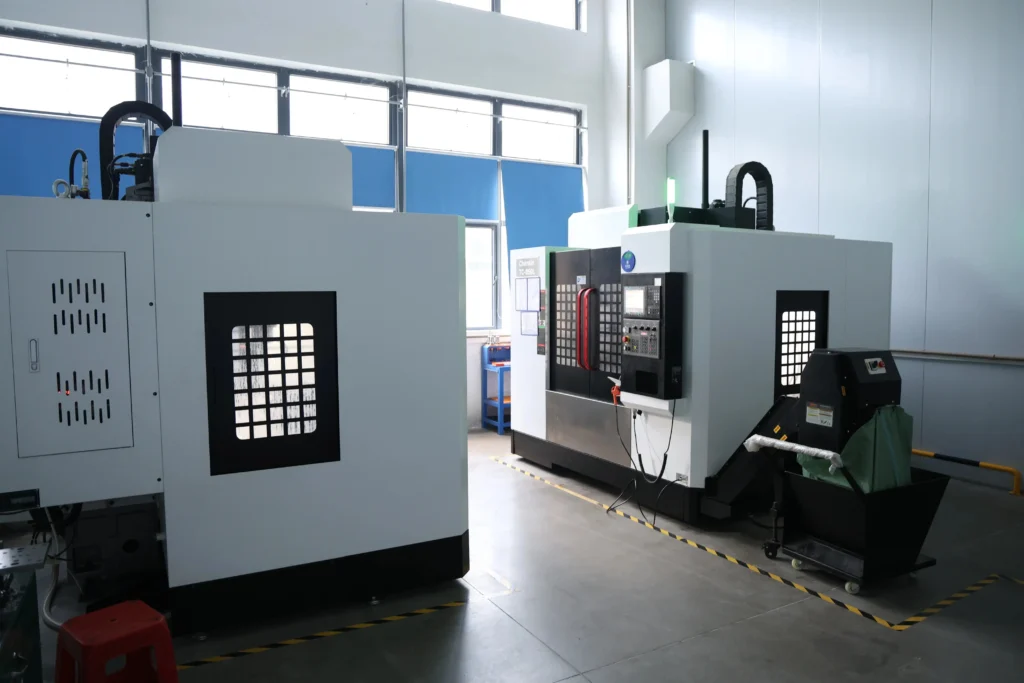
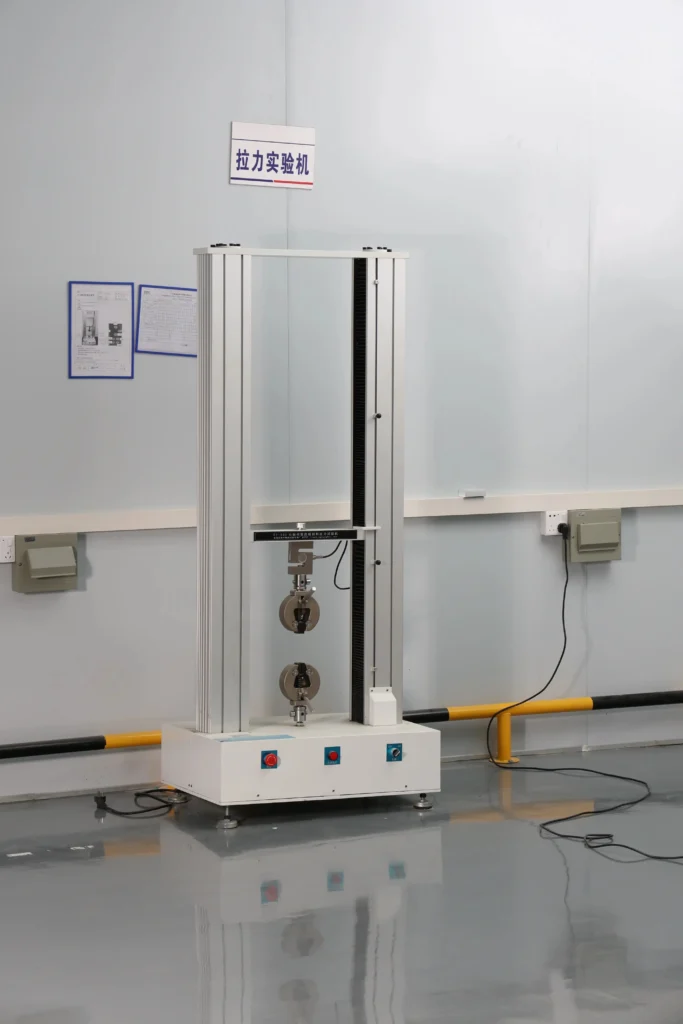
Certificate numbers and dates are not printed here; ask for the document that matches your order. The photos below show machines that are visible in the VoltixC factory; they show what equipment is on site, not a test plan or results for this series.




Whoever makes your heavy duty cable lugs, these four questions show how the quote was built:
Which document covers the exact lug size and finish I am ordering, and can I see it before I confirm the order?
Is the stud hole on the quote taken from my drawing or from a catalog default?
Which die size does the supplier name for each AWG size on my list?
Are the values on the datasheet supplier-listed or re-tested, and which ones were re-tested?
Price on a heavy-duty copper lug order follows the copper in each lug, the finish, the stud hole and the quantity per size. Each row pairs a cost driver with the choice that stays on your side.
| Driver | Effect on cost | What you control |
|---|---|---|
| AWG size mix | Larger gauges carry more copper per lug, so a list weighted to 2/0 to 4/0 AWG costs more than one weighted to 8 to 4 AWG | The sizes and the count per size |
| Finish | Tin plating adds a process step compared with bare copper | Bare or tin-plated, set per size or for the whole list |
| Stud hole | A hole size that is not on the sheet may need a tooling change | The stud size from your equipment drawing |
| Barrel and palm changes | A longer barrel or a wider palm means a drawing-based part | Whether the listed part fits, or a drawing is needed |
| Quantity per size | Several small lots of different sizes cost more to set up than a few larger lots | Grouping sizes and quantities on one list |
| Packing and labels | Bulk bags cost less than counted bags with printed labels | Pack count, label text and carton marks |
| Documents | Extra paperwork adds work to the order | Which certificate or report copies you need |
A complete quote request for AWG copper cable lugs has six parts:
MOQ, packing, payment terms and lead time are confirmed per order by email or the enquiry form; this page gives no figures for them. Sampling is the exception: the fastest samples take 7 days. If the stud or barrel fit on your equipment is unproven, ask for samples of one or two sizes first and check them on the real cable before the full list goes into production.
The enquiry form asks for your contact details, product line, conductor size, quantity and a message; it has no upload field. Send drawings or cable photos by email to hugo@voltixconnect.com after you submit the form.
Before you build the size list, the tool converts a conductor size and the three guides explain gauge-to-stud matching, lug forms and drawing dimensions.
Enter a conductor size in AWG, kcmil or mm² and read the AWG-to-mm² and stud size tables in the cable lug size chart.
Match battery cable gauge to lug and stud in the battery cable lug size guide before you fill in your size list.
Compare tube, compression, two-hole and mechanical lugs in the cable terminal types guide.
Read barrel, palm and hole dimensions off a drawing with the cable lug dimensions guide.
The AWG heavy-duty series covers nine gauges: 8, 6, 4, 2 and 1 AWG, plus 1/0, 2/0, 3/0 and 4/0 AWG, in 36 part numbers with stud holes from 5.1 mm to 13.1 mm. Every part is tin-plated copper. Sizes outside 8 AWG to 4/0 AWG are not on the current list; ask before you specify.
Yes. Lugs in this series bolt to a stud, which suits copper battery cable from 8 AWG to 4/0 AWG. Match the lug to the gauge on the cable jacket and give the stud size for each lead. The battery cable lug size guide pairs gauges with studs before you order. Replacement battery cable ends follow the same rule: go by the gauge on the cable, not by the size of the old lug.
The specification sheet prints an mm² figure beside each gauge, from 10 mm² for 8 AWG to 120 mm² for 4/0 AWG; treat those as the supplier’s labels, not exact conversions. For a precise AWG-to-mm² check, use the cable lug size chart. If your cable is sold in mm², write both values on the enquiry and the matching AWG part is confirmed per order.
No. 1/0 AWG, also written 0 AWG, is two sizes larger than 2 AWG, with 1 AWG in between. The sheet gives each its own barrel: 8.5 mm inside diameter for 2 AWG, 9.1 mm for 1 AWG and 10.4 mm for 1/0. Buyers asking for 0 gauge copper lugs want the 1/0 parts.
2/0 is bigger. For aught sizes the number of zeros rises with the wire size, so 4/0 is the largest gauge in this series and 1/0 the smallest of the four aught sizes. On the sheet, the 2/0 barrel is 11.7 mm inside diameter against 10.4 mm for 1/0.
Crimp them. According to West Marine, ABYC E-11.16.3.7 states that solder shall not be the sole means of mechanical connection in a marine circuit. A crimp made with a die matched to the lug and cable size gives the mechanical joint; solder, if used, is only an addition.
West Marine reports that ABYC E-11.14.4.1.10 allows no more than four terminals on one terminal stud; extra connections go on additional studs joined by jumpers or copper straps. Size the lug hole to the stud as well: according to West Marine, ring terminals should be the same nominal size as the stud under ABYC E-11.14.4.1.11.
The joint loosens at the lug. A barrel one size too large, or a die that does not match the lug, leaves the strands loose inside a barrel that can look fine on the bench and fail later under load. According to TE Connectivity, a quality crimp requires correct tooling for the terminal and wire, the correct terminal for the application, properly prepared wire and a trained operator. West Marine adds that, under ABYC E-11.14.3.8, solderless crimp-on connectors must be crimped with a tool designed for the connector.
No. The values are per the supplier specification sheet, as printed: gauge, mm² figure, stud hole, barrel diameters, length and tongue width for each of the 36 part numbers, with a tin-plated copper body. They are not individually re-tested, and your drawing is checked against them per order.
4/0 lugs take a far larger cable than 4 AWG. On the sheet, 4 AWG lugs have a 7.3 mm barrel inside diameter and a 38.9 mm length; 4/0 lugs have 14.2 mm and 60.5 mm. Check the slash on the cable jacket before you order.
Put the gauge, stud size, finish and quantity for each lug on one list, and it is checked row by row against the 36 part numbers on the specification sheet.