VOLTIXC / ENQUIRY
Request a Quote
Tell us what you need and we will review your enquiry.

Heat-shrink crimp terminals for sealed wire-to-wire and wire-to-stud joints; forms and sizes confirmed per order.
Fast answer: Heat shrink butt connectors are crimp splices whose sleeve shrinks around the wire insulation when heated, closing the joint without solder. The same build comes as ring, spade, disconnect and multi-wire terminals. This page explains how they work, how color bands are read, and when vinyl or solder-seal parts fit better. Send your wire sizes for a quote.
Each of the five forms puts a metal crimp barrel inside a shrinkable outer sleeve. Heat-shrink parts are made to order: mark the sleeve, adhesive and gauge bands on your drawing, each one is confirmed per order, and the quotation follows the drawing line by line.
A heat shrink butt connector works in two stages: a die crimps the metal barrel onto each wire end, and heat then shrinks the outer sleeve onto the wire insulation to close the joint. You won’t find solder in it. Buyers also ask for it as a heat shrink crimp connector, a heat shrink wire connector or a shrink tube butt connector, and it belongs with the other crimp connectors.
Current runs through the barrel alone; the sleeve and the two wire entries are there to seal.
The metal barrel grips the stripped conductor. In TE Connectivity’s guide to crimping, the wire barrel provides the electrical and mechanical connection, while the insulation barrel provides strain relief, takes a lighter crimp and makes no electrical connection.
A heat-shrink sleeve covers the barrel and both wire entries, and heat pulls it down onto the jacket on each side. Whether it has an inner adhesive layer is confirmed per order.
At each wire entry the jacket’s outside diameter has to sit inside the range the sleeve can shrink onto, or that end stays open.
Tip Crimp first, then heat. The sleeve has no grip of its own, so a joint that was heated over a poor crimp can still pull apart.
Skip the heat and both ends stay open to damp air. A sleeve warmed from one side only can leave the far end loose. And when the jacket is thicker than the entry, the sleeve can’t close at all.
Some connectors carry a solder ring inside the sleeve, and one heating step melts the solder onto the wires while it seals both ends. Those parts have their own page, solder seal wire connectors. Everything below deals with crimp-and-sleeve parts that have no solder ring.
Heat-shrink crimp terminals share one build, a crimp barrel inside a shrinkable sleeve, and differ in what the wire lands on. Pick the form by what the wire connects to, then by wire band. VoltixC quotes all five forms below to order as heat shrink electrical terminals, and sizes are confirmed per order for each.
| Form | Lands on | What the enquiry needs |
|---|---|---|
| Heat shrink butt connectors | Another wire, in line: the two cut ends meet in one barrel and the sleeve closes both entries | The wire band at each end, and whether the joint lengthens a lead or repairs a cut run |
| Heat shrink ring terminals | A threaded stud; the closed ring stays captive even if the nut backs off | Stud size as well as wire gauge, because the hole is picked by stud size |
| Heat shrink spade terminals, also called heat shrink spade connectors | A screw terminal, for example on a strip opened for service; the open fork slides under a loosened screw head without the screw coming out | Screw size with the wire band |
| Heat-shrink quick disconnects | A flat tab: the female receptacle pushes onto a male tab, or the male tab plugs into a receptacle, with the sleeve wrapped over the crimp barrel | Tab width and thickness for each lead |
| Multi-wire heat-shrink connectors | Several wires at one point, such as a branch lead to a run, joined by a T-shaped or three-way body under a single sleeve | A drawing with the wire count, bands and body shape |
Source: forms quoted to order by VoltixC; no heat-shrink series is listed with part numbers, so wire bands, stud holes and tab sizes are confirmed per order.
A part outside these five rows, such as a step-down butt connector or a ring for an odd stud, starts from your drawing or a photo of a sample. Add the wire gauge and a caliper reading of the jacket, and the sleeve entry is sized to that wire, confirmed per order.
| Name in catalogs and searches | What it refers to |
|---|---|
| Heat shrink butt connectors: heat shrink butt splice connectors, butt connectors heat shrink | The in-line butt form, under its catalog and search names |
| Connector heat shrink, wire connectors heat shrink | Search word orders for the same in-line part |
| Heat shrink electrical connectors, electrical heat shrink butt crimp terminals | Broad names that take in all five forms |
| Crimp connectors with heat shrink | The same build: the sleeve comes fitted on the barrel |
| Shrink tube wire connectors, shrink wrap wire connectors | Retail names for the sleeve; the barrel still takes a crimp |
| Heat shrink tubing | Loose tubing slid over a plain connector on site, not a sleeve built onto the part |
| Waterproof butt connectors, waterproof splice connectors | Retail names for adhesive-lined parts; read them as a sealed wire entry, not as an IP rating |
| Marine grade butt connectors | Retail name for sealed butt connectors on boats and trailers; no marine approval is stated for VoltixC parts |
| Heat shrink bullet connectors | A bullet form with the same sleeve, quoted on request and confirmed per order |
| Automotive wire harness terminals | OEM automotive harness terminal systems are outside the VoltixC range; ask before you specify |
Source: catalog and search names for these parts; VoltixC quotes the five forms in the first table.
Pick the sleeve color by wire band: red is the smallest of three bands, blue the middle and yellow the largest. The color tells you which size band the barrel takes and says nothing about current. ABB’s Spec-Kon table for vinyl-insulated ring terminals uses red, blue and yellow for three separate conductor size bands, rising from red to yellow. Heat-shrink parts use the same three colors, and the AWG or mm² band behind each VoltixC color is confirmed per order on the drawing.
| Form | Sleeve color | Wire band | Connects to |
|---|---|---|---|
| Butt connector | Red | Smallest of the three bands | Another wire, in line |
| Butt connector | Blue | Middle band | Another wire, in line |
| Butt connector | Yellow | Largest of the three bands | Another wire, in line |
| Ring terminal | Red | Smallest of the three bands | Threaded stud |
| Ring terminal | Blue | Middle band | Threaded stud |
| Ring terminal | Yellow | Largest of the three bands | Threaded stud |
| Spade terminal | Red | Smallest of the three bands | Screw, loosened in place |
| Spade terminal | Blue | Middle band | Screw, loosened in place |
| Spade terminal | Yellow | Largest of the three bands | Screw, loosened in place |
| Female disconnect | Red | Smallest of the three bands | Male flat tab |
| Female disconnect | Blue | Middle band | Male flat tab |
| Female disconnect | Yellow | Largest of the three bands | Male flat tab |
| Male disconnect | Red | Smallest of the three bands | Female receptacle |
| Male disconnect | Blue | Middle band | Female receptacle |
| Male disconnect | Yellow | Largest of the three bands | Female receptacle |
Source: color convention per ABB’s Spec-Kon table for vinyl-insulated ring terminals (one manufacturer’s example); VoltixC heat-shrink sizes are confirmed per order.
The table leaves out multi-wire connectors, since the band at each entry depends on the body you specify.
Spec note No heat-shrink series is listed with part numbers, so the next table gives the general build of these parts rather than VoltixC catalog values. Each line is confirmed per order or customizable on your drawing.
| Parameter | General build | On a VoltixC order |
|---|---|---|
| Barrel | Copper crimp barrel; tinned copper can be specified | Barrel material confirmed per order |
| Wire stop | A built-in wire stop at the center of a butt connector is optional | Ask for it on the enquiry line |
| Electrical crimp | The crimped barrel carries the current; the sleeve carries none | Die matched to the band on the drawing |
| Sleeve | Heat-shrink sleeve over the barrel; it shrinks to insulate the joint and both wire entries | Sleeve material confirmed per order |
| Adhesive lining | Adhesive-lined sleeve for added protection at the wire entries, or an unlined sleeve | Lined or unlined, set line by line |
| Sleeve color | Color-coded red, blue and yellow by wire band, by industry convention | Other colors are customizable |
| Wire band | Each color covers one AWG wire band | AWG and mm² limits set on the drawing |
| Jacket fit | The sleeve entry has to pass over the wire’s insulation outside diameter | Send a caliper reading with the gauge |
| Shrink temperature and ratio | Set by the sleeve material; no value is stated on this page | Follow the sleeve supplier’s instructions |
| Where used | Damp, outdoor and vibrating joints, where an open joint is exposed to corrosion | Other uses: ask before you specify |
| Crimping tool | A crimping tool with a die for insulated terminals, sized to the band | Tools are not supplied by VoltixC |
| Packing | Bulk bags or counted packs | Customizable, with your label |
Source: general construction of heat-shrink crimp terminals; no VoltixC part numbers, ratings or test values are implied.
Measure the jacket as well as the gauge. TE Connectivity notes that insulation outside diameters vary among wires of the same AWG size, so the insulation barrel must accommodate the wire’s outside diameter. A heat-shrink part adds a second limit at the sleeve entry, so put the caliper reading next to the gauge on your enquiry.
For two different wire sizes, use a step-down part with a different band at each end, or a body made to your drawing; both are confirmed per order. A small wire in a barrel meant for the next band up stays loose, even after the sleeve shrinks.
Use a vinyl-insulated butt connector for dry indoor joints, a heat-shrink crimp splice where the joint has to be closed against damp air, weather or vibration, and a solder seal connector when you want solder and a seal from one heating step. For heavy battery and power cable, use a bare copper splice. You can compare all four routes in the table; the rest of the page deals only with the heat-shrink crimp route.
| Route | How it joins | How the joint is closed | On-site tools | Better when | VoltixC page |
|---|---|---|---|---|---|
| Heat-shrink crimp | Die crimp on a metal barrel | Sleeve shrinks onto the jacket at both ends; adhesive lining confirmed per order | Crimp die plus a heat source | Small-gauge joints exposed to damp air, weather or vibration, with no solder wanted | Heat shrink butt connectors (this page) |
| Vinyl-insulated crimp | Die crimp on a metal barrel | Factory vinyl sleeve over the barrel; the wire entries stay open | Crimp die only | Dry indoor joints, or sites with no heat source | Vinyl butt connectors |
| Solder seal | Solder ring melts onto the stripped wire ends | Heat-shrink sleeve closes in the same heating step | Heat source only | Sealed joints where a soldered connection is wanted | Solder seal connectors |
| Non-insulated copper splice | Die compression on a bare copper tube | Nothing on the part; any cover is added on site | Die sized to the tube | Battery, power and grounding cable beyond the small-gauge bands | Copper butt splice connectors |
Source: general build descriptions of each route; the barrel role follows TE Connectivity’s guide to crimping. No sealing, temperature or pull rating is implied for any route.
Once they’re installed, a solder-ring connector and a crimp-only heat-shrink part look alike, since both end in a shrunk sleeve. The conductor is held differently. A crimp part holds the wire by the barrel’s grip, and the die and the band decide that grip; with solder seal, melted solder bonds the strands, so the heating has to be even. Choose the route your installers can repeat on every joint.
Four signals point to a different route.
Vinyl and nylon rings, spades and disconnects have their own series pages, all linked from the crimp connector overview.
Ask Which Route Fits My JointCrimp the barrel first, then heat the sleeve evenly until it lies tight on both jackets, and finish with a visual check and a light pull. The full guide on how to crimp wires has die choice, strip length and what to do about a failed crimp. Below is the order for heat-shrink parts only.
Blue sleeve, blue-band wire, blue-band die: match all three, and use a die profile meant for sleeved terminals.
Strip enough that the bare conductor fills the barrel. The jacket should begin right at the barrel’s end and stay under the sleeve.
Push one wire in until it stops, crimp, then turn the connector round and do the other side. Two crimps per butt connector, one each side.
Heat from the middle outward with whatever heat source the sleeve supplier’s instructions name, until the sleeve has shrunk fully onto both jackets. This page gives no temperature or time; both depend on the sleeve material.
Both ends tight all round, no scorch marks? Then pull each wire gently by hand.
Reheating does not help a bad crimp, because the electrical and mechanical connection comes from the wire barrel while the sleeve only closes the joint around it (TE Connectivity).
When a heat-shrink crimp joint fails, look at the wire band, the crimp, the heat and the jacket fit, in that order. The table lists five symptoms with a likely cause and a first check for each.
| Symptom | Likely cause | What to check |
|---|---|---|
| Wire pulls out of the barrel and the wire connection opens | Band too large for the wire, or the crimp was made in the wrong die | Sleeve color against the wire band; die profile against the band |
| One end of the sleeve is still loose | Heat stopped short of that end, or the jacket is thinner than the sleeve’s shrink range | Heating pattern from the middle out; jacket diameter against the part |
| Sleeve is scorched, split or blistered | Heat held too close or too long on one spot | Heat source and distance per the sleeve supplier’s instructions |
| Sleeve entry will not pass over the jacket | Jacket outside diameter larger than the entry | Jacket diameter on the enquiry; a larger band or a part made to drawing |
| Crimp mark sits on the insulation, not the bare wire | Strip length too short, or the wire not pushed home | Strip length against barrel length; electrical wire seated to the stop |
Source: barrel roles and jacket fit per TE Connectivity’s guide to crimping; the other rows describe general assembly checks, not VoltixC test records.
The rows about the sleeve entry and the crimp mark on insulation both go back to the barrel. TE Connectivity’s guide says the insulation barrel must accommodate the wire’s outside diameter, and that a crimp on the insulation barrel only relieves strain without making the electrical connection. A crimp mark on the jacket means the conductor was never gripped.
When a joint fails the pull check, cut it out and fit a new connector; a second crimp on the same barrel or another round of heat will not repair it.
Use heat-shrink crimp terminals on small-gauge joints that have to be sealed against moisture, weather or vibration. Dry cabinet wiring, joints that must be soldered and heavy battery or power cable need something else. The cards below describe job types worked out from how the part is built, and none of them refers to a VoltixC customer.
Garden lights, signs and outdoor controls leave in-line joints out in rain and changing temperatures. Once the sleeve has shrunk onto both jackets, it keeps water off the barrel. Check the jacket on outdoor-rated cable against the sleeve entry before you order.
Road water and spray reach the lighting and accessory leads on trailers and small boats. Marine heat shrink connectors here means crimp parts with a sealing sleeve, and any marine wiring rule for the vessel comes first. Measure the jacket before choosing the band, since wires of the same AWG size can have different insulation outside diameters, as TE Connectivity points out.
Pump and fan motor leads shake every time the motor starts. The crimp holds the conductor, and the shrunk sleeve braces the wire where it leaves the barrel. Give each side its own crimp and heat both ends all the way.
Damp air in plant rooms, crawl spaces and basements corrodes an open joint over time. A heat shrink butt splice seals both wire entries; a vinyl sleeve leaves them open. Keep the finished joint off wet floors and walls.
To rejoin a cut harness or extend a short lead, fit one butt connector per wire. Stagger the joints along the bundle so the sleeves don’t stack up into one bulge.
A dry control cabinet or appliance housing needs no seal, and bringing in a heat source only adds a step. Use a vinyl-insulated part from the butt connectors page.
A specification that calls for solder rules out a crimp-only part. The solder seal wire connectors page has parts that join and seal in one heating step.
Battery leads, feeders and grounding conductors are heavier than the small-gauge bands allow. Terminate them with a compression lug, or join them with a bare copper splice, from the lug terminal range.
Before you buy, check what a supplier can show and put four questions to it. VoltixC’s CE and UL certificates and its RoHS test report are below.
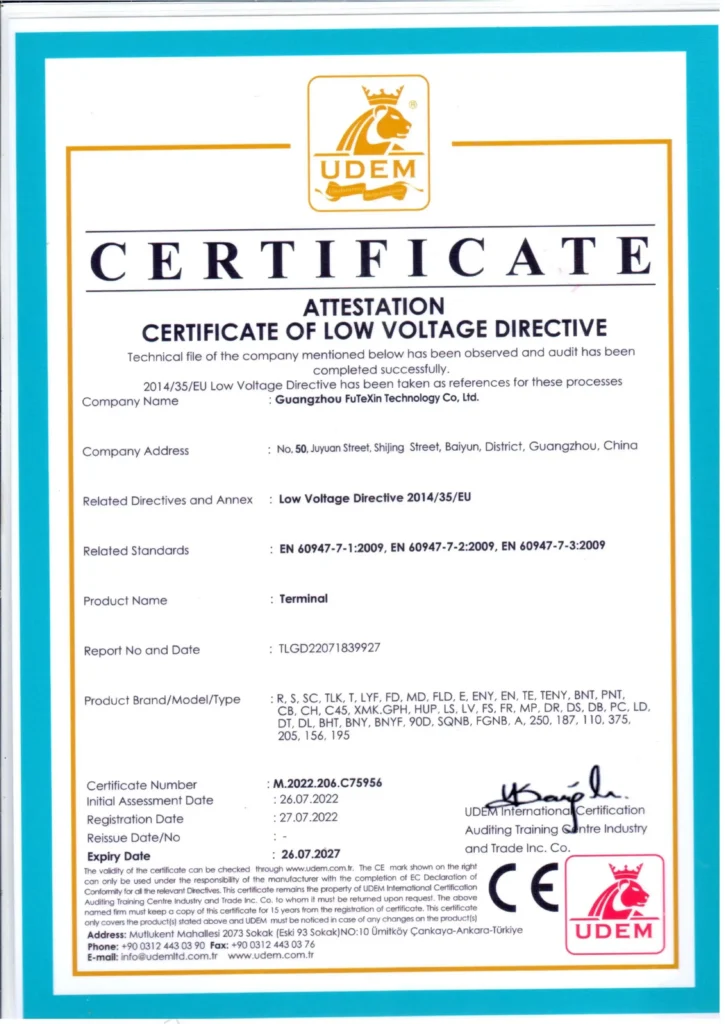
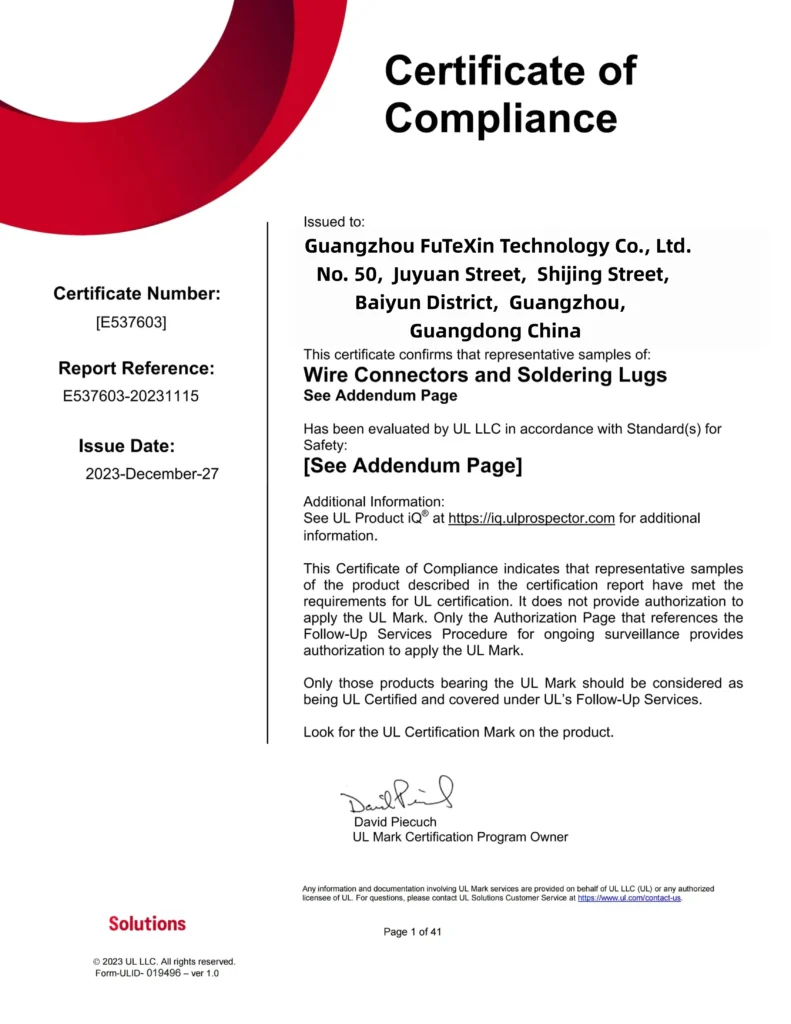
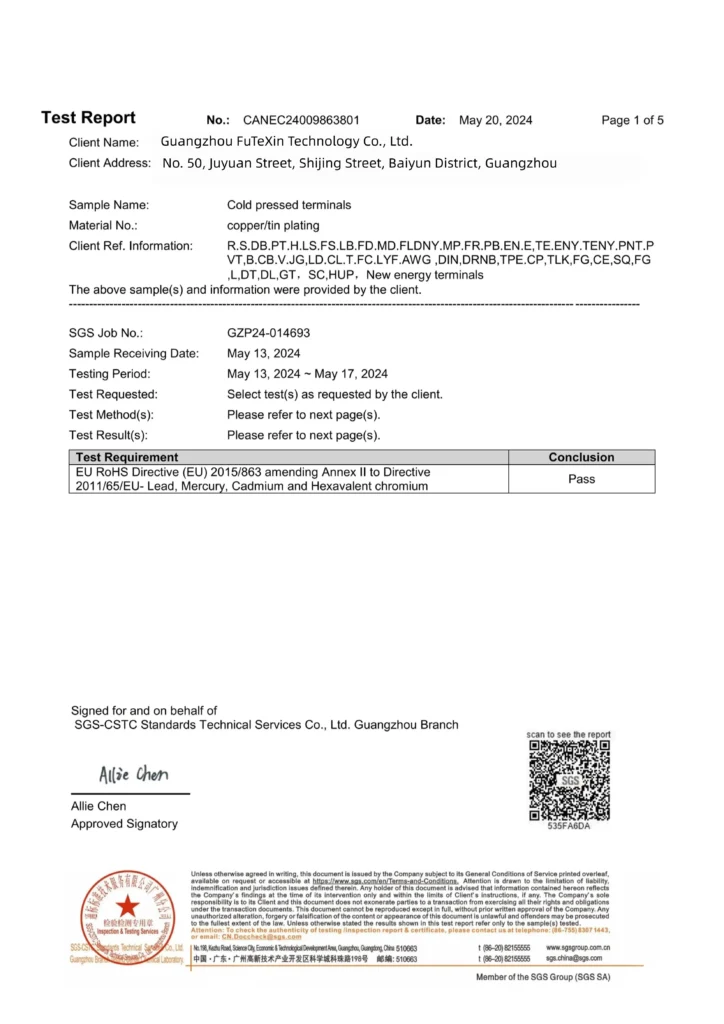
CE covers the full VoltixC product range under the Low Voltage Directive 2014/35/EU, against EN 60947-7-1, EN 60947-7-2 and EN 60947-7-3. VoltixC is UL certified, with a RoHS test report available (SGS). All three documents name Guangzhou FuTeXin Technology Co., Ltd., the company behind VoltixC. Certificate numbers are not printed on this page.
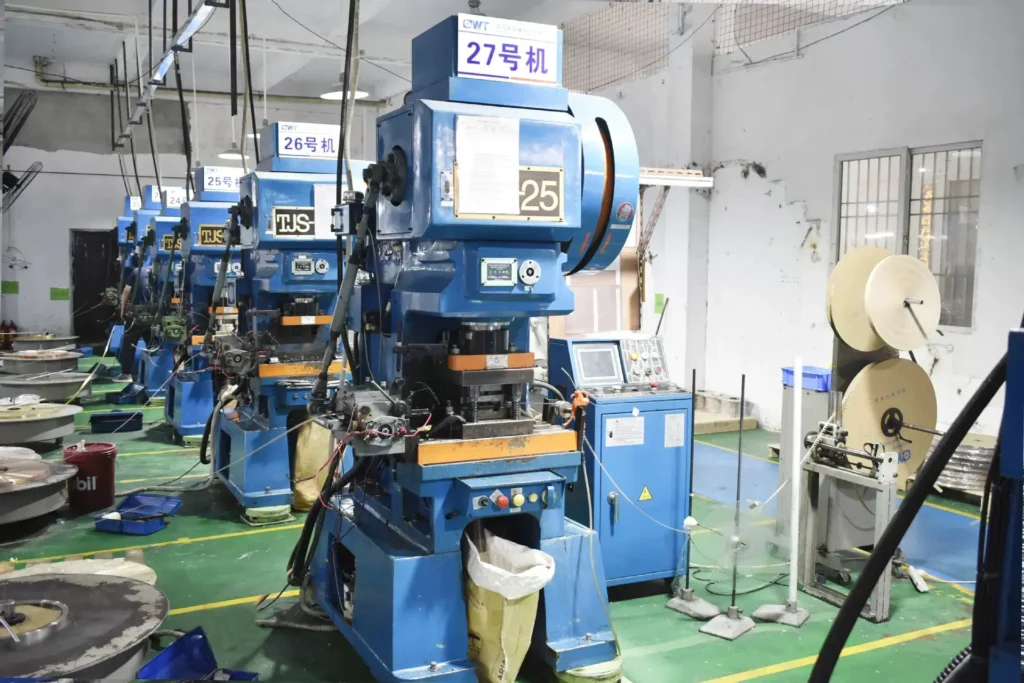
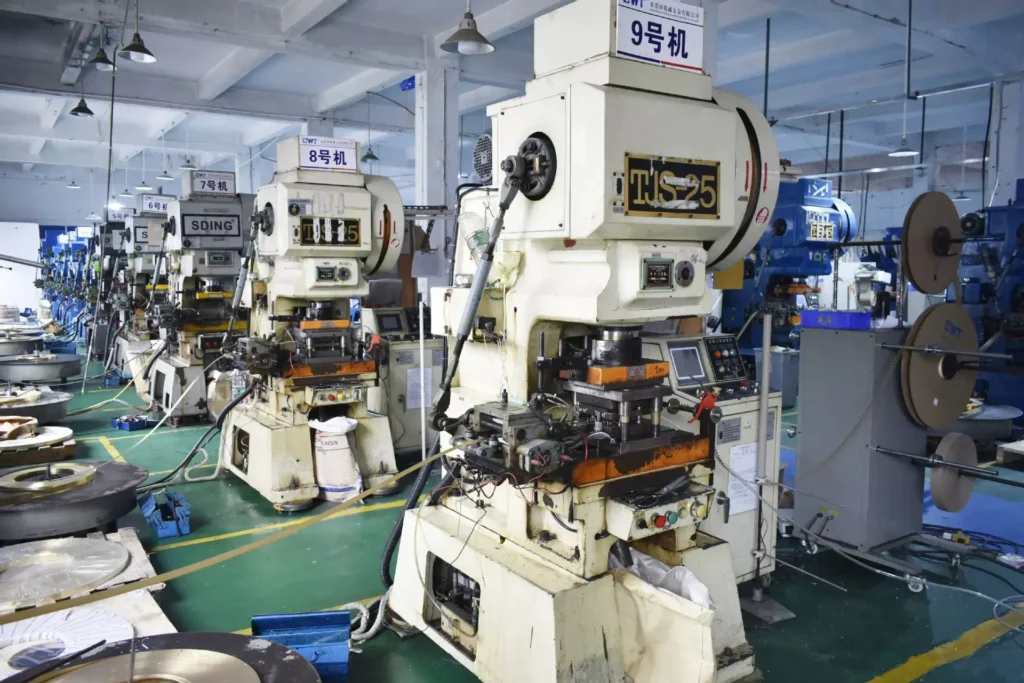
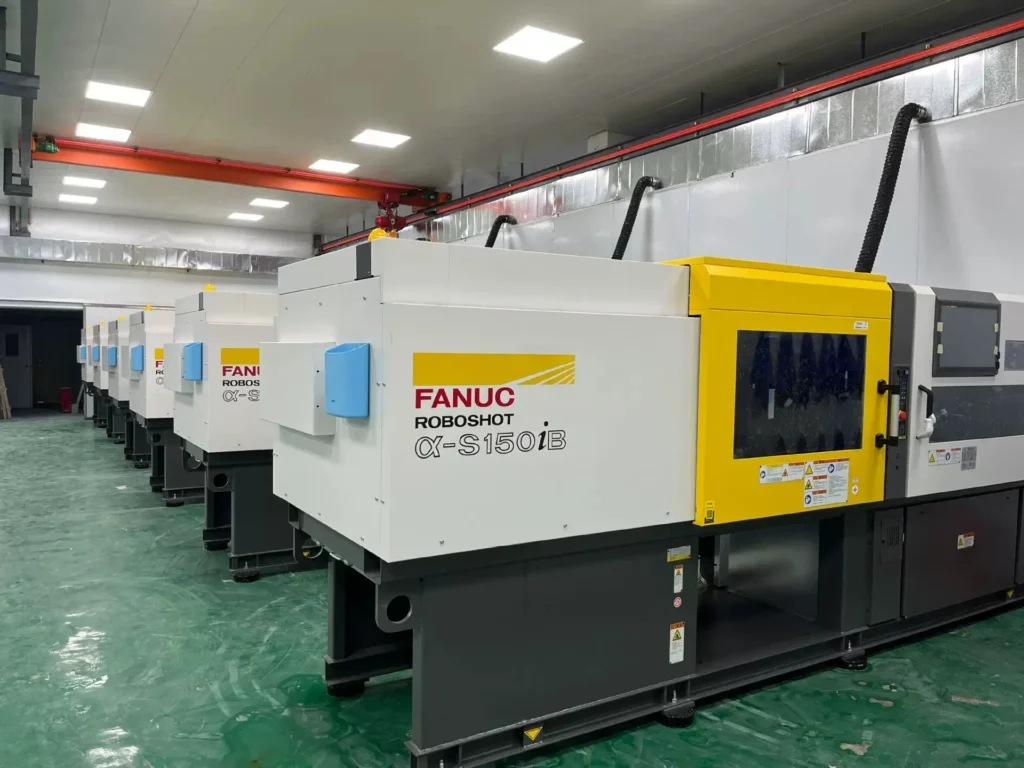
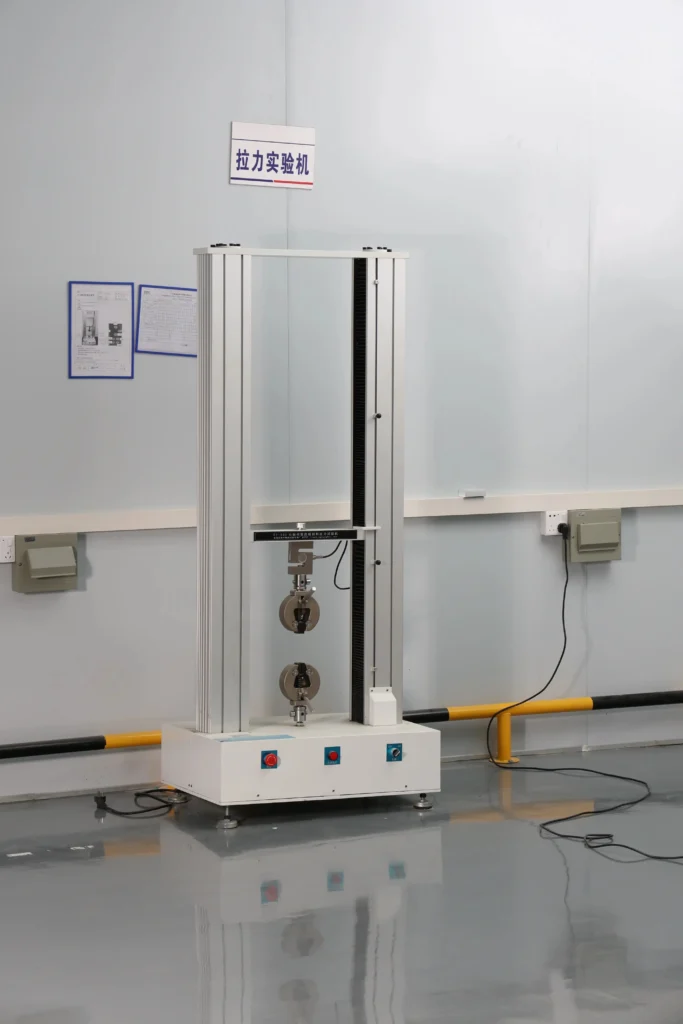
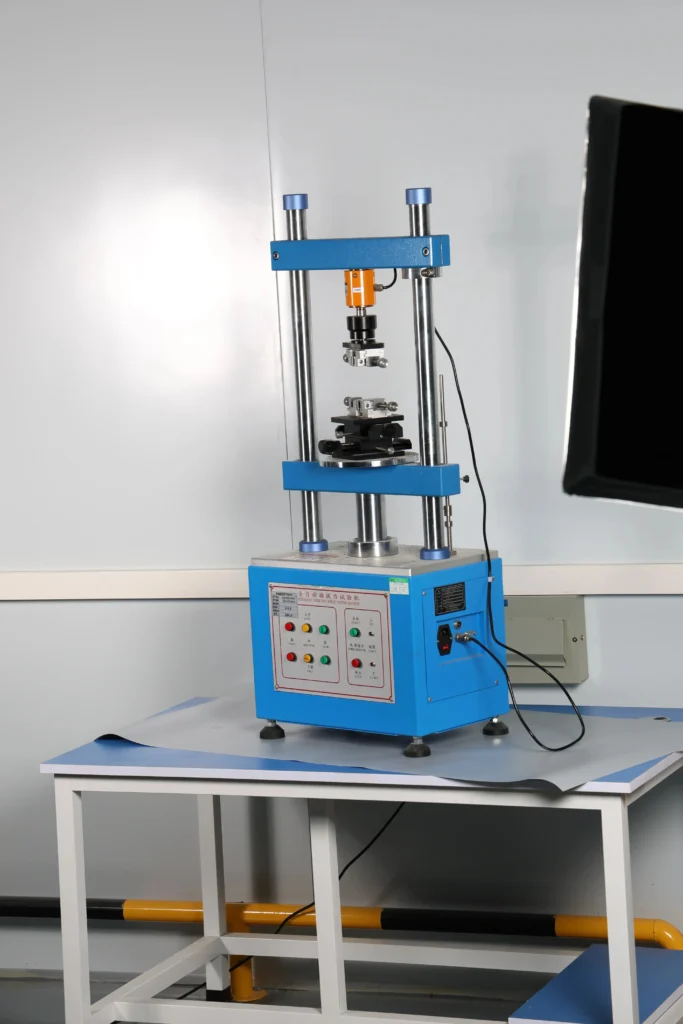
A 25-ton high-speed stamping press, a second 25-ton press, an injection molding machine, a tensile tester and an insertion and extraction force tester on the VoltixC floor in Baiyun District, Guangzhou. A photo is not a test record, so no readings are shown; where and how a heat-shrink order is made is confirmed per order.
Four things to settle with any supplier, VoltixC included:
Yes: form, sleeve color and packing can follow your drawing or sample, and each item is confirmed per order. The drawing also fixes the sleeve, the adhesive and the gauge bands, because each heat-shrink line is made to order. Send it, or a sample, for review and mark what needs to change:
A sample comes before the main run, and the fastest sampling time is 7 days, so you can crimp and heat one on your own wire first. Send a short offcut of that wire with the drawing and the sleeve entry can be matched to the jacket you use. Tooling and delivery timing are confirmed per order.
Heat shrink butt connectors are priced from six enquiry details: form, number of bands, adhesive-lined or unlined sleeve, custom color or packing, quantity on each band line, and drawing review. There is no published price list for these parts. Each quotation is built line by line from your enquiry, so the more fields you fill in, the easier two quotes are to compare.
| Driver | Effect on cost | What you control |
|---|---|---|
| Form | A ring, spade, disconnect or multi-wire body needs more metal forming than a plain in-line barrel | Keep in-line joints on butt connectors and save the other forms for studs, screws and tabs |
| Number of wire bands | Every band on the list is its own part, sleeve and pack | Check whether two leads close in size can share one band before sending the list |
| Sleeve and adhesive | Lined and unlined sleeves are built, and priced, as different parts | Mark the lines that sit in damp or outdoor spots; the others may not need a lining |
| Sleeve color | A color beyond red, blue and yellow means a sleeve made for your order | Name the lines that need another color and leave the rest on the band colors |
| Packing and labels | Counting parts into small packs and applying your label adds work per pack | Choose bulk bags or counted packs, and send the label artwork |
| Quantity per band | The quantity on each band line sets the run for that part | Put a quantity against every band line instead of one order total |
| Drawing and custom parts | A step-down, multi-wire or non-standard ring needs a drawing review first | Include the drawing or a sample photo in your first message |
| Kit or band lines | A retail connector kit, terminal kit or wire connectors kit mixes bands in one box; a quotation prices each band line | List band lines with quantities instead of naming a kit |
Source: cost drivers for heat-shrink orders at VoltixC; no figures are published, and each value is confirmed per order.
You can mix several bands and forms in one order. Put each band on its own line with its own quantity and the quotation answers line by line; a complete heat-shrink terminal enquiry fills in every field of the next table.
| Field | Why it matters |
|---|---|
| Form | Butt, ring, spade, disconnect and multi-wire are different parts |
| Conductor size in AWG or mm² | Sets the band and the sleeve color |
| Jacket outside diameter | Decides whether the sleeve entry fits the wire |
| Stud, screw or tab size | Sets the ring hole, the fork width or the tab size |
| Sleeve color and adhesive | Changes the part build and the run |
| Packing and quantity per band | Sets the pack format and the run size |
Source: VoltixC enquiry fields; values are confirmed per order.
Lead time, MOQ and payment are confirmed per order by email or the enquiry form. The form takes product line, conductor size and quantity, and drawings or photos can follow by email after you submit it. The fastest sample takes 7 days from an agreed drawing.
According to UL Standards & Engagement, UL 486A-486B covers copper conductor ranges of 30 AWG through 10 AWG solid and 30 AWG through 2,000 kcmil stranded. Naming it is not a claim that any VoltixC heat-shrink part is certified to it.
Settle the crimping method, the connector family and the ring stud-hole size on these pages before you send the enquiry.
Strip length, die choice, the pull test and what to do with a failed crimp. Read the wire crimping guide
Splice, terminal and sealed connectors side by side, with heat-shrink crimp parts placed among them. Read about the types of wire connectors
Crimp terminals grouped by barrel, sleeve material and tongue shape. Read about crimp terminal types
Look up the stud hole for a ring or fork before you fill in the enquiry. Open the ring terminal stud-size chart
A heat shrink butt connector is crimped onto each wire first, and its sleeve only seals the joint afterwards. A solder seal connector carries a solder ring inside the sleeve, so one heating step melts the solder onto the wires and seals both ends at the same time. The first needs a crimp die and a heat source; the second needs heat alone. Solder seal parts are listed on the solder seal wire connectors page.
Red fits the smallest of three wire bands, blue the middle band and yellow the largest. According to ABB’s Spec-Kon table for vinyl-insulated ring terminals, red, blue and yellow denote three conductor size bands that rise from red to yellow. That color scheme is an industry convention rather than a VoltixC rating. The AWG or mm² range behind each color on a heat-shrink order is confirmed per order on the drawing, so list your gauges with the enquiry.
Yes, every heat shrink butt connector needs a crimp before the sleeve is heated. TE Connectivity’s crimping guide places the electrical and mechanical connection in the wire barrel, and the sleeve does not replace it. A connector that is heated but never crimped can slide off the wire. Die choice and strip length are explained in the guide on how to crimp wires.
Yes. Ring, spade and quick disconnect forms, plus multi-wire bodies, can be quoted to order alongside butt connectors. No heat-shrink series is listed with part numbers on this page, so the form, wire band, stud or tab size and sleeve build are confirmed per order. Give the form and size for each line, and add a drawing for anything outside the five forms described above.
A heat shrink butt connector takes thick-jacketed wire only when the jacket passes into the sleeve entry. According to TE Connectivity, insulation outside diameters vary among wires of the same AWG size, so the gauge alone does not settle the fit. Put the jacket outside diameter on the enquiry, or send a photo of the wire beside a ruler. The sleeve entry size is then matched to that diameter on the quotation.
For a dry indoor joint that sees no moisture or vibration, a vinyl-insulated butt connector does the job, and the butt connectors page lists those parts. Move to a heat-shrink crimp part once the joint sits in damp air, outdoors or on equipment that shakes. The installation code that governs your equipment decides in the end, whichever part you prefer.
Both can be set per order. Name the sleeve color for each band line, and state the pack count, the bag or box format and the label text you want. A first sample can be ready in as little as 7 days, which lets you check the color and the shrink on your own wire before you approve the run.
Send the form, the conductor size in AWG or mm², the jacket outside diameter, and the stud, screw or tab size for ring, spade and disconnect parts. Add the sleeve color, the adhesive choice, the packing and the quantity for each band. Lead time, MOQ and payment are confirmed per order. Send drawings or photos by email after submitting the form.
Send the wire bands, forms and quantities, and a reply follows by email; enquiries are answered 24/7.
Send Your Heat-Shrink Terminal Spec