VOLTIXC / ENQUIRY
Request a Quote
Tell us what you need and we will review your enquiry.

BV vinyl-insulated butt splices and CE closed-end crimp connectors for small-gauge copper wire joints
Fast answer: Butt connectors join two wire ends inside one crimp sleeve, while closed-end connectors cap two or more wires twisted together. This page lists 8 BV vinyl-insulated butt splices from 22-16 AWG to 2 AWG and 4 CE closed-end crimp connectors from 22-16 AWG to 8 AWG. Choose the joint type and gauge band, then request a quote.
The range covers 12 part numbers in two series, each with AWG, mm² and body dimensions per supplier specification sheet. BV sizes add a sleeve color and a maximum current; CE sizes add a 600 V, 105 °C rating and a box quantity. Both series sit in the VoltixC crimp connectors range, next to the ring, spade and quick disconnect terminals.
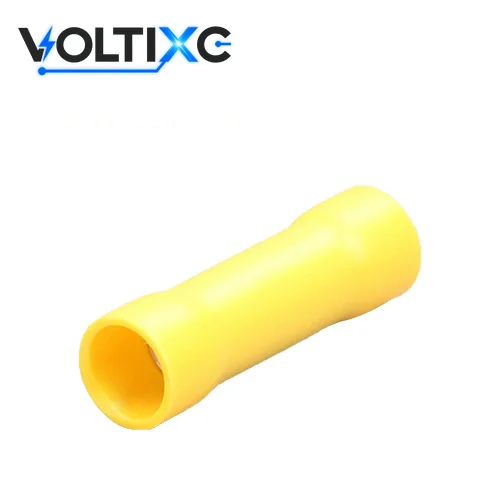
A butt connector is the plainest wire to wire crimp connector: each stripped wire end goes into a metal barrel, and a crimp die presses that barrel onto the strands so current passes straight through. The insulated version slides a plastic sleeve over the barrel, so the metal stays covered once the crimp is made. Catalogues list it under butt splice connectors, wire butt connectors and crimp butt connectors too.
According to TE Connectivity, the wire barrel provides the electrical and mechanical connection, while the insulation barrel provides strain relief and needs a more relaxed crimp without carrying current. Closed end crimp connectors use the same idea from one side only. According to 3M, a closed-end connector is a crimp sleeve connector with a copper insert used to splice copper conductors.
UL 486C applies to single-polarity, hand- or tool-applied splicing wire and cable connectors for copper, aluminum or copper-clad aluminum conductors used under CSA C22.1, NFPA 70 or NOM-001-SEDE. According to UL Solutions, its wire-connector certification services name splicing wire connectors and insulating caps as separate categories. VoltixC cites these sources to show which rulebook a butt splice falls under. The BV and CE supplier data does not state an evaluation to UL 486C.
A bad splice fails in a few predictable ways, and each one traces back to a size or crimp choice:
A barrel too large for the wire leaves the strands loose, so the joint can pull apart after installation.
A barrel too small for the wire forces the installer to trim strands, which leaves less copper carrying the load.
An insulation barrel crushed as hard as the wire barrel cuts into the wire’s own jacket, the opposite of the relaxed crimp TE describes.
A closed-end cap loaded with more or larger wires than its rating lets strands escape from the crimp.
Twelve part numbers are listed: 8 BV butt splices for inline joints and 4 CE closed-end connectors (series) for capped joints, each with AWG, mm² and dimensions per supplier specification sheet. BV parts are vinyl insulated butt splices with a wire entry at each end. CE parts are closed at one end, so every wire enters from the same side.
UL 486C covers splicing connectors intended to hold two or more conductors for use with 6 AWG or smaller conductors, and it lists tool-applied crimp connectors among its examples. For copper, it lists conductor ranges of 30–10 AWG solid and 30–6 AWG stranded for splicing wire connectors. Ten of the twelve sizes below sit inside that 6 AWG line. The BV 4 AWG and 2 AWG sizes sit above it: according to CSA Group, the scope of a separate wire-connector standard includes splicing wire connectors intended for conductors of 4 AWG (21.2 mm²) or larger.
BV is the straight-through part: two wire ends meet inside one vinyl-covered barrel. The supplier sheet prints a tin-plated copper body, a standard sleeve color and a maximum current for every size, from 19 A on BV1.25 to 160 A on BV38.
| Part No. | AWG | mm² | L (mm) | l (mm) | D (mm) | Max current (A) | Color |
|---|---|---|---|---|---|---|---|
| BV1.25 | 22-16 | 0.5-1.5 | 24.8 | 15 | 4.3 | 19 | Red |
| BV2 | 16-14 | 1.5-2.5 | 25 | 15 | 4.8 | 27 | Blue |
| BV3.5 | 14-12 | 2.5-4 | 25.5 | 15 | 5.9 | 37 | Black |
| BV5.5 | 12-10 | 4-6 | 25.5 | 15 | 6.5 | 48 | Yellow |
| BV8 | 8 | 8 | 37 | 21 | 8.2 | 62 | Red |
| BV14 | 6 | 10-16 | 43.8 | 27 | 10.1 | 88 | Blue |
| BV22 | 4 | 22 | 52.5 | 29 | 13.6 | 115 | Yellow |
| BV38 | 2 | 38 | 55 | 32 | 16 | 160 | Red |
Source: per supplier specification sheet (BV series). L, l and D are dimensions as labelled on the supplier drawing, in mm; rows run from the smallest gauge band to the largest.
The CE closed-end connectors (series) are the capped part, listed in some catalogues as closed end wire connectors: the wires go in side by side through the open end, and one crimp holds the bundle. The sheet prints a copper inner sleeve, a 600 V and 105 °C rating and a box quantity for each size; the cap is nylon per the series description.
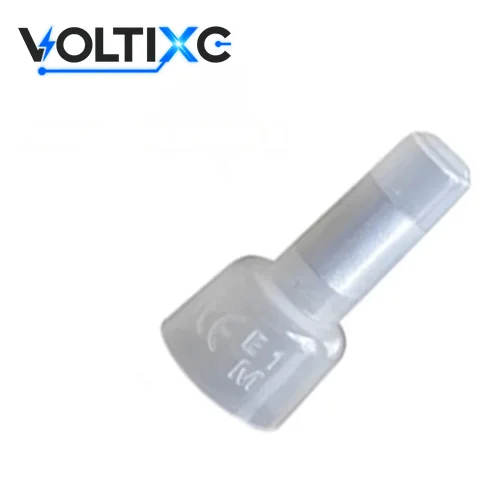
| Part No. | AWG | mm² | L (mm) | W (mm) | Voltage (V) | Temp. (°C) | Pack qty (pcs/box) |
|---|---|---|---|---|---|---|---|
| CE1 | 22-16 | 1.25 | 21 | 5 | 600 | 105 | 1,000 |
| CE2 | 16-14 | 2 | 21 | 5.5 | 600 | 105 | 1,000 |
| CE5 | 12-10 | 5.5 | 25.5 | 7.5 | 600 | 105 | 500 |
| CE8 | 8 | 8 | 29.8 | 9.4 | 600 | 105 | 250 |
Data note: these 12 part numbers are the complete BV and CE specification tables, and VoltixC has not re-tested them one by one. Strip length and the wire count per CE cap are not on the sheets and are confirmed per order.
Source: per supplier specification sheet (CE series). L and W are dimensions as labelled on the supplier drawing, in mm.
The same parts turn up under many search names. This table maps each one to what it means on this page.
| Name used in a search | What it means on this page |
|---|---|
| insulated butt connectors; vinyl insulated butt connectors | The BV series: a vinyl sleeve over a tin-plated copper barrel, BV1.25 to BV38 |
| wire splice connector; splice wire connector; wire splicing connectors; splice connectors for wire | A BV butt splice: two wire ends crimped in line, BV1.25 to BV38 |
| splice electrical connectors; electrical butt connectors; butt connectors electrical | The same BV parts, named by use rather than by shape |
| butt splice wire connectors; butt joiner | BV butt splices; butt joiner is the British name for the same part |
| crimp cap; closed end crimp terminal | The CE closed-end connectors (series), CE1 to CE8 |
| 3 way butt connector; three way butt connector | Three wires meeting at one point take one CE cap; there is no three-way butt splice on the list |
| step down butt connector | Joins two different gauges; each BV part has one gauge band, so this is not on the current list; ask before you specify |
| heat shrink butt connectors | A sealed crimp joint quoted on its own page; the BV and CE values in these tables do not apply to it |
Find your wire gauge in the left column, then read across: two ends in line take a BV butt splice, and a bundle capped off takes a CE closed-end connector. A “Not listed” cell means the supplier data has no part for that pairing, so the part is not on the current list; ask before you specify.
| Your wire (AWG) | Two ends in line | Two or more wires capped | Check before ordering | Also searched as |
|---|---|---|---|---|
| 22-16 | BV1.25 | CE1 | Fine wire with a thick jacket may not fit the sleeve | 18ga wire connectors |
| 16-14 | BV2 | CE2 | Count every wire going into the CE cap | 14 gauge wire connectors |
| 14-12 | BV3.5 | Not listed | A 14-12 bundle falls between CE2 and CE5 | wire connectors 12 gauge |
| 12-10 | BV5.5 | CE5 | Solid 10 AWG is the top solid size in UL 486C’s copper range | 10 gauge wire connectors |
| 8 | BV8 | CE8 | Largest CE size on the list | 8 gauge wire connectors |
| 6 | BV14 | Not listed | Top stranded size in UL 486C’s copper range | 6 awg butt connector |
| 4 | BV22 | Not listed | Above the 6 AWG line of UL 486C | 4 awg butt connector |
| 2 | BV38 | Not listed | Largest BV size; heavier cable goes to a bare copper splice | 2 awg splice connector |
Source: sizes from VoltixC supplier data as listed; UL 486C ranges as cited in the section above.
A gauge band alone does not settle the fit, so each size line also needs these answers:
Check the jacket, not only the gauge. According to TE Connectivity, insulation outside diameters vary among wires with the same AWG size, so the insulation barrel must accommodate the wire’s outside diameter and the crimp range must match it. Send the wire type or the outside diameter with any thick-jacketed wire.
Count the wires in a closed-end joint. According to 3M’s S11-A data sheet, closed-end connectors are rated by copper wire combinations, such as 2 to 5 #22 or 2 or 3 #20 conductors. List each wire by count and gauge for every CE line.
Keep both ends in one band. Each BV row gives a single AWG band, so a joint from 14 AWG to 10 AWG spans two rows and is not on the current list; give both sizes and ask before you specify.
The BV sheet prints a standard sleeve color for each size, and the same colors repeat across bands, with 14-12 AWG in black. According to ABB’s Spec-Kon vinyl-insulated ring table, red denotes 0.5–1.5 mm², blue denotes 1.5–2.5 mm² and yellow denotes 4.0–6.0 mm² conductors. According to TE Connectivity’s featured wire-pin products, yellow is shown for 12–10 AWG (2.62–6.64 mm²), blue for 17–13 AWG (1–2.5 mm²) and red for 22–16 AWG (0.3–1.42 mm²), as product examples rather than a universal code. Use color as a visual cue only, and order BV parts by part number and gauge band.
Use the BV and CE parts on this page for small-gauge copper joints that are crimped once and need no seal. Move to another VoltixC page when the joint must be sealed, joined with solder, or made on cable heavier than 2 AWG.
| Route | How the joint is made | Pick it when | Where to look |
|---|---|---|---|
| Vinyl-insulated butt splice (BV) | Crimp only; vinyl sleeve over the barrel, both ends open | Two ends in line, 22-16 AWG to 2 AWG, no seal required | This page |
| Closed-end connector (CE) | Crimp only; the cap closes one end | Two or more wires joined and capped, 22-16 AWG to 8 AWG | This page |
| Heat-shrink crimp connector | Crimp first, then heat shrinks the sleeve onto the wire jackets | The specification asks for a sealed joint | heat shrink butt connectors |
| Solder-seal connector | A solder ring inside a heat-shrink sleeve melts as the sleeve shrinks | The drawing calls for a soldered joint | solder-seal connector page |
| Bare copper butt splice | Crimp only, no sleeve; insulation added on site | The cable is heavier than 2 AWG, or the installer will insulate the joint with tape or tubing | bare copper butt splices |
Source: joint construction by product type. Route notes follow the ranges listed on each VoltixC page; not a test result.
Heat shrink is the route when the joint will see water, washdown or outdoor air. The supplier data for BV and CE lists no sealing feature: the vinyl sleeve on a BV splice is open at both ends, and the CE cap is open where the wires go in. A heat-shrink crimp connector keeps the crimp step and adds a sleeve that closes onto the wire jackets, so the ordering data stays close to BV: gauge band, wire count and quantity.
A customer drawing that names solder instead of a crimp points to the solder-seal page. That changes the joining step itself. The joint is made with a heat source instead of a crimp die, so a solder-seal line on the enquiry needs the wire gauge and the heat method.
Cable heavier than the 2 AWG top of the BV list belongs on the bare copper splice page, as does any joint that will be insulated on site with tape or tubing anyway. Bare splices come without a sleeve, and at those cable sizes the barrel wall and the crimp die become the main ordering data.
Where three or more wires meet at one point and none of them continues on, stay with CE; don’t use two BV splices. A single CE cap carries the whole bundle, while an inline splice joins one pair of ends at a time.
BV and CE parts fit small-gauge copper joints inside equipment, panels, boxes and fixtures where a crimped, insulated joint with no seal is enough. They are the wrong pick for wet joints, for cable heavier than 2 AWG and for any job that needs a rating the supplier data does not give. The job types below are worked out from how each connector is built and from the sources cited; they are not records of VoltixC installations.
A BV splice joins two ends of the same gauge band in a straight line, which suits lengthening a lead or replacing a damaged section inside a cabinet or machine.
Requirement: both wires fall in one BV band from 22-16 AWG to 2 AWG.
Failure condition: the ends come from two different bands, or the joint hangs where the wire will be pulled.
A CE connector joins two or more wires that end at the same point, such as leads meeting a fixture tail or several conductors tied together inside an appliance.
Requirement: the bundle is listed by count and gauge for one of the four CE sizes.
Failure condition: more or larger wires than the cap’s rated combination; the 3M data sheet cited above rates each closed-end part by wire combination.
A distributor stocking both series covers inline and capped joints from 22-16 AWG up with 12 sizes.
Requirement: the pack count, bag label and sleeve color per size are fixed on the order.
Failure condition: a gap at 14-12 AWG or 6 AWG and above on the CE side, where no closed-end size is listed.
The BV sleeve and CE cap are open where the wire enters, and the supplier data lists no sealing feature. Joints that will see water go to the heat-shrink or solder-seal routes compared in the section above.
According to West Marine, ABYC pull-test ratings are 15 lb for 16 AWG connectors, 40 lb for 10 AWG terminals and 150 lb for 00 battery-cable terminals. Those figures come from marine practice. The BV and CE supplier data gives no pull-test value, so a boat builder tests sample joints against the ABYC figure before approval, and a sealed joint may be required on top.
The largest listed BV size is 2 AWG, so heavier cable goes to a bare copper splice. UL 486C also covers splicers for aluminum and copper-clad aluminum conductors, as cited above, but the BV and CE descriptions name a copper body only and state no aluminum conductor rating, so use them on copper wire.
Strip, insert, crimp and pull: the same four moves make both joints. The difference is that closed-end wires are twisted together first and all enter from one side, while a butt splice takes one wire end from each side.
Strip the insulation. According to 3M’s S11-A data sheet, closed-end installation is: strip all wires ½ inch, pre-twist the wires, insert them into the connector and crimp. That ½ inch figure belongs to the 3M part; the strip length for a BV or CE size is confirmed per order.
Insert the wire. For a BV splice, push one end in from each side so the bare strands fill the metal barrel and no jacket sits inside it. For a CE cap, twist the bundle and push it in until it bottoms.
Crimp the wire barrel with the die that matches the gauge band on the part. On sleeves with an insulation barrel, that section takes a lighter crimp, since it grips the jacket for strain relief and carries no current.
Pull each wire by hand. A wire that moves means the band, strip length or die was wrong; cut the joint out and make it again rather than crimping twice.
VoltixC does not sell crimp tools, so the die comes from the tool maker for the gauge band you order. The guide on how to crimp wires covers die choice and the pull check in more depth, and how to use butt connectors walks through a butt splice from start to finish.
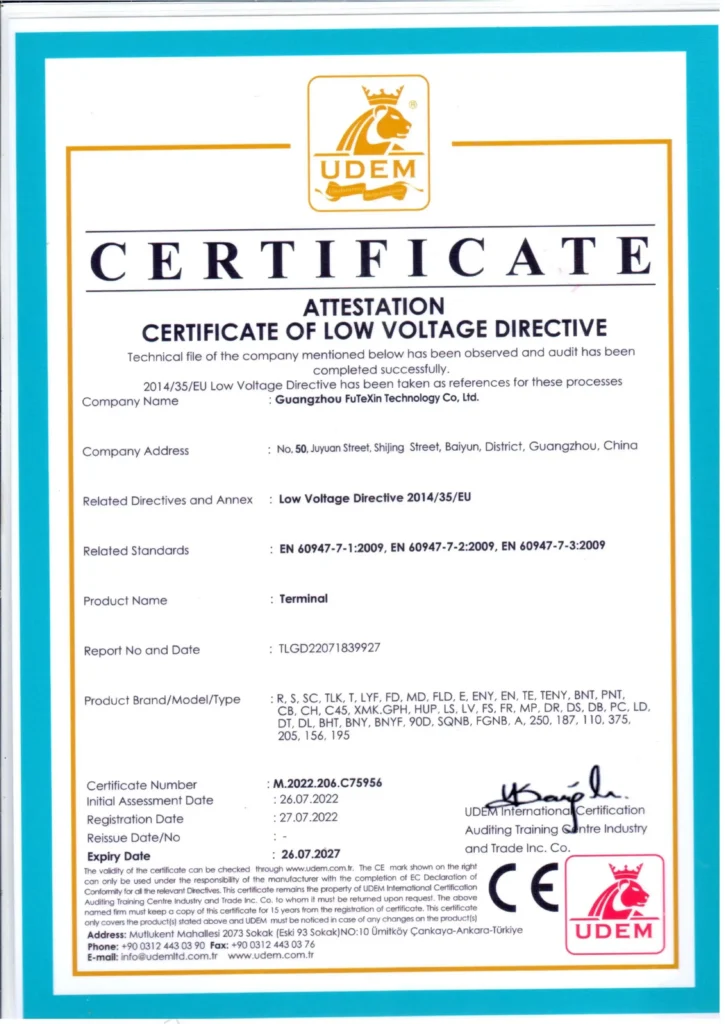
VoltixC is UL certified, and its CE marking (LVD 2014/35/EU) covers every VoltixC terminal product, so it applies to the BV butt splices and the CE closed-end connectors (series) alike. For RoHS, VoltixC has a test report rather than a certificate, with the RoHS test report available (SGS) on request.
The CE attestation lists EN 60947-7-1, EN 60947-7-2 and EN 60947-7-3, and the SGS report tested lead, mercury, cadmium and hexavalent chromium on tin-plated copper terminal samples. All three documents name Guangzhou FuTeXin Technology Co., Ltd., the company behind the VoltixC brand. Document numbers and dates are not printed on this page.
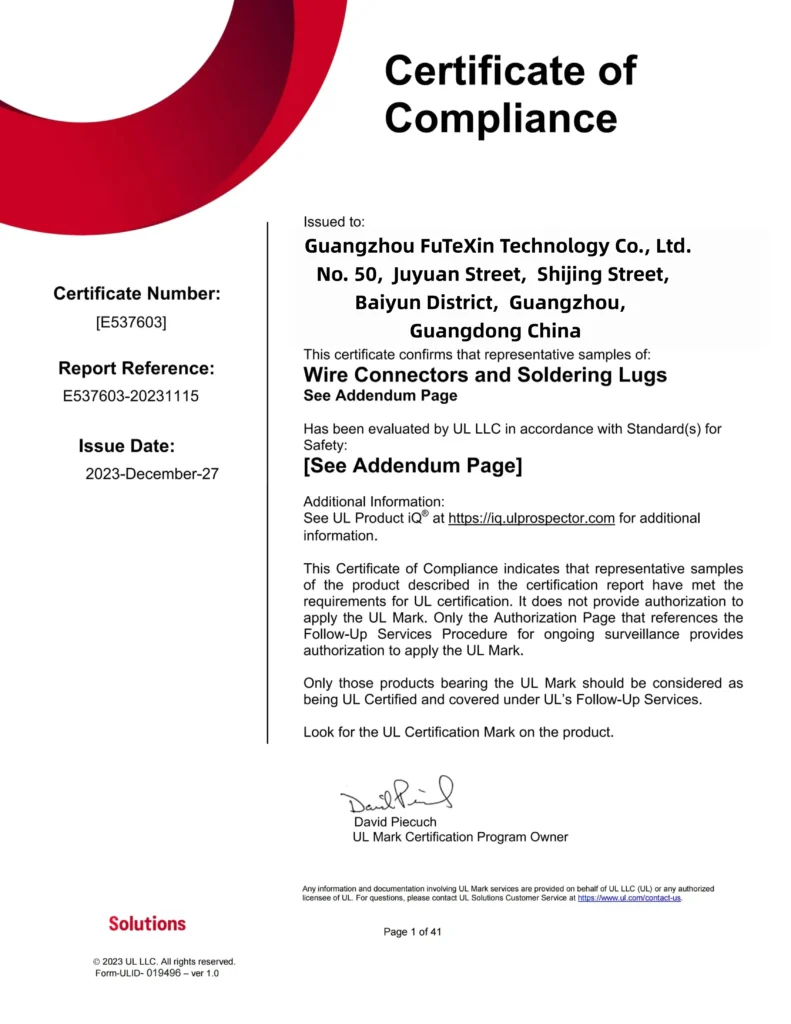
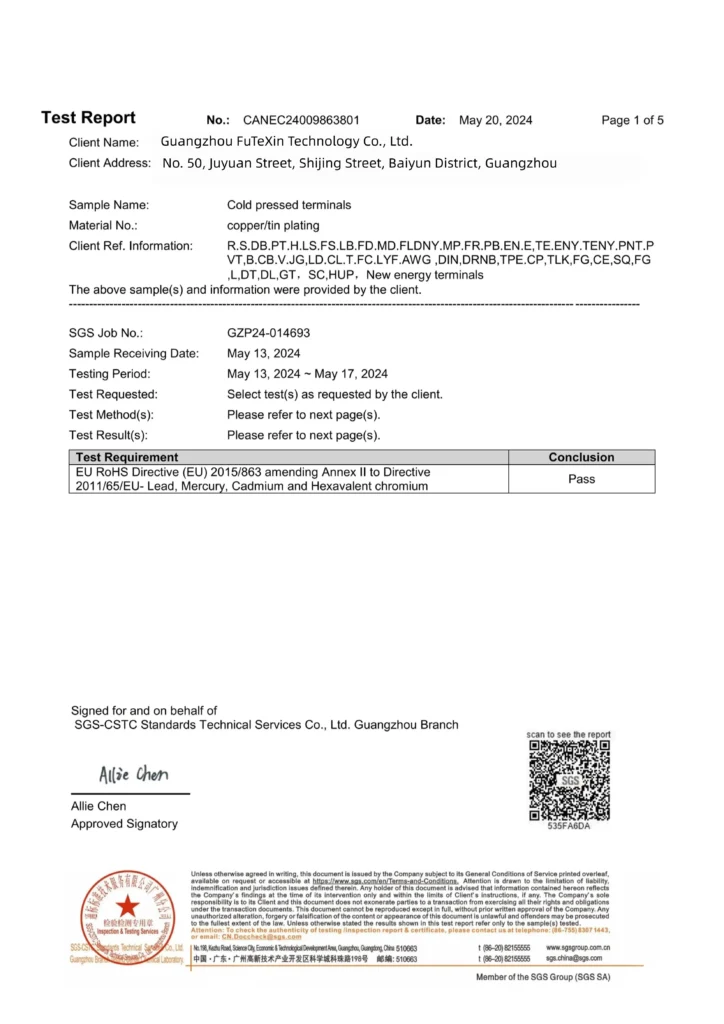
A splice sits under different rules from a ring or spade terminal. UL 486C does not apply to terminal wire connectors, flat quick-connect terminals or soldering lugs. A UL 486C evaluation of a terminal therefore says nothing about a splice, and the reverse is also true. Put these checks in your enquiry before you approve a BV or CE part:
| Check to request | Why it matters for BV and CE |
|---|---|
| The document that applies to the quoted item | Numbers and dates are not printed here |
| The standard the part was evaluated to, if any | UL 486C stops at 6 AWG; BV 4 AWG and 2 AWG sit above that line |
| Voltage rating for BV sizes | The BV sheet gives a maximum current per size but no voltage; the CE sheet prints 600 V and 105 °C |
| A RoHS declaration for the sleeve or cap material | The SGS report covers four heavy metals, not the phthalates in a vinyl sleeve |
As an example of what a rating line looks like, 3M’s S11-A data sheet lists its nylon-insulated closed-end connector with a copper sleeve, a 600 V building-wire rating and a 105 °C maximum operating temperature. The CE series sheet prints the same pair, 600 V and 105 °C, as a supplier rating, not a VoltixC test result.
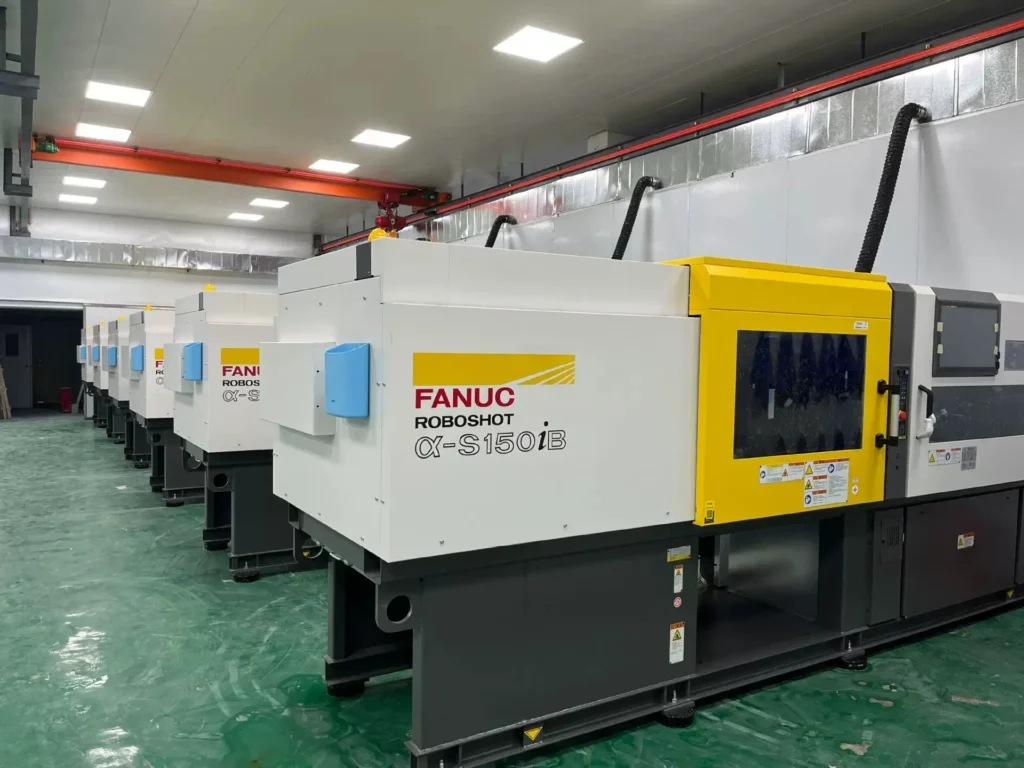
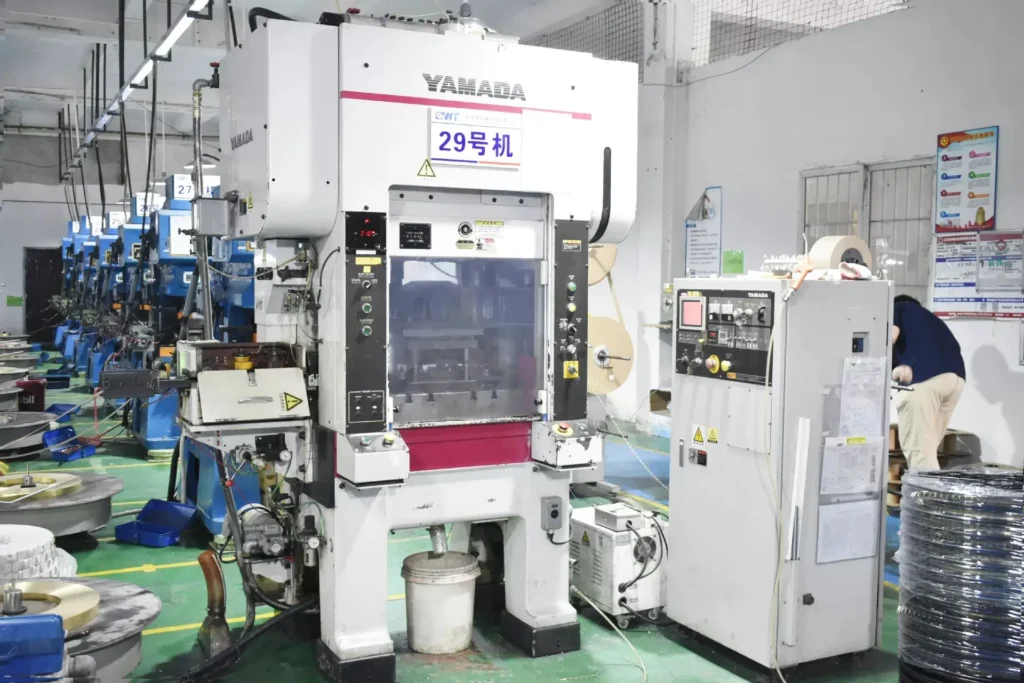
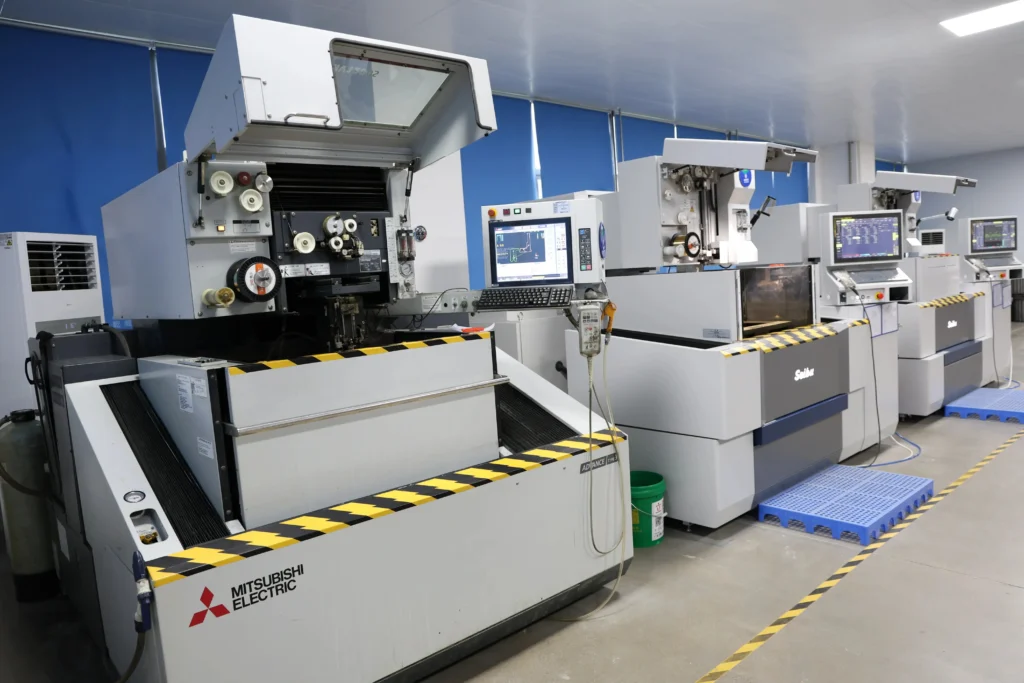
VoltixC is a cable lug and wire terminal manufacturer in Guangzhou, China, with a 1,200 m² factory, 25 staff and 135 production machines. The photos below show machines on site. They do not show which machine made a given BV or CE part, or what was measured.
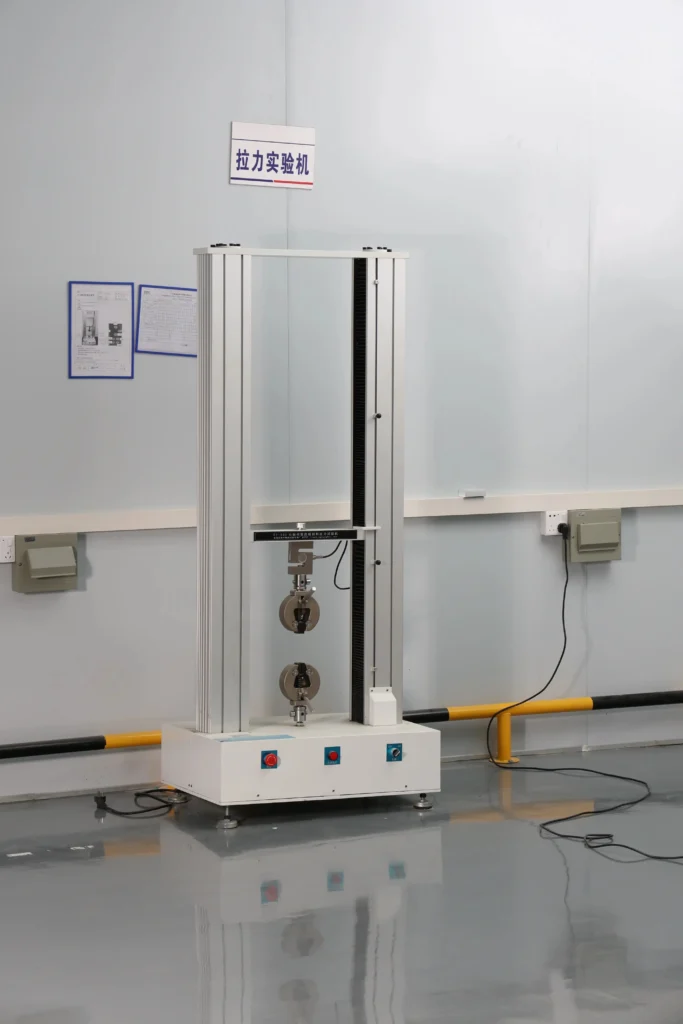
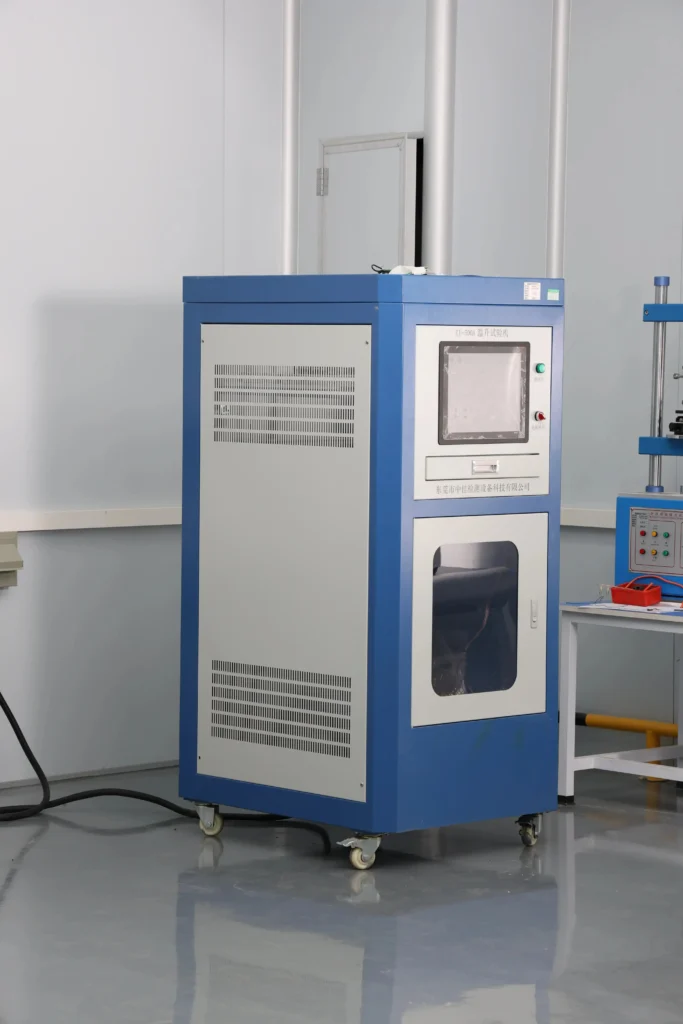
A butt connector quote is priced line by line, so cost follows what sits on each line: the quantity per size, the packing and labels, the documents you ask for, and any change from the listed part. Prices are not published on this page.
| Driver | Effect on cost | What you control |
|---|---|---|
| Quantity on each size line | A larger run on one size spreads machine setup over more pieces | Group demand onto fewer gauge bands where the wiring allows |
| Number of sizes and joint types | Every extra BV or CE size is its own line and changeover | Leave out sizes you do not stock or install |
| Sleeve or cap material and color | The listed vinyl (BV) and nylon (CE) are the base; another material or a custom color is a change to the part | Accept the listed sleeve unless your specification says otherwise |
| Pack count and labels | Bag counts, private labels and carton marks add handling | Send pack counts and label artwork with the first enquiry |
| Compliance documents | Each document request is matched to the item and its material | Name the documents you need, such as RoHS, at the start |
| Samples before bulk | A sample round adds a step before the main run | Approve samples against your own die and wire |
| Shapes outside the list | A part not in the table needs new tooling; tooling is confirmed per order | Stay with listed sizes where the job allows |
For the RoHS line, the amended Annex II set by Directive (EU) 2015/863 fixes DEHP, BBP, DBP and DIBP each at 0.1% by weight in homogeneous materials. The limit applies to each homogeneous material, so name the item and its sleeve or cap material when you ask for a declaration.
Minimum quantity, payment terms and lead time are agreed on each quotation, by email or through the enquiry form. A BV or CE sample round is quoted from 7 days, and bulk timing is set when the order is confirmed.
Put these details in the enquiry so the quote matches your joints:
The enquiry form has Name, Company, Email, Country, Product line, Conductor size, Quantity and Message fields. It has no upload field, so drawings or wire photos go by email to hugo@voltixconnect.com after you submit the form.
VoltixC has no sizing tool for splices yet. These four guides answer the installation and selection questions that come up before a splice order.
How to use butt connectors: strip, insert, crimp and check an inline splice.
Crimping guide: die choice, strip length and the hand pull check for any crimp terminal or splice.
Electrical connector types: where butt splices and closed-end connectors sit among the main electrical connector types.
Crimp connector types compared: rings, spades, quick disconnects, splices and caps compared, including sleeve color conventions.
Use a BV butt splice when two wire ends continue in a straight line, one end entering from each side. Use a CE closed-end connector when two or more wires stop at the same point and are capped together. If three or more wires meet and none continues on, one CE cap does the job of several splices.
Use one where wires end together, such as leads joined inside a box, fixture or appliance. According to 3M, a closed-end connector is a crimp sleeve connector with a copper insert used to splice copper conductors. The CE series lists four sizes: CE1 for 22-16 AWG, CE2 for 16-14 AWG, CE5 for 12-10 AWG and CE8 for 8 AWG.
Strip each wire, push the ends into the barrel, crimp with the die for the gauge band and pull each wire by hand to check it holds. For closed-end parts, 3M’s S11-A data sheet gives its own sequence: strip all wires ½ inch, pre-twist them, insert them and crimp. The step-by-step butt splice guide covers it in full.
The BV series lists 8 part numbers, BV1.25 to BV38, for 22-16, 16-14, 14-12, 12-10, 8, 6, 4 and 2 AWG, all vinyl insulated over a tin-plated copper body. The supplier sheet gives a maximum current from 19 A for BV1.25 to 160 A for BV38.
Not on the current list. CE sizes stop at 22-16, 16-14, 12-10 and 8 AWG, so a 14-12 AWG bundle or a 6 AWG joint is a special request; ask before you specify. A BV butt splice is listed at both 14-12 AWG and 6 AWG if the joint can be made inline.
It depends on the part: the CE sheet gives a gauge band and mm² for each size but no wire count. According to 3M’s S11-A data sheet, closed-end connectors are rated by copper wire combinations, such as 2 to 5 #22 or 2 or 3 #20 conductors. List the count and gauge of every wire, and the combination for each CE size is confirmed per order.
UL 486C covers splicing connectors that hold two or more conductors for use with 6 AWG or smaller conductors. For the BV 4 AWG and 2 AWG sizes, CSA Group describes a separate standard whose scope includes splicing connectors for 4 AWG (21.2 mm²) or larger. The BV and CE supplier sheets do not name either standard.
BV and CE parts are built to be crimped only, with no solder step. When a drawing asks for solder, the matching route is solder-seal connectors, which joins the wires with a solder ring inside a heat-shrink sleeve.
No single code covers every brand. ABB’s Spec-Kon table uses red for 0.5–1.5 mm², blue for 1.5–2.5 mm² and yellow for 4.0–6.0 mm². TE presents its own color examples as product examples rather than a universal code. The BV sheet gives its own standard color per size, for example red for BV1.25 and yellow for BV5.5, and the CE sheet lists no cap color.
The amended RoHS Annex II sets DEHP, BBP, DBP and DIBP each at 0.1% by weight in homogeneous materials. VoltixC has a RoHS test report available (SGS), but it covers lead, mercury, cadmium and hexavalent chromium on tin-plated copper terminal samples, not these phthalates. Ask for a declaration that names the BV item and its sleeve material before you approve it.
They come from the supplier specification sheets for the BV and CE series, read cell by cell, and were not re-tested for this page. The sheets give no strip length or wire count per cap, so those two are confirmed per order.
List each gauge band, the joint type for it and the quantity in one message. Lines that match a listed BV or CE size are quoted as listed, and for a line that is not on the current list, ask before you specify. Wire photos and drawings go to hugo@voltixconnect.com once the form is in.