VOLTIXC / ENQUIRY
Request a Quote
Tell us what you need and we will review your enquiry.

FRD female and MPD male vinyl-insulated bullet connectors for wire-to-wire joints that plug apart
Fast answer: Bullet connectors join two wires with a round male pin that pushes into a matching female sleeve, so the joint can be pulled apart and made again. VoltixC lists FRD female and MPD male vinyl-insulated bullet connectors in three wire bands: 22-16, 16-14 and 12-10 AWG. Order both halves in the same band, then request a quote.
On the female side the part numbers are FRD1.25-156, FRD2-156, FRD2-195 and FRD5.5-195; on the male side they are MPD1.25-156, MPD2-156, MPD2-195 and MPD5.5-195.
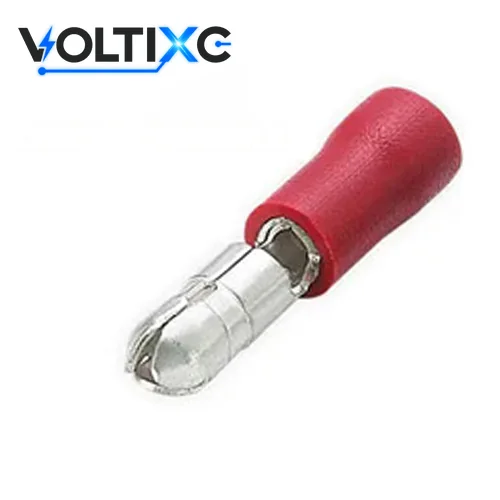
Bullet connectors hold by the grip of a female sleeve on a round male pin, and that grip is light enough for the joint to come apart by hand. Each half is crimped onto its own wire before the two halves ever meet, so the wire joint and the plug joint are two separate connections.
Each half is crimped on its own first: the crimp tool squeezes its metal barrel shut on the stripped conductor.
A vinyl sleeve hides that barrel on both halves and holds the wire jacket just behind the crimp.
The male pin slides into the female sleeve. According to 3M, dents and rolled edges on its female bullet disconnect provide holding force while allowing easy disconnection.
Pulling the halves apart opens the circuit without cutting or stripping the wire again.
The weak spot of any plug-apart joint is the contact face, not the crimp. Fretting is wear from tiny repeated movement between two touching metal surfaces, and it builds oxide right where the current has to pass. Fretting corrosion is identified as a typical problem in low-force electrical contacts, according to a paper published by IEEE. A peer-reviewed tribology study goes further: tin-plated contacts are highly susceptible to fretting corrosion, which limits their use in electrical connectors.
The FRD and MPD series descriptions name tin plating, which places these bullet connectors in the contact group that study describes. When fretting sets in, the symptom is an intermittent circuit: a joint that works on the bench, then drops out on a machine that shakes or on a lead that swings each time a panel opens. A bullet joint earns its place where wiring has to be parted for service. Where the wires never need to separate and the harness moves all day, a crimped splice with no plug contact removes the weak spot entirely.
Eight bullet connector part numbers are on the supplier specification sheet, four FRD female and four MPD male, and each side covers 22-16, 16-14 and 12-10 AWG. Each female code has a male partner with the same number, and that pair shares one band. Put the part number from the table, FRD2-156 or MPD2-156 for example, on the enquiry. The 16-14 AWG band has a -156 and a -195 version on each side, and on the sheet the two differ only in W.
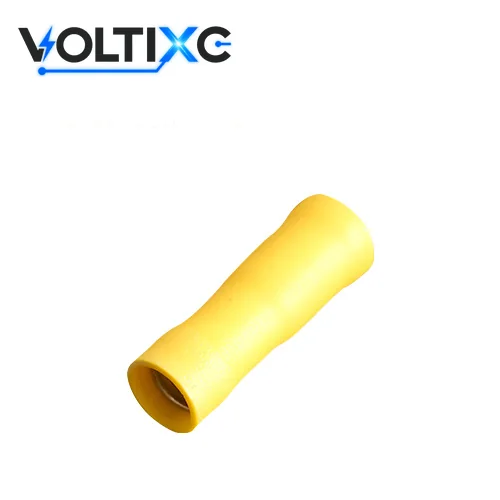
The FRD sleeve is vinyl and wraps the round socket, so the metal stays covered while the joint is open.
On MPD, the male half, the round pin sticks out at the front and the vinyl sleeve sits behind it over the wire barrel.
| Part No. | Half | Wire (AWG) | mm² | W (mm) | D (mm) | L (mm) | Insulation color |
|---|---|---|---|---|---|---|---|
| FRD1.25-156 | Female (FRD) | 22-16 | 0.5-1.5 | 4 | 3.8 | 23.3 | Red |
| FRD2-156 | Female (FRD) | 16-14 | 1.5-2.5 | 4 | 4.7 | 23.3 | Blue |
| FRD2-195 | Female (FRD) | 16-14 | 1.5-2.5 | 5 | 4.7 | 23.3 | Blue |
| FRD5.5-195 | Female (FRD) | 12-10 | 4-6 | 5 | 6.2 | 25.1 | Yellow |
| MPD1.25-156 | Male (MPD) | 22-16 | 0.5-1.5 | 4 | 1.7 | 21 | Red |
| MPD2-156 | Male (MPD) | 16-14 | 1.5-2.5 | 4 | 2.3 | 21 | Blue |
| MPD2-195 | Male (MPD) | 16-14 | 1.5-2.5 | 5 | 2.3 | 21 | Blue |
| MPD5.5-195 | Male (MPD) | 12-10 | 4-6 | 5 | 3.4 | 25 | Yellow |
Source: per supplier specification sheet for the FRD and MPD series; values not individually re-tested.
Data note: The sheet header gives a brass body, tin plating and a PVC sleeve for all eight part numbers, 1,000 pieces per box and “temperature resistant 75” with no unit printed. W, D and L are the dimension labels printed on the sheet, in mm. These 8 part numbers are the full specification table; request the complete sheet with your quote.
| Name on this page | Also searched as |
|---|---|
| Bullet connectors | electrical bullet connectors, bullet electrical connectors, bullet wire connectors |
| FRD female and MPD male halves | bullet terminal, female bullet connector, male bullet connector, terminals wire bullet connector |
Pin diameter is the second size on any bullet part. For its bullet-style disconnects, 3M lists bullet diameters of 0.156 in and 0.180 in. That is one maker’s range; this page names no pin diameter for FRD or MPD parts, so send the diameter you need, or a photo of the half already fitted, with the enquiry.
Sleeve color follows the wire band on the sheet: red for 22-16, blue for 16-14 and yellow for 12-10 AWG. ABB’s Spec-Kon vinyl-insulated ring table gives red for 0.5–1.5 mm², blue for 1.5–2.5 mm² and yellow for 4.0–6.0 mm² conductors. The FRD and MPD mm² bands on the sheet follow the same split.
Bullet-style connectors are offered as male and female versions with vinyl, nylon, nylon-grip or heat-shrink insulation in the Burndy line. Of those sleeves, only vinyl is listed here. 3M’s vinyl-insulated bullet-style male disconnect is rated for -40 to 105 °C. The FRD and MPD sheet prints 75 with no unit, so confirm the rating in writing before you specify these parts for a warm location.
Your conductor gauge gives the band, and the matrix below maps each gauge to a female and male pair.
| Your wire or joint | Listed band | Female half / male half | Check before ordering |
|---|---|---|---|
| 22-18 AWG (22, 20 or 18) | 22-16 | FRD1.25-156 / MPD1.25-156 | Jacket outside diameter on thin-wall or thick-wall wire |
| 16 AWG | 22-16 or 16-14 | FRD1.25-156 or an FRD2 version / MPD1.25-156 or an MPD2 version | 16 AWG sits at the edge of both bands; pick by jacket diameter and the die you crimp with |
| 14 AWG | 16-14 | FRD2-156 or FRD2-195 / MPD2-156 or MPD2-195 | Jacket outside diameter; -156 or -195 to match the other half |
| 12 or 10 AWG | 12-10 | FRD5.5-195 / MPD5.5-195 | Jacket outside diameter and the crimp die for the 12-10 band |
| A half already fitted in the harness | Same band and version as that half | The opposite side | Pin or socket diameter of the fitted half |
| 8 AWG or heavier, or an OEM automotive wire harness terminal system | Not in this listing | Not listed | See the route table further down |
Source: bands and part numbers per supplier specification sheet; checks are general crimp practice, not VoltixC test data.
Then work through the jacket, the side and the pin.
Measure the jacket. TE Connectivity’s crimping guide says insulation outside diameters vary among wires with the same AWG size, so the insulation barrel must accommodate the wire’s outside diameter and the crimp range must match it. For wire with a thicker jacket than standard hook-up wire, send the measurement or the wire type.
Decide which wire stays live when unplugged and put the female FRD half on it; the MPD pin sits bare once the joint is open, and the female sleeve covers its socket.
This page names no bullet diameter. If a half from another source is already in the harness, send its diameter or a photo of it beside a ruler.
People searching for 3.5 mm bullet connectors or 4 mm bullet connectors mean the pin diameter. This page leaves that size out for FRD and MPD parts, and the pin is matched per order against your sample or drawing.
Send My Size ListThe supplier specification sheet gives FRD and MPD bullet connectors a brass body with tin plating and a PVC sleeve, and the series descriptions call the metal 65 brass. The sleeve is there to insulate the crimp barrel; a nylon insulated version is not on the current list, so ask before you specify one.
| Part of the connector | FRD female | MPD male |
|---|---|---|
| Body | Brass (sheet header); 65 brass in the series description | Brass (sheet header); 65 brass in the series description |
| Plating | Tin (sheet header) | Tin (sheet header) |
| Insulation | PVC (sheet header); vinyl in the listing titles | PVC (sheet header); PVC sheath in the series description |
Source: per supplier specification sheet (header values) and VoltixC supplier series descriptions; not individually re-tested.
3M makes its bullet-style disconnects of brass with corrosion-resistant tin plating. That matches the metal pair in the FRD and MPD descriptions, as one maker’s example and no test of these parts. On the 3M male bullet snap plug, a funnel-shaped, rigid-molded PVC sleeve covers a butted-seam barrel. The MPD listing gives no seam type, so ask for a cut sample or a drawing if the seam matters to your crimp process.
Choose the crimp tool by connector type as well as wire size. West Marine writes that solderless crimp-on connectors must be attached with a crimping tool designed for the connector under ABYC E-11.14.3.8. The bullet connector crimping guide walks through stripping and crimping these parts step by step.
Use bullet connectors when two wires have to part by hand without tools; switch to another crimp connector when the wire ends on a flat tab, a stud or a screw, or when the joint never needs to open. The table gives each route and the case where it does the job better than a bullet.
| Route | Joint it makes | Pick it over a bullet when | Where to look |
|---|---|---|---|
| Quick disconnect terminals | Wire to a flat blade or receptacle | The mating part on a switch, relay or appliance is a flat tab | quick disconnects |
| Insulated butt splices | Permanent wire-to-wire splice | The joint never has to open | insulated butt splices |
| Solder-seal splices | Permanent splice closed with heat and solder | The splice sits where moisture can reach it | solder-seal splices |
| Heat-shrink crimp splices | Permanent crimp splice under shrink tubing | You want a sealed splice without a solder ring | heat-shrink crimp splices |
| Spade terminals | Wire to a screw on a terminal strip | The wire ends under a screw, not at another wire | spade terminal range |
| Ring terminals | Wire bolted onto a stud | The wire must not slip off even if the nut loosens | insulated ring terminals |
| Wire ferrules | Sleeve over a stranded wire end | The stranded end goes into a screw or spring clamp | wire ferrules |
| Bare copper splices | Uninsulated compression splice for heavier cable | The wire is 8 AWG or heavier | bare copper splices |
Source: joint types by product family; see each linked page for its own listed sizes.
A quick disconnect also unplugs by hand, which makes it the nearest alternative. Its halves are a flat blade and a folded receptacle, while a bullet uses a round pin and a round sleeve, and the two types do not fit each other. Keep bullets for wire-to-wire joints you control, and use a quick disconnect when one end is already a tab on a device.
Make a joint that will never be opened again as a permanent splice. With no plug contact, it gives fretting nothing to work on. For a sealed joint, look at the solder-seal or heat-shrink routes, because the vinyl bullet listing here names no seal.
Heavier wire and bare bullets fall outside this page. VoltixC lists only vinyl-insulated FRD and MPD parts for 22-10 AWG, so there is no bullet here for 8 AWG or heavier wire and no uninsulated bullet. Burndy’s bullet-style connectors are offered as male and female versions with vinyl, nylon, nylon-grip or heat-shrink insulation. For the other terminal types on this site, go back to crimp connectors.
Use FRD and MPD electrical bullet connectors on a 22 to 10 AWG wire joint that you open for service or replacement; leave them out where the joint shakes all day, gets wet or runs hot. This page cites no end-user installation, and the cards below follow from how a plug-apart joint behaves.
Fans, lamps, sensors and small pumps that get replaced whole can carry one half on their own lead. The harness keeps the other half, and a new unit plugs straight in. Match the band (an MPD2-156 on a 14 AWG lead goes into an FRD2-156) and send the pin diameter with the quotation request.
Put a bullet joint where the wiring crosses a door, a lid or a removable panel. The panel then lifts off with no wire cut. Leave slack either side; a plug hanging on its cable swings with every opening and wears its contact face.
On a test rig that gets rewired between runs, each change is a pull and a push instead of a cut and a new crimp. Label each lead with its AWG band; eight codes in three bands are easy to mix up.
The IEEE paper cited above identifies fretting corrosion as a typical problem in low-force electrical contacts. A bullet joint on an engine, a compressor or a vibrating frame is one of those contacts. Use a crimped splice from the route table there.
These vinyl parts have no listed seal. For spray, washdown or outdoor runs, pick a sealed splice or ask for a heat-shrink bullet version by drawing.
The supplier data gives 75 with no temperature unit for FRD or MPD parts. Keep them away from heaters, hot lamp bases and engine parts unless you hold a rating for the exact part. Wire of 8 AWG or heavier is outside this listing altogether.
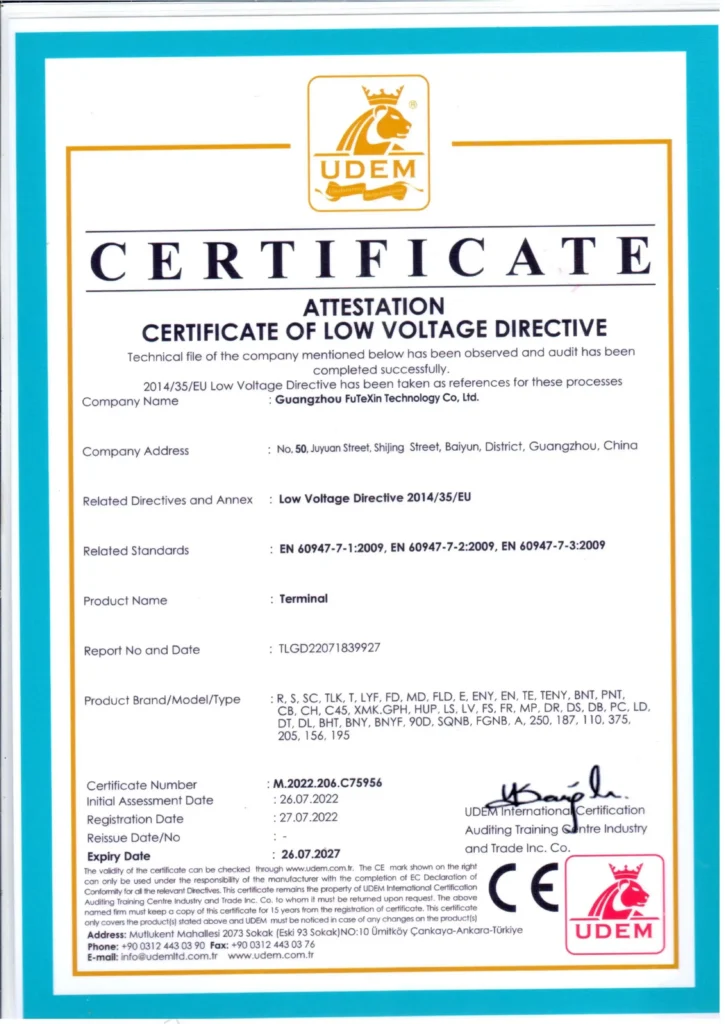
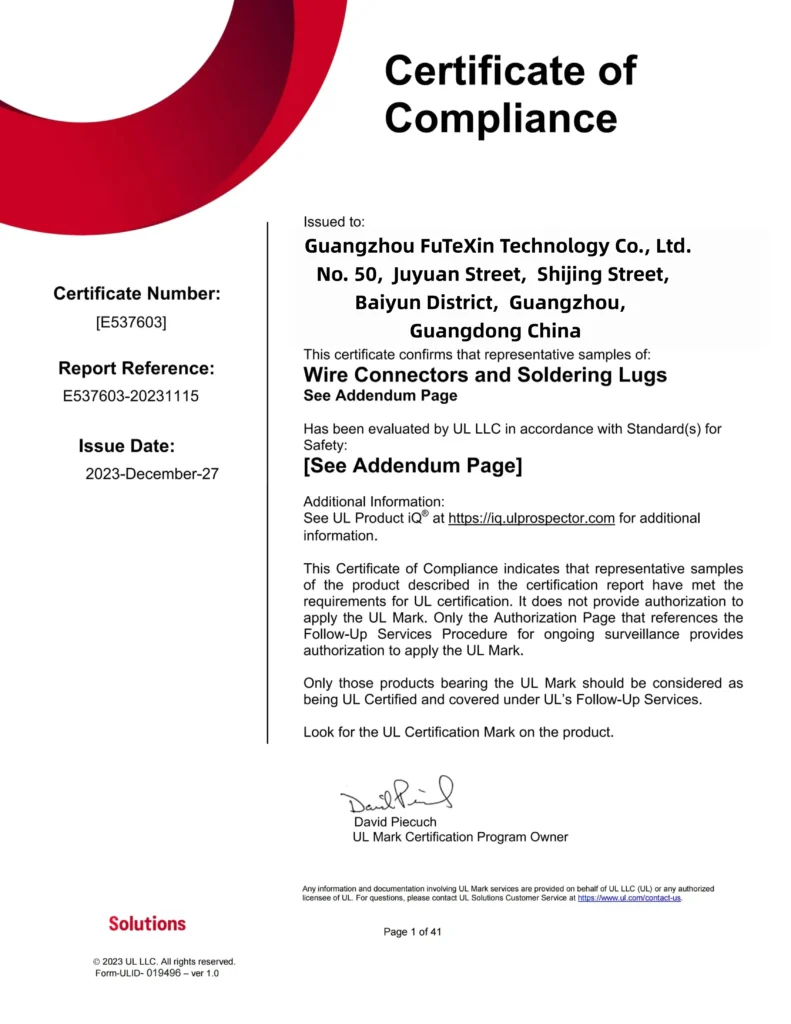
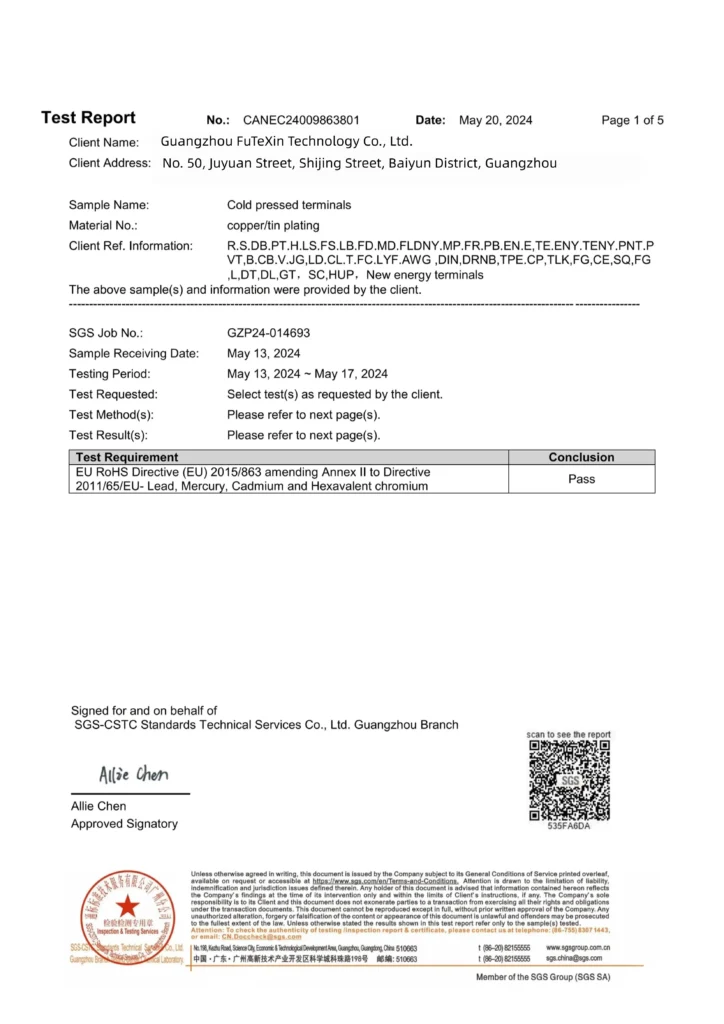
VoltixC is UL certified, holds a CE attestation that covers its full terminal range, FRD and MPD bullet connectors included, and has a RoHS test report available (SGS). The CE attestation is issued under the Low Voltage Directive 2014/35/EU against EN 60947-7-1, EN 60947-7-2 and EN 60947-7-3, and all three documents name Guangzhou FuTeXin Technology Co., Ltd., the company behind the VoltixC brand. This page shows the images without certificate numbers or dates.
The equipment photos below come from the 1,200 m² plant in Guangzhou, which runs 135 production machines. None of them is a test report for FRD or MPD parts.
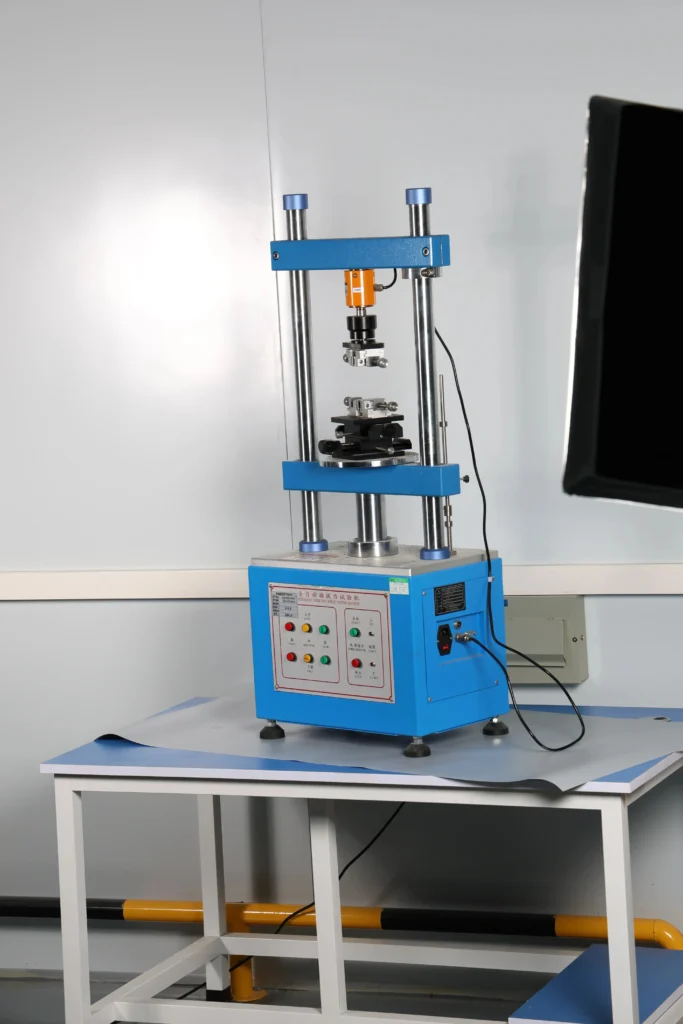
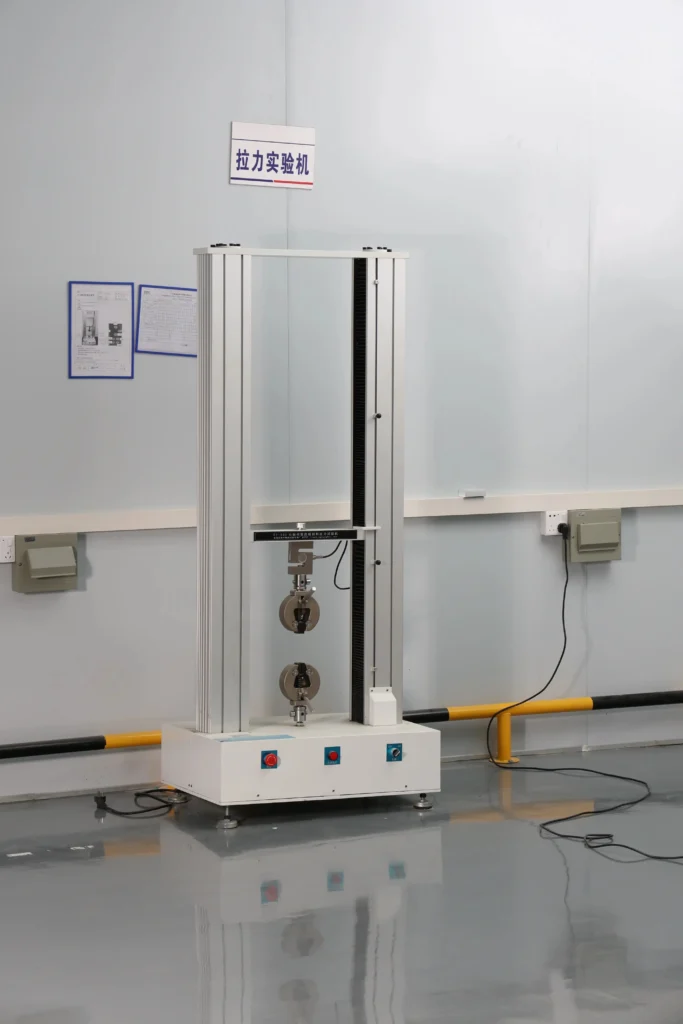


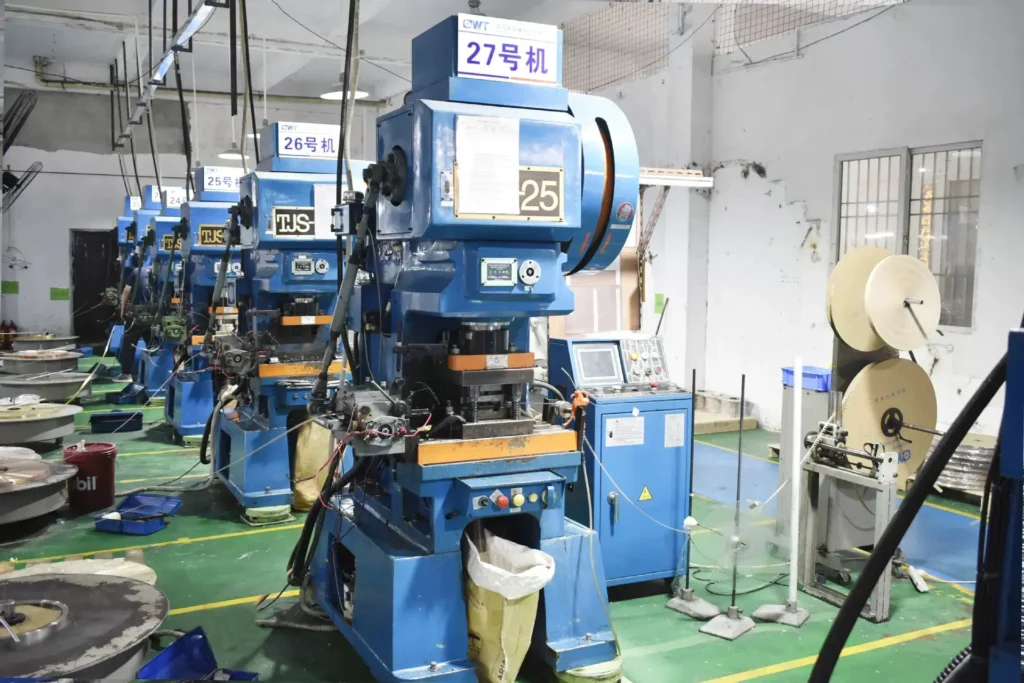
Settle the four open points in this table before you approve a bullet connector sample.
| Open point | Reason on a plug-apart joint |
|---|---|
| Whether the UL certification lists the FRD or MPD code | The UL addendum page that names covered products is not shown here |
| Pin and socket diameter of each half | Halves from two sources may not mate even in the same band |
| Body metal and plating named on the order documents | The sheet gives brass and tin; your own customer may need them in writing |
| RoHS declaration covering the vinyl sleeve | The SGS report covers lead, mercury, cadmium and hexavalent chromium; ask how the sleeve is covered |
Code mix, pin fit, sleeve, paperwork and packing set the price of a bullet connector order; MOQ, lead time and payment are confirmed per order by email or the enquiry form. The table lists nine cost drivers for FRD and MPD orders.
| Driver | Effect on cost | What you control |
|---|---|---|
| Code mix | Each of the eight FRD and MPD part numbers is its own line on the quote | How many codes you need, and whether one band can serve two wire sizes |
| Female to male ratio | Each side is priced on its own count | The count per side, which need not match when one side sits on spare leads |
| Pin fit to an existing half | Matching a socket or pin from another source can need a sample check | The diameter, a sample, or a clear photo with a ruler |
| Sleeve material and color | The sheet lists PVC (vinyl) in red, blue or yellow by band; nylon or heat-shrink sleeves are a different part | Staying with vinyl and the band color, or naming the sleeve you need |
| Body and plating statement | A material or plating statement per order adds paperwork | Asking only for the documents your own customer requires |
| RoHS paperwork for the sleeve | A declaration against the amended Annex II adds paperwork. The amended Annex II sets DEHP, BBP, DBP and DIBP each at 0.1% by weight in homogeneous materials. | Requesting the declaration together with the quote |
| Packing and labels | Counted bags, printed labels or mixed kits add handling | Pack count, label text and whether bands are packed apart |
| Quantity | Larger runs spread setup over more parts | First-order quantity and expected yearly volume |
| Special shapes | A double female bullet connector or another shape outside the listing needs its own tooling | A drawing sent by email |
Source: Annex II limits from Directive (EU) 2015/863 as published on EUR-Lex; commercial terms are not stated on this page.
Allow 7 days at the fastest for a first set of FRD and MPD samples. Dates for tooling, production and shipping are confirmed per order. If your list gives a count for each FRD and MPD code, the quote comes back line by line in the same order. The enquiry form has no upload field, so send drawings, photos of an existing half and label artwork by email to hugo@voltixconnect.com.
Four pages cover the work around a bullet connector order: two crimping guides, a guide to connector types and a stud size chart.
Strip length, die choice and the pull check for each half are in how to crimp bullet connectors.
For the general method behind every crimp on this site, from tool and die choice to common failures, read how to crimp wires.
See where the bullet sits beside rings, spades, splices and ferrules in wire crimp connector types.
If the same harness also ends on a stud, size the ring terminal with the ring terminal size chart.
Use bullets when both ends are wires. When one end is a flat tab on a switch, relay or appliance, a quick disconnect is the right part, because its flat blade and folded receptacle won’t mate with the round pin and round sleeve of a bullet. The tab route is covered on the quick disconnect terminals page.
Both the wire band and the pin diameter have to match. The pairs are FRD1.25-156 with MPD1.25-156 for 22-16 AWG, FRD2-156 with MPD2-156 and FRD2-195 with MPD2-195 for 16-14 AWG, and FRD5.5-195 with MPD5.5-195 for 12-10 AWG, so male and female connectors are ordered as matching pairs. This page names no pin diameter, so if a female connector or male connector from another source must mate with yours, send a sample or a measured diameter and it is matched per order.
Three bands per side, 22-16, 16-14 and 12-10 AWG, give eight part numbers: FRD1.25-156, FRD2-156, FRD2-195 and FRD5.5-195 on the female side and MPD1.25-156, MPD2-156, MPD2-195 and MPD5.5-195 on the male side. Wire of 8 AWG or heavier is outside this listing.
The answer depends on where the wire ends. Under a screw on a terminal strip, a spade terminal is the part to use; see spade terminals. Where the wire meets another wire and the joint has to unplug by hand, use a bullet connector.
Crimp each half to its own wire, give each crimp a firm pull, then push the male pin fully into the female sleeve. Per West Marine, citing ABYC E-11.14.3.8, solderless crimp-on connectors must be attached with a crimping tool designed for the connector.
A 3.5 mm or 4 mm pin is matched per order, because this page gives a wire range and letter dimensions for FRD and MPD parts but no pin diameter. Send the diameter, or a sample of the half you need to mate, with the enquiry. For scale, bullet diameters of 0.156 in and 0.180 in appear on 3M’s own bullet-style disconnects.
The supplier sheet gives red for 22-16 AWG, blue for 16-14 AWG and yellow for 12-10 AWG on both FRD and MPD parts; the photos on this page show a yellow FRD sleeve and a red MPD sleeve. In ABB’s Spec-Kon vinyl-insulated ring table, red is used for 0.5–1.5 mm², blue for 1.5–2.5 mm² and yellow for 4.0–6.0 mm² conductors. Name the scheme in your enquiry if the harness has to follow a different one.
Under the amended RoHS Annex II, DEHP, BBP, DBP and DIBP are capped at 0.1% by weight each in homogeneous materials. Request the RoHS declaration with your quote; the SGS test report on file covers lead, mercury, cadmium and hexavalent chromium, not these four phthalates.
Each figure is copied from the supplier specification sheet for the FRD and MPD series, which gives wire range, mm², letter dimensions and sleeve color for all eight part numbers. They were taken as printed and have not been re-tested item by item. A named pin diameter and a temperature unit are not on this page, so both are confirmed per order.
A double female bullet connector isn’t one of the eight listed parts; it’s a separate shape that needs its own tooling, so it is quoted as a custom part. Email a drawing or a sample photo to hugo@voltixconnect.com, and terms are confirmed per order.
A quote request for bullet connectors should give the part numbers, a separate count for each side and whatever this page leaves open, such as pin diameter.
The enquiry form has fields for name, company, email, country, product line, conductor size and quantity, and the five items go in its message box. Drawings and photos of the mating half go by email to hugo@voltixconnect.com with your company name in the subject line, because the form takes no uploads.
Ask a VoltixC Engineer