VOLTIXC / ENQUIRY
Request a Quote
Tell us what you need and we will review your enquiry.

Copper and aluminum compression lugs with a two-hole palm, for busbars and equipment pads drilled for two bolts.
Fast answer: Two-hole compression lugs combine a crimped barrel with a two-hole palm, so the joint resists rotation on busbars and equipment pads. VoltixC lists copper and aluminum two-hole compression series here. Confirm conductor material and size, hole spacing and bolt size, then request a quotation.
The two series on this page hold 2,306 part numbers per supplier specification sheet. The copper series runs from 14-10 AWG to 1000 kcmil in straight, 45° and 90° forms; the aluminum series runs from 2 AWG to 750 kcmil in straight form. Each part number lists its bolt size and its hole spacing, from 0.50 in to 1.75 in. Both series belong to the VoltixC cable lugs range.
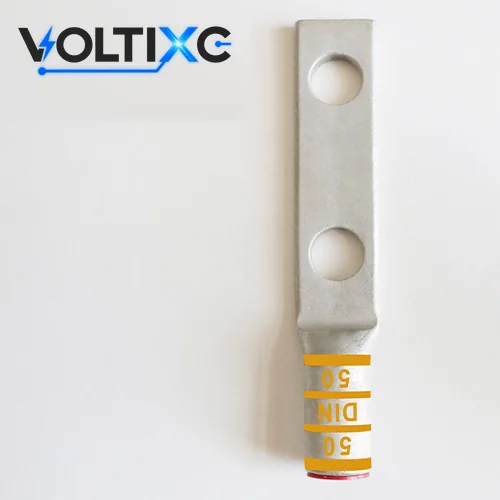
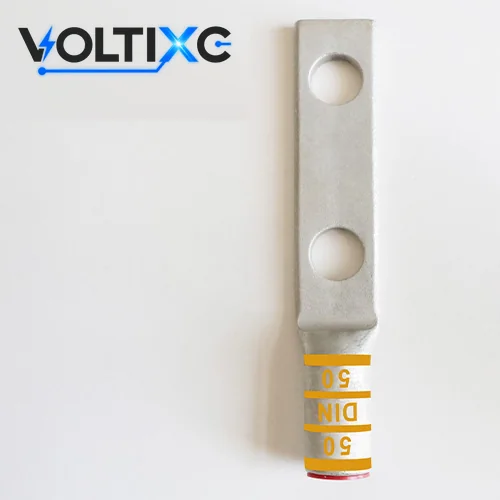
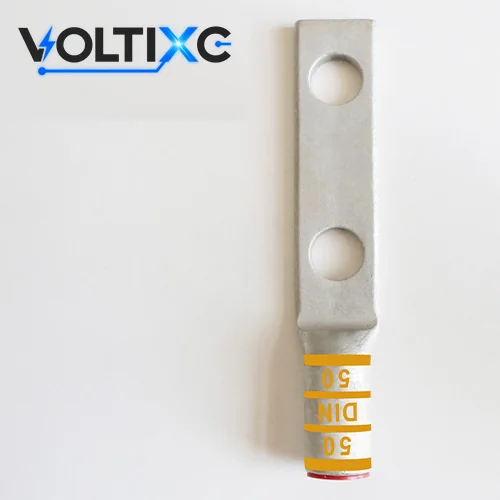
A two-hole compression lug does two jobs: its barrel is crimped onto the conductor, and its flat palm is bolted to a busbar or equipment pad through two holes. According to Electrical Engineering Portal, a crimp connection places the conductor into a terminal with a tubular opening and presses or deforms the tube onto it. In catalogs and enquiries it may appear as a 2-hole compression lug or a two hole lug compression connector.
A one-hole lug sits on one bolt and can turn on it when the cable pulls sideways. With two bolts through the palm plate, the lug can’t turn.
Making the joint with two-hole compression lugs takes four steps:
Strip the conductor to the barrel depth. According to TE Connectivity, insulation must be removed cleanly to the proper length without nicking or breaking strands.
Push the conductor fully into the barrel so no bare strands sit outside it.
Crimp with the die that matches the lug. According to the ILSCO installation guide, installers should use the die specified by the connector maker, which colored bands or stamped die codes may identify.
Bolt the palm to the bus or pad through both holes, using the fastener and torque the equipment maker specifies.
A bad joint gives you resistance and heat. Galliana et al. report that crimped-connection quality and electrical resistance depend on the material, cable section, crimp method, crimp profile, and the location and shape of the indents. So matching your cable size to a row isn’t enough on its own. With the wrong die, conductor class or insertion depth you can still end up with a poor joint, even when the lug is right on paper.
VoltixC lists 2,306 two-hole compression lug part numbers in two series: 2,250 copper parts from 14-10 AWG to 1000 kcmil and 56 aluminum parts from 2 AWG to 750 kcmil. The copper two hole compression lugs come with a straight (0°), 45° or 90° palm; the aluminum two hole compression lugs are listed with a straight palm only. Each part number has a bolt size, a hole spacing and a barrel ID on the supplier specification sheet.
The tables show one catalog number per wire gauge, and the last column names the other bolt sizes listed at that gauge. Values are per supplier specification sheet (inches as printed, mm converted) and are not individually re-tested; hole spacing is the dimension lettered G on the supplier drawing. Barrel colors named on this page come from the supplier’s product listing. Hole diameter and plating are not on the sheet and are confirmed per order.
The copper series is the only one on this page with angled palms: every copper gauge is listed at 45° and 90°, and every gauge except 350 kcmil at 0° as well. Bolt sizes run from #8 to 5/8 in, and 1/2 in bolts at a 1.75 in hole spacing are listed from 8 AWG to 1000 kcmil.
| Cat. No. | Wire gauge (AWG / kcmil) | Palm angle | Bolt / stud size (in) | Hole spacing G (in / mm) | Barrel ID (mm) | Other bolt sizes listed (in) |
|---|---|---|---|---|---|---|
| LB141458 | 14-10 AWG | 0° | 1/4 | 0.63 / 16.00 | 3.30 | #10, 3/8 |
| LB081434A | 8 AWG | 90° | 1/4 | 0.75 / 19.05 | 4.57 | #8, #10, 3/8, 1/2 |
| DB061401F | 6 AWG | 45° | 1/4 | 1.00 / 25.40 | 5.59 | #10, 5/16, 3/8, 1/2 |
| LB041434 | 4 AWG | 0° | 1/4 | 0.75 / 19.05 | 6.86 | #10, 5/16, 3/8, 1/2 |
| DB023801F | 2 AWG | 45° | 3/8 | 1.00 / 25.40 | 7.62 | #10, 1/4, 5/16, 1/2 |
| DB013801 | 1 AWG | 0° | 3/8 | 1.00 / 25.40 | 9.14 | 1/4, 5/16, 1/2 |
| DB103801 | 1/0 AWG | 0° | 3/8 | 1.00 / 25.40 | 10.16 | 1/4, 5/16, 1/2 |
| DB201243 | 2/0 AWG | 0° | 1/2 | 1.75 / 44.45 | 11.18 | 1/4, 5/16, 3/8 |
| Cat. No. | Wire gauge (AWG / kcmil) | Palm angle | Bolt / stud size (in) | Hole spacing G (in / mm) | Barrel ID (mm) | Other bolt sizes listed (in) |
|---|---|---|---|---|---|---|
| DB301243A | 3/0 AWG | 90° | 1/2 | 1.75 / 44.45 | 12.95 | 1/4, 5/16, 3/8 |
| DB401243 | 4/0 AWG | 0° | 1/2 | 1.75 / 44.45 | 14.22 | 1/4, 5/16, 3/8 |
| DB251243 | 250 kcmil | 0° | 1/2 | 1.75 / 44.45 | 16.00 | 1/4, 5/16, 3/8 |
| DB311243 | 300 kcmil | 0° | 1/2 | 1.75 / 44.45 | 17.78 | 3/8 |
| DB351243F | 350 kcmil | 45° | 1/2 | 1.75 / 44.45 | 19.05 | 1/4, 5/16, 3/8 |
| LB411243A | 400 kcmil | 90° | 1/2 | 1.75 / 44.45 | 20.07 | 1/4, 3/8 |
| DB451243-251 | 450 kcmil | 0° | 1/2 | 1.75 / 44.45 | 23.37 | 3/8 |
| DB511243 | 500 kcmil | 0° | 1/2 | 1.75 / 44.45 | 22.35 | 1/4, 3/8 |
| DB611243F-250 | 600 kcmil | 45° | 1/2 | 1.75 / 44.45 | 23.37 | 3/8 |
| DB711243-242 | 700 kcmil | 0° | 1/2 | 1.75 / 44.45 | 24.64 | 3/8 |
| DB751243 | 750 kcmil | 0° | 1/2 | 1.75 / 44.45 | 26.92 | 3/8, 5/8 |
| DB811243A | 800 kcmil | 90° | 1/2 | 1.75 / 44.45 | 28.19 | 3/8 |
| DB911243 | 900 kcmil | 0° | 1/2 | 1.75 / 44.45 | 30.23 | 3/8, 5/8 |
| DB111243 | 1000 kcmil | 0° | 1/2 | 1.75 / 44.45 | 31.75 | 3/8 |
The full specification table holds 2,250 copper part numbers; request the complete list with your quote.
Source: per supplier specification sheet (copper two-hole tables at 0°, 45° and 90°); values not individually re-tested.
The aluminum series has straight palms only and starts at 2 AWG. Every aluminum gauge is listed with 1/2 in bolts at a 1.75 in hole spacing, and 11 of the 13 gauges also with 3/8 in bolts.
| Cat. No. | Wire gauge (AWG / kcmil) | Palm angle | Bolt / stud size (in) | Hole spacing G (in / mm) | Barrel ID (mm) | Other bolt sizes listed (in) |
|---|---|---|---|---|---|---|
| AL021243-62 | 2 AWG | 0° | 1/2 | 1.75 / 44.45 | 7.87 | — |
| AL101243-62 | 1/0 AWG | 0° | 1/2 | 1.75 / 44.45 | 9.91 | 3/8 |
| AL201243 | 2/0 AWG | 0° | 1/2 | 1.75 / 44.45 | 11.68 | 3/8 |
| AL301243 | 3/0 AWG | 0° | 1/2 | 1.75 / 44.45 | 13.21 | 3/8 |
| AL401243 | 4/0 AWG | 0° | 1/2 | 1.75 / 44.45 | 15.24 | 3/8 |
| AL251243 | 250 kcmil | 0° | 1/2 | 1.75 / 44.45 | 16.51 | 3/8 |
| AL311243 | 300 kcmil | 0° | 1/2 | 1.75 / 44.45 | 18.03 | 3/8 |
| AL351243 | 350 kcmil | 0° | 1/2 | 1.75 / 44.45 | 19.05 | 3/8 |
| Cat. No. | Wire gauge (AWG / kcmil) | Palm angle | Bolt / stud size (in) | Hole spacing G (in / mm) | Barrel ID (mm) | Other bolt sizes listed (in) |
|---|---|---|---|---|---|---|
| AL411243 | 400 kcmil | 0° | 1/2 | 1.75 / 44.45 | 20.57 | 3/8 |
| AL511243 | 500 kcmil | 0° | 1/2 | 1.75 / 44.45 | 22.86 | 3/8 |
| AL611243 | 600 kcmil | 0° | 1/2 | 1.75 / 44.45 | 25.15 | 3/8 |
| AL711243 | 700 kcmil | 0° | 1/2 | 1.75 / 44.45 | 26.92 | 3/8 |
| AL751243 | 750 kcmil | 0° | 1/2 | 1.75 / 44.45 | 27.94 | — |
56 aluminum part numbers are in the full specification table, and the complete list comes with your quote on request.
Source: per supplier specification sheet (aluminum two-hole tables); values not individually re-tested.
Five things decide the right two-hole compression lug: conductor metal, conductor size, palm angle, hole pattern, and the die that goes with the barrel color. The tables above answer the first four; the die comes from the chart for the tool you use.
| Check | What to look at | Where the answer is |
|---|---|---|
| Conductor metal | Copper cable goes to the copper series; aluminum cable goes to the aluminum series | Series headings above |
| Conductor size | Match the AWG or kcmil value of your cable to one row; 14-10 AWG to 1000 kcmil in copper, 2 AWG to 750 kcmil in aluminum | Wire gauge column |
| Palm angle | 0°, 45° or 90° in copper; 0° only in aluminum | Palm angle column |
| Hole spacing and bolt size | On the copper sheet, 3/8 in bolts mostly sit at a 1.00 in spacing and 1/2 in bolts at 1.75 in. According to 3M, the NEMA center-to-center spacing for two-hole lugs is 1.75 in (44.5 mm). | Bolt / stud size and hole spacing G columns; other bolt sizes in the last column |
| Die and barrel color | According to ILSCO’s copper compression chart, #8 AWG wire takes a red color code, #6 AWG a blue one and 250 kcmil a yellow one; the supplier listing gives the copper lugs at those sizes the same three colors | The die maker’s chart |
| Inspection window | Not on the current list; ask before you specify | — |
| Size names buyers search | “4/0 2 hole compression lug” points to the 4/0 AWG row; “2 hole compression lugs 500 MCM” points to the 500 kcmil row, since MCM and kcmil are the same unit | Wire gauge column |
Spec note: the sheet gives bolt size, not hole diameter. As one example, according to CMC, its AHL400-2 aluminum two-hole NEMA compression stacking lug has a 0.562 in hole for 1/2 in bolts. Send the bolt size from your drawing with the enquiry.
Tip: one nominal size does not fix the conductor build. According to ILSCO, its CSWS-2/0-38 lug takes 2/0 stranded copper but only 1/0 in flexible classes such as DLO, so state the cable class along with the AWG or kcmil value.
Caution: the supplier listing codes the two series in different colors at the same size, so read the color for the part you order rather than from a copper lug you used before.
Every copper compression lug in the copper series is listed with a copper body, and every aluminum part with an aluminum body. Plating and joint compound are not on the specification sheet, so they are set on your drawing and confirmed per order.
| Item | Two-hole copper compression lugs | Aluminum series |
|---|---|---|
| Body metal (supplier listing) | Copper | Aluminum |
| Part numbers on the sheet | 2,250, 14-10 AWG to 1000 kcmil | 56, 2 AWG to 750 kcmil |
| Palm angles listed | 0°, 45°, 90° | 0° |
| Bolt sizes listed | #8, #10, 1/4, 5/16, 3/8, 1/2, 5/8 in | 3/8, 1/2 in |
| Hole spacing (G) | 0.50 to 1.75 in | 1.00 and 1.75 in |
| Barrel ID | 3.30 to 31.75 mm | 7.87 to 27.94 mm |
| Other lettered dimensions (full sheet) | A (straight palms only), B, C | A, B, C, D, F, H |
| Surface finish | Not listed; bare or tin-plated to your requirement, confirmed per order | Not listed; confirmed per order |
| Joint compound | Not listed | Not listed; pre-filled compound confirmed per order |
Aluminum terminations add a step that copper ones skip. As one example, according to CMC, its aluminum two-hole NEMA compression stacking connectors come pre-filled and plugged with electrical joint compound. The conductor itself matters too: in a study of 240 mm² aluminum cable, connecting soft annealed aluminum conductors was considerably more difficult than connecting hard-drawn ones.
The crimp profile is chosen with the die, not with the lug body. According to Klauke, hexagonal crimping suits both copper and aluminium conductors. Name the tool and die family you use on site in your enquiry; the die reference for each size is confirmed per order.
Use two-hole compression lugs, copper or aluminum, when the bus or pad is drilled for two bolts and your crew crimps with color-coded dies. If the hardware has one stud, another VoltixC page fits better. The same goes for a specification that already names a catalog number from a tube lug series, and for a site with no crimp tooling.
| Route | How it is built | How VoltixC data sizes it | Pick it when |
|---|---|---|---|
| Two-hole compression lugs (this page) | Color-coded crimp barrel, two-hole palm, copper or aluminum body | Catalog numbers by AWG or kcmil, each with bolt size and hole spacing; copper at 0°, 45°, 90° | The bar or pad has two holes and you crimp by die color |
| One-hole compression lugs | The same color-coded barrel with a single mounting hole, copper or aluminum | AWG and kcmil rows; copper at 0°, 45°, 90° | The terminal has one stud or one bolt position |
| Two-hole copper tube lugs, AD and CL-2H series | Copper tube lugs with a two-hole palm, sold by catalog number | Catalog numbers such as AD60 or CL60-2H, with AWG ranges such as 250/300 | Your bill of materials already names an AD or CL-2H number |
| Mechanical lugs | Screw-clamp body, no crimp die | Conductor range per lug body | No compression tool is on site, or the conductor must be clamped rather than crimped |
| Copper butt splice connectors | Barrel at both ends, no palm | Conductor size per splice | Two cables are joined end to end, with no bus or pad involved |
The one-hole and two-hole compression lugs have the same barrel design, so look at the mounting face to choose between them. A single-hole palm can turn on its bolt; a second bolt stops it turning. On a bar with only one hole, a two-hole lug adds nothing and means drilling a second hole.
According to the Galliana et al. study, crimp quality depends on material, cable section, crimp method and crimp profile, so a route change means checking the die and profile again along with the part number.
Switch to another page if one of these applies:
Two-hole compression lugs fit fixed connections where a cable lands on a flat pad or bar drilled for two bolts and stays under load for long periods. NASA researchers state that reliable crimped contacts need strict process controls and continuous pull-force process verification. The cards below follow from how the part is built (crimped barrel, two-hole palm, 2,306 listed part numbers); they describe job types, and no VoltixC installation is cited.
Conditions: busbar attachment on a copper or aluminum bar drilled for two bolts, with the cable arriving at a fixed angle.
Start with: the hole spacing and bolt size from the bar drawing, matched to the G and bolt columns.
Watch: the palm width against the bar width, which the tables here do not show. One forum participant links two-hole lugs, long barrels and die-type crimps to connections that carry current for months or years.
Conditions: a pad inside a panel, switchboard, drive cabinet or battery cabinet with a two-hole pattern (a single battery post takes a one-hole battery cable lug instead).
Start with: the pad drawing and the cable size per phase.
Watch: space between phases, since the palm and bolts take room on each side.
Conditions: the cable has to turn close to the pad.
Start with: the 45° and 90° copper parts; all 22 copper gauges are listed at both angles.
Watch: the table shows one angle per gauge, so ask for the 45° or 90° catalog number at your bolt size.
Conditions: aluminum cable landing on a pad rated for aluminum.
Start with: the aluminum rows, 2 AWG to 750 kcmil.
Watch: joint compound and barrel sealing; ask whether the barrel needs heat shrink after crimping aluminum conductors, a point raised on Mike Holt’s Forum.
Rows here are sized by AWG and kcmil, not by strand class. One forum participant reports that fine-strand wire can fail to crimp, pull out or break when used with the wrong lugs. Send the cable class so the barrel can be checked; welding cable lugs are not part of this range.
NASA’s workmanship standard for crimping requires stranded wire and prohibits crimping solid wire; that is an aerospace rule, but it is a reason to raise solid conductors before ordering a crimp lug.
The aluminum series is listed with an aluminum body; it is not a bimetallic part with a copper palm, and VoltixC does not list bimetallic lugs in this range. No finish or rating for landing an aluminum lug on a copper pad is stated in the supplier data; ask before you specify that joint. For one lug body that takes either conductor metal, compare dual rated mechanical lugs.
IEC 61238-1-3 covers compression and mechanical connectors for power cables above 1 kV up to 30 kV. The specification sheet carries no voltage rating and use above 1 kV is not claimed here; ask before you specify these lugs for any voltage class.
You can check three compliance documents and six VoltixC plant photos before you order. VoltixC is the brand of Guangzhou FuTeXin Technology Co., Ltd., which runs a 1,200 m² factory with 135 production machines and 25 staff. Certificate numbers and dates are not shown here.
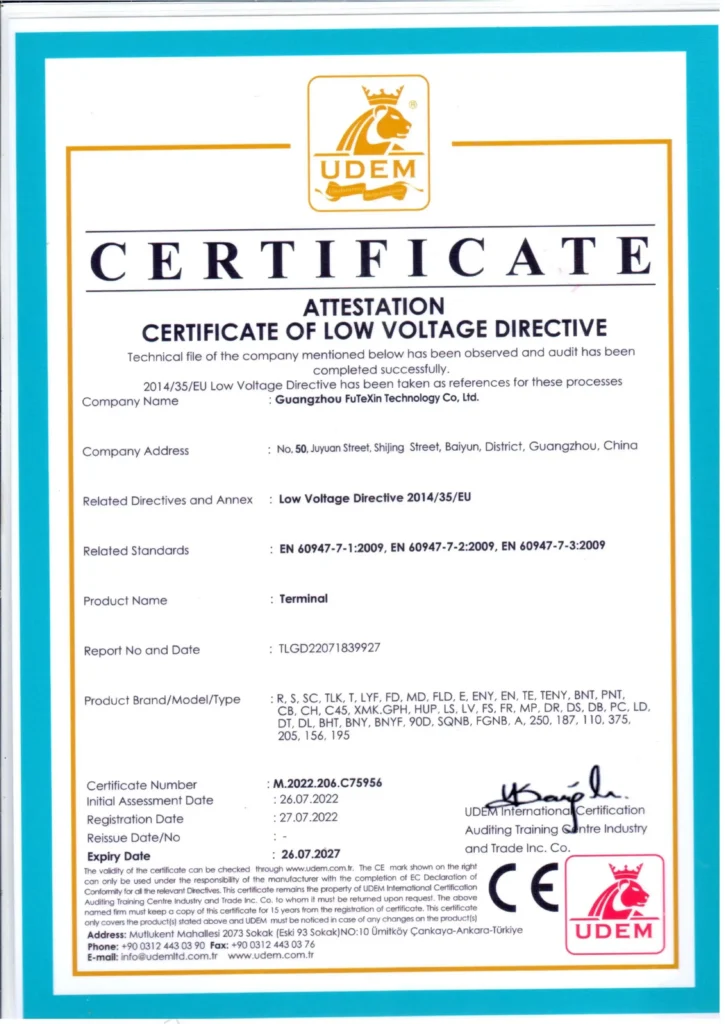
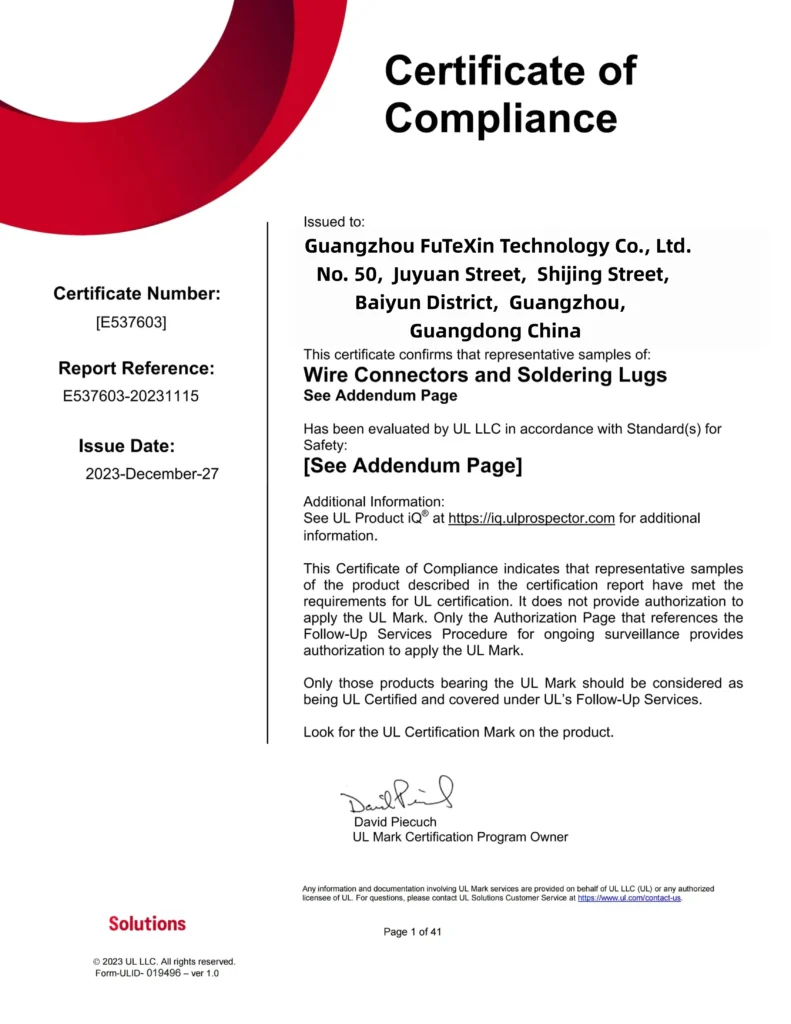
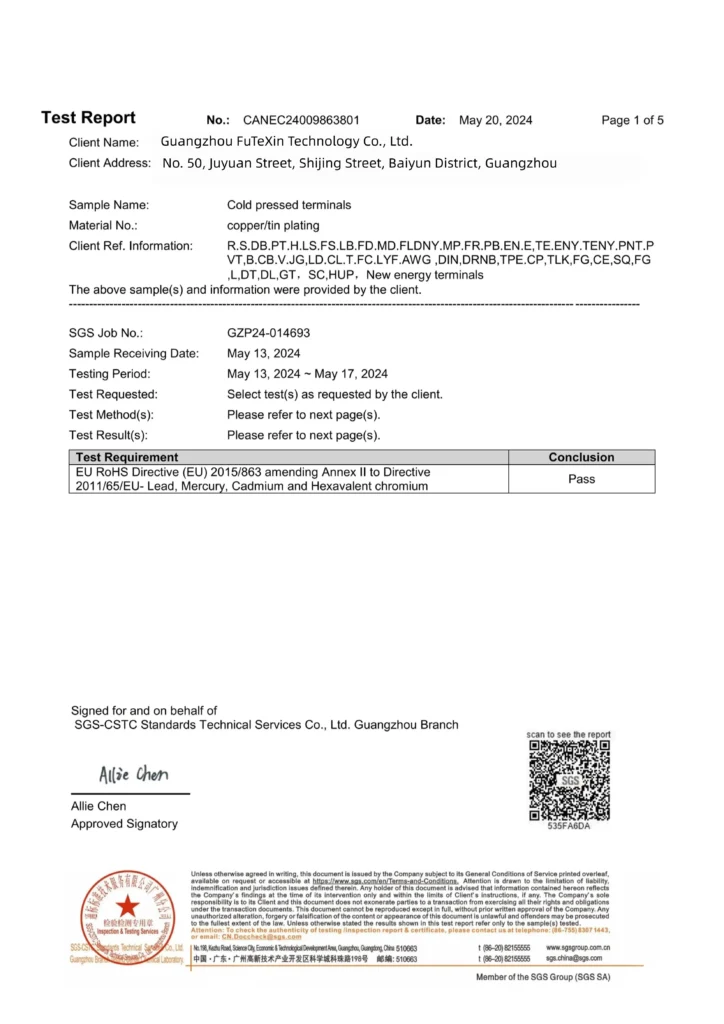
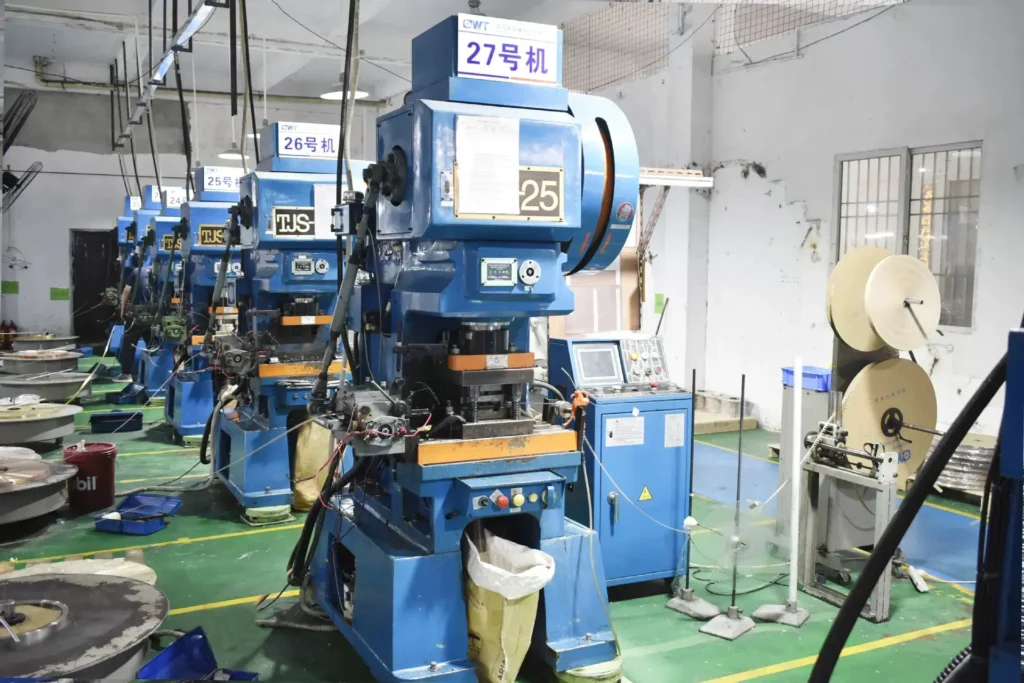

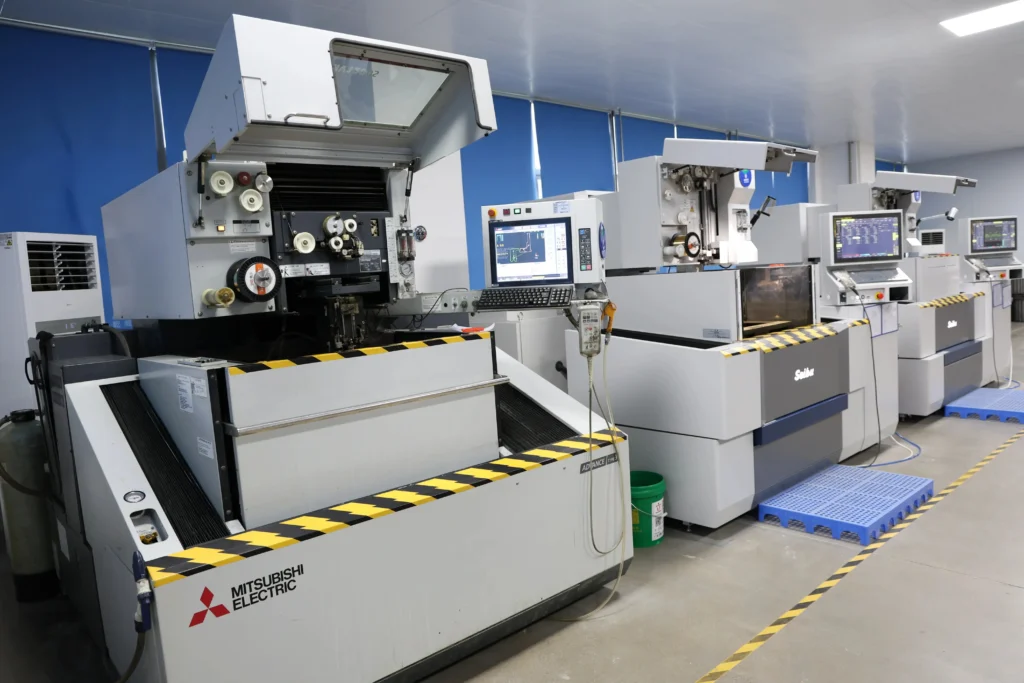
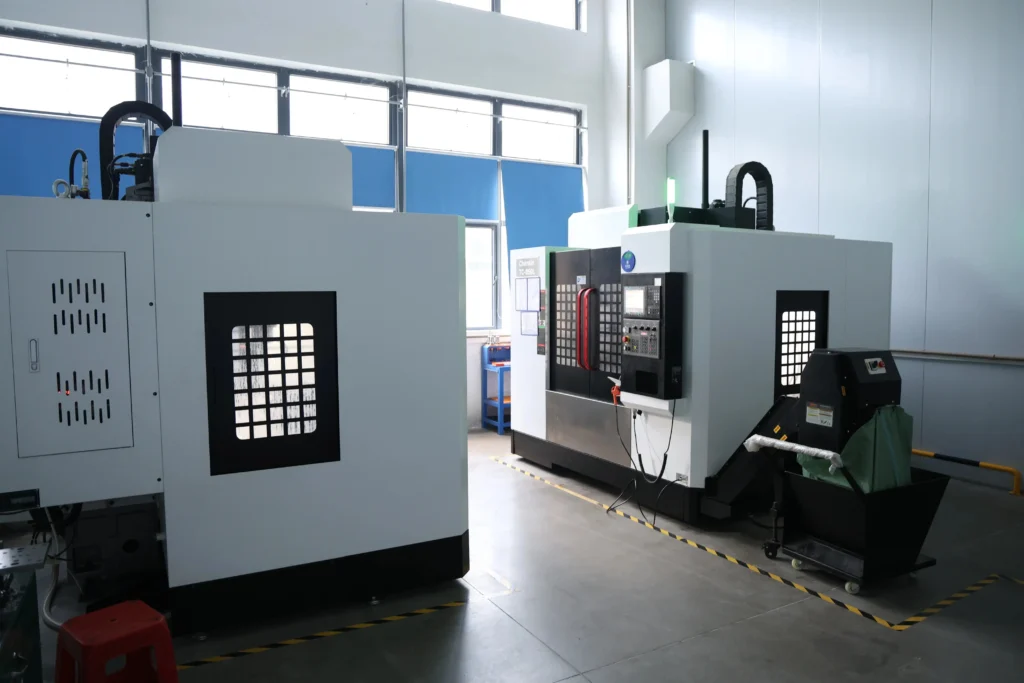
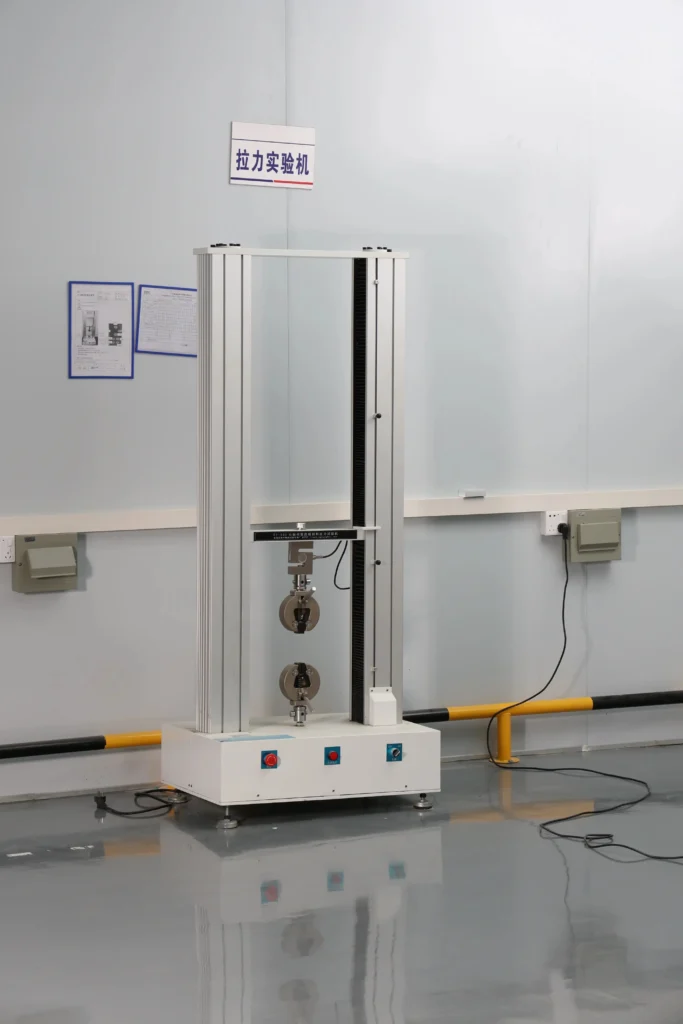
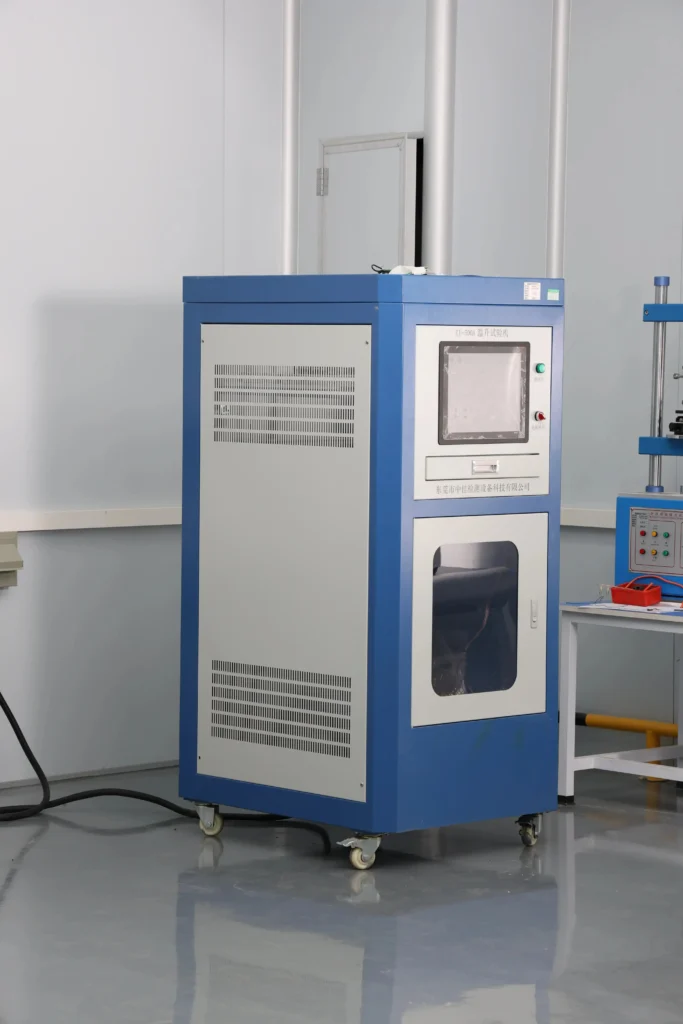
Other standards, test methods and makers named on this page are cited for reference, not as VoltixC certifications.
The price of a two-hole compression lug order moves with the metal, the size mix, and how far each part departs from the listed rows. In each row, the middle column says what the driver does to cost and the right column says which part of it is yours to set.
| Driver | Effect on cost | What you control |
|---|---|---|
| Body metal | Copper and aluminum bodies are priced as different parts | Match the series to the conductor metal; do not upgrade by default |
| Conductor size | A larger barrel and palm use more metal per piece | Send the exact AWG or kcmil per line, not a range |
| Palm angle | Each angle has its own catalog number, so 0°, 45° and 90° versions are quoted as separate lines | Order angled palms only for the runs that need them |
| Hole spacing, bolt size and palm width | A spacing or bolt size outside the listed part numbers may need new tooling | Pick a listed G and bolt size, or send the bus or pad drawing |
| Surface finish | Tin plating adds a finishing step over bare metal | State bare or tin-plated per line |
| Quantity per size | Setup is spread over more pieces when one size runs in volume | Group repeat sizes into one line where you can |
| Mixed-size kits | Retail kits mix sizes in one box; a trade order prices each size as its own line | List each size and quantity rather than a kit |
| Packing and labels | Per-size bags, labels or private marking add handling | Say how each size should be packed and marked |
| Samples and drawing sign-off | A sample checks fit before volume is made | Ask for samples on the sizes you have not used before |
The fastest sample turnaround is 7 days. 3M’s data sheet says lugs must be crimped with an approved die set using the engineering data supplied with the lugs, and other tool and die combinations need the tool maker’s input. MOQ, payment terms and lead time are confirmed per order by email or the enquiry form, and none of them is printed on this page.
Two habits keep a quote short. First, list sizes in the same unit as the tables here (AWG up to 4/0, kcmil above it), because a size written in mm² has to be converted before a row can be matched. Second, give one line per size and angle; a line such as “4/0, all angles” becomes three parts on the quotation.
Parts outside the listed rows are made to your drawing. When a pad needs a palm width, hole pattern or barrel length that the data does not hold, the drawing becomes the specification, and VoltixC can open dedicated tooling for volume work; whether a size justifies new tooling is confirmed per order.
Before you fill in the enquiry, these four pages answer the sizing and route questions that come up on two-hole parts; the wider range of copper cable lugs sits one level up.
Filter the listed VoltixC lugs by conductor size, hole count and body metal in the cable lug size chart, then copy the matching rows into your enquiry.
Weigh crimped barrels against screw-clamp bodies for your tooling and conductor in compression vs mechanical lugs.
Read barrel, palm and hole dimensions on a drawing with the cable lug dimensions guide.
Place two-hole compression lugs among the other forms in the guide to choosing cable lugs.
Use a two-hole compression lug when the bus bar or equipment pad is drilled for two bolts and the joint must not turn under cable load. Two bolts leave the palm with no single point to turn around. If the terminal has a single stud, a one-hole compression lug is the matching part.
The copper series lists hole spacings from 0.50 in to 1.75 in and the aluminum series 1.00 in and 1.75 in, per supplier specification sheet. On the copper sheet, 3/8 in bolts mostly sit at 1.00 in and 1/2 in bolts at 1.75 in. According to 3M, the NEMA center-to-center spacing for two-hole lugs is 1.75 in (44.5 mm).
Do not assume so. The supplier listing codes the two series in different barrel colors at the same size: 4/0 AWG is purple in copper and white in aluminum, and 250 kcmil is yellow in copper and red in aluminum. According to the ILSCO installation guide, installers should use the die the connector maker specifies.
Yes. The copper series lists 179 part numbers at 4/0 AWG, at 0°, 45° and 90° with bolt sizes from 1/4 to 1/2 in; DB401243 is the straight part with a 1/2 in bolt and a 1.75 in hole spacing. The aluminum series lists 5 at 4/0 AWG, among them AL401243 with the same bolt and spacing.
Yes; MCM and kcmil are the same unit. The copper series lists 93 part numbers at 500 kcmil across 0°, 45° and 90°, among them DB511243 (1/2 in bolt, 1.75 in spacing), and the aluminum series lists 5, among them AL511243.
The specification sheet does not name a NEMA pattern, so this page does not claim one. It does list 1/2 in bolts at a 1.75 in hole spacing in every copper gauge from 8 AWG to 1000 kcmil and in every aluminum gauge; according to 3M, 1.75 in (44.5 mm) is the NEMA center-to-center spacing. Put the NEMA requirement on your drawing so the part can be checked against it.
Barrel length is not a named column on the specification sheet. Send the barrel length or the number of crimps your specification calls for, and the long-barrel requirement is checked against your drawing and confirmed per order.
In copper, the range runs from 14-10 AWG to 1000 kcmil, 2,250 part numbers in all; LB141458 and DB111243 are the straight parts at the two ends of the table. In aluminum, it runs from 2 AWG (AL021243-62) to 750 kcmil (AL751243), 56 part numbers in all.
The color points to the crimp die. According to ILSCO’s copper compression chart, #8 AWG copper wire takes a red code, #6 AWG a blue one and 250 kcmil a yellow one, and the supplier listing codes the copper lugs at those three sizes red, blue and yellow. The color is a cross-check, not a replacement for the die chart of the tool you use.
Yes. Every copper gauge on the sheet is listed at 45° and 90°, and every gauge except 350 kcmil at 0° as well. The table shows one angle per gauge; in the catalog numbers, an F suffix marks 45° and an A suffix marks 90°.
No. The tables show values per supplier specification sheet; the parts are not individually re-tested, and fields the sheet does not give are confirmed per order. Check the row against your cable, bus drawing and die chart before approval.
Send one line per size and angle, and the quote comes back against the same lines.
The enquiry form takes your name, company, email, country, product line, conductor size, quantity and a message. It has no upload field, so send drawings or photos of the existing lug by email to hugo@voltixconnect.com.
Ask a VoltixC Engineer