VOLTIXC / ENQUIRY
Request a Quote
Tell us what you need and we will review your enquiry.

ENY nylon-insulated cord-end ferrules and EN non-insulated wire ferrules for stranded conductors in screw and spring-clamp terminals
Fast answer: Wire ferrules are metal sleeves crimped over the stripped end of a stranded wire, so the strands enter a screw or spring clamp as one bundle. VoltixC lists 72 ENY nylon-insulated cord-end ferrules and 146 EN non-insulated wire ferrules, from 26 AWG (0.25 mm²) to 800/1000 kcmil (see the table note). Pick by wire size, then request a quote.
The insulated ENY range stops at 150 mm², the 250/300 size, while the bare EN range adds five larger sleeves up to 500 mm²; every row on the two sheets gives the cross-section in mm² and a sleeve length.
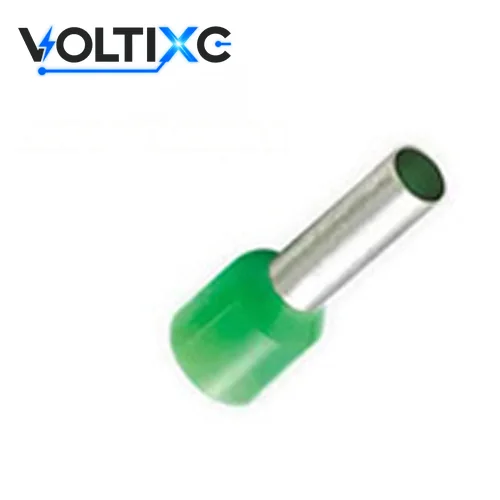
Wire ferrules are thin metal tubes crimped onto the stripped end of a stranded conductor, so the strands stay bundled when a terminal screw or spring clamps down on them. According to TE Connectivity, a crimp ferrule is a soft metal tube crimped onto the end of a stripped wire to protect the strands from fraying. Bootlace ferrules, crimp ferrules and ferrule connectors are other catalogue names for it, and the name used below is “wire ferrules”.
A bare stranded end is the weak point of a clamp joint. According to Electrical Engineering Portal, overtightening a flexible copper conductor can shear strands, and an incorrect cross-section lets the strands spread and make poor contact. Hubbell/Burndy describes the ferrule’s job as terminating stranded wire so that each strand carries current once the sleeve is properly crimped. A strand that bends back outside the clamp carries nothing and leaves less copper under the screw.
How a ferrule joint is built:
The stripped strands slide into the sleeve. On an ENY ferrule, the nylon collar’s funnel end guides them in and covers the cut edge of the wire insulation.
A ferrule die compresses the metal sleeve around the strands, and the collar stays uncompressed. According to TE Connectivity, the ferrule flare gathers the strands, while the conical plastic entry sleeve bridges from insulation to ferrule and is not pressed during installation.
The crimped sleeve goes into the terminal, so the screw or spring bears on metal rather than on loose strands. According to Electrical Engineering Portal, crimping ferrules avoids the strand shearing and dispersion risks found with direct screw terminals.
Two families of documents define this product type. According to Phoenix Contact, its non-insulated ferrules conform to DIN 46228-1 and UL 486F-A, and its insulated ferrules to DIN 46228-4 and UL 486F-E. The UL 486E scope also covers equipment wiring terminals used with conductors prepared with UL 486F ferrules, when their ratings and instructions are followed. This page makes no conformity claim for ENY or EN parts under DIN 46228 or UL 486F; the documents are named so the terms on your drawing and on the quotation match.
VoltixC lists 218 wire ferrules on two supplier specification sheets: 72 ENY nylon-insulated cord-end ferrules and 146 EN non-insulated wire ferrules. ENY covers 0.25 to 150 mm² (26 AWG to 250/300 kcmil, see the table note), and EN carries on to 500 mm². Each row below is one wire size at one sleeve length, with dimensions in mm as printed on the sheet.
The ENY series puts a nylon collar behind a tin-plated copper sleeve. Its sheet lists 72 part numbers in 18 sizes, with the metal pin length F running from 5 to 38 mm and the pack quantity falling from 1,000 per box at the small sizes to 50 at 120 and 150 mm². The table shows each size at its shortest pin, plus the longest pin where a size has several.
| Part No. | AWG | mm² | Pin length F (mm) | Overall L (mm) | W (mm) | Color | Pack qty (per box) |
|---|---|---|---|---|---|---|---|
| ENY0206 | 26 AWG | 0.25 | 6 | 10.4 | 1.9 | Multiple colours | 1,000 |
| ENY0306 | 24 AWG | 0.34 | 6 | 10.4 | 1.9 | Multiple colours | 1,000 |
| ENY0505 | 22 AWG | 0.5 | 5 | 11 | 2.6 | Multiple colours | 1,000 |
| ENY0512 | 22 AWG | 0.5 | 12 | 18 | 2.6 | Multiple colours | 1,000 |
| ENY7506 | 20 AWG | 0.75 | 6 | 12 | 2.8 | Multiple colours | 1,000 |
| ENY7518 | 20 AWG | 0.75 | 18 | 24.3 | 2.8 | Multiple colours | 1,000 |
| ENY1006 | 18 AWG | 1 | 6 | 12 | 3 | Multiple colours | 1,000 |
| ENY1018 | 18 AWG | 1 | 18 | 24.3 | 3 | Multiple colours | 1,000 |
| Part No. | AWG | mm² | Pin length F (mm) | Overall L (mm) | W (mm) | Color | Pack qty (per box) |
|---|---|---|---|---|---|---|---|
| ENY1506 | 16 AWG | 1.5 | 6 | 12.3 | 3.5 | Multiple colours | 1,000 |
| ENY1518 | 16 AWG | 1.5 | 18 | 24 | 3.5 | Multiple colours | 1,000 |
| ENY2508 | 14 AWG | 2.5 | 8 | 15 | 4.2 | Multiple colours | 1,000 |
| ENY2525 | 14 AWG | 2.5 | 25 | 32.4 | 4.2 | Multiple colours | 1,000 |
| ENY4010 | 12 AWG | 4 | 10 | 17.4 | 4.8 | Multiple colours | 1,000 |
| ENY4018 | 12 AWG | 4 | 18 | 25.4 | 4.8 | Multiple colours | 1,000 |
| ENY6010 | 10 AWG | 6 | 10 | 18.5 | 6.3 | Multiple colours | 1,000 |
| ENY6018 | 10 AWG | 6 | 18 | 26.5 | 6.3 | Multiple colours | 1,000 |
| ENY10-12 | 8 AWG | 10 | 12 | 20.8 | 7.6 | Multiple colours | 1,000 |
| ENY10-18 | 8 AWG | 10 | 18 | 26.8 | 7.6 | Multiple colours | 1,000 |
| ENY16-12 | 6 AWG | 16 | 12 | 22 | 8.8 | Multiple colours | 500 |
| ENY25-12 | 4 AWG | 25 | 12 | 24 | 11.2 | Multiple colours | 250 |
| ENY25-25 | 4 AWG | 25 | 25 | 37 | 11.2 | Multiple colours | 250 |
| ENY35-22 | 2 AWG | 35 | 22 | 36 | 12.7 | Multiple colours | 250 |
| ENY50-12 | 1/0 AWG | 50 | 12 | 28 | 15 | Multiple colours | 250 |
| ENY50-30 | 1/0 AWG | 50 | 30 | 46 | 15 | Multiple colours | 250 |
| ENY70-20 | 2/0 AWG | 70 | 20 | 37 | 16 | Multiple colours | 100 |
| ENY95-25 | 3/0 AWG | 95 | 25 | 44 | 18.5 | Multiple colours | 100 |
| ENY120-27 | 4/0 AWG | 120 | 27 | 47.6 | 20.3 | Multiple colours | 50 |
| ENY120-34 | 4/0 AWG | 120 | 34 | 54.6 | 20.3 | Multiple colours | 50 |
| ENY150-25 | 250/300 kcmil* | 150 | 25 | 50.6 | 23.4 | Multiple colours | 50 |
| ENY150-38 | 250/300 kcmil* | 150 | 38 | 63.6 | 23.4 | Multiple colours | 50 |
Source: per supplier specification sheet (ENY drawing, dimensions in mm); values as printed, not individually re-tested.
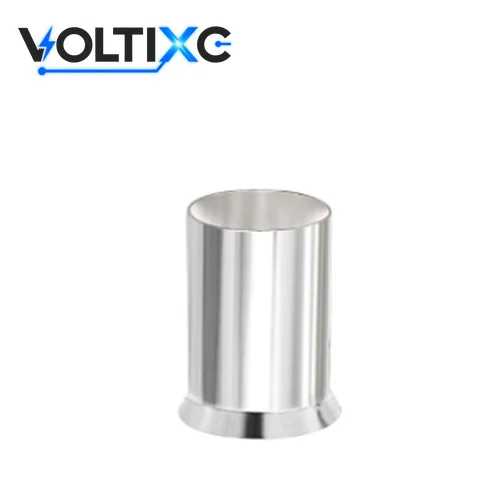
The EN series is the bare tin-plated copper sleeve without a collar. Its sheet lists 146 part numbers in 23 sizes, with the sleeve length L running from 5 to 60 mm, and the five sizes above 150 mm² exist only in EN. From 0.25 to 0.75 mm² the EN sheet prints a different AWG number from the ENY sheet for the same cross-section (24 AWG against 26 AWG at 0.25 mm², for example), so order these sizes by mm².
| Part No. | AWG | mm² | L (mm) | W (mm) | Barrel ID (mm) | Barrel OD (mm) |
|---|---|---|---|---|---|---|
| EN0205 | 24 AWG | 0.25 | 5 | 1.7 | 0.8 | 1.1 |
| EN0305 | 22 AWG | 0.34 | 5 | 1.8 | 0.9 | 1.2 |
| EN0505 | 20 AWG | 0.5 | 5 | 2.1 | 1 | 1.3 |
| EN7505 | 18 AWG | 0.75 | 5 | 2.3 | 1.2 | 1.5 |
| EN7520 | 18 AWG | 0.75 | 20 | 2.3 | 1.2 | 1.5 |
| EN1006 | 18 AWG | 1 | 6 | 2.5 | 1.4 | 1.7 |
| EN1025 | 18 AWG | 1 | 25 | 2.5 | 1.4 | 1.7 |
| EN1506 | 16 AWG | 1.5 | 6 | 2.8 | 1.7 | 2 |
| Part No. | AWG | mm² | L (mm) | W (mm) | Barrel ID (mm) | Barrel OD (mm) |
|---|---|---|---|---|---|---|
| EN2506 | 14 AWG | 2.5 | 6 | 3.4 | 2.3 | 2.6 |
| EN2530 | 14 AWG | 2.5 | 30 | 3.4 | 2.3 | 2.6 |
| EN4007 | 12 AWG | 4 | 7 | 4 | 2.8 | 3.2 |
| EN6006 | 10 AWG | 6 | 6 | 4.7 | 3.5 | 3.9 |
| EN10-6 | 8 AWG | 10 | 6 | 5.8 | 4.5 | 4.9 |
| EN10-25 | 8 AWG | 10 | 25 | 5.8 | 4.5 | 4.9 |
| EN16-6 | 6 AWG | 16 | 6 | 7.6 | 5.8 | 6.2 |
| EN16-32 | 6 AWG | 16 | 32 | 7.6 | 5.8 | 6.2 |
| EN25-6 | 4 AWG | 25 | 6 | 9.3 | 7.3 | 7.7 |
| EN25-50 | 4 AWG | 25 | 50 | 9.3 | 7.3 | 7.7 |
| EN35-12 | 2 AWG | 35 | 12 | 10.8 | 8.3 | 8.7 |
| EN35-32 | 2 AWG | 35 | 32 | 10.8 | 8.3 | 8.7 |
| EN50-12 | 1/0 AWG | 50 | 12 | 12.8 | 10.3 | 10.9 |
| EN70-22 | 2/0 AWG | 70 | 22 | 15.8 | 13.5 | 14.2 |
| EN95-25 | 3/0 AWG | 95 | 25 | 17.3 | 14.8 | 15.6 |
| EN120-30 | 4/0 AWG | 120 | 30 | 20.2 | 16.7 | 17.7 |
| EN150-32 | 250/300 kcmil* | 150 | 32 | 23 | 19.6 | 20.6 |
| EN185-25 | 300/350 kcmil* | 185 | 25 | 23.9 | 20.2 | 21.4 |
| EN240-32 | 400 kcmil* | 240 | 32 | 26.5 | 23 | 24.2 |
| EN325-34 | 500/600 kcmil* | 325 | 34 | 28 | 25.5 | 26.7 |
| EN400 | 600/750 kcmil* | 400 | 40 | 32 | 29.2 | 30.6 |
| EN500 | 800/1000 kcmil* | 500 | 40 | 36 | 33.2 | 34.6 |
Source: per supplier specification sheet (EN drawing, dimensions in mm); values as printed, not individually re-tested.
* Data note: both sheets print every size in an AWG column, and from 250/300 upward those figures read as kcmil (thousand circular mils, marked MCM on the sheet); what a slash pair such as 250/300 means is confirmed per order. The two tables show 60 rows; 218 part numbers are in the full specification table, so request the complete list with your quote.
Catalogs and buyers use several names for the same sleeve, and the table matches each one to the rows above.
| Name you may search | Where it lands on this page |
|---|---|
| Wire ferrules, bootlace ferrules, cord-end ferrules, crimp ferrules | ENY (insulated) and EN (bare) sleeves |
| Ferrule terminal, ferrule crimp terminal, cord end terminal | The same sleeve; the terminal it goes into supplies the clamp |
| Ferrule connectors, ferrule crimp connectors, ferrule electrical connector | The same sleeve, named as a connector |
| Wire termination ferrules, terminal block wire ferrules | The same sleeve, named by the job it does |
| Insulated wire ferrules | ENY series |
| Non-insulated wire ferrules | EN series |
| Wire terminal E2508 | Closest listed parts by the digits: ENY2508 and EN2508 (2.5 mm², 8 mm); check the other maker’s drawing against the row |
Both supplier sheets give a copper sleeve with tin plating, and the ENY collar is nylon: it insulates the strand entry, while EN is an uninsulated bare sleeve. Neither sheet states a copper grade or a plating thickness.
| Part | ENY | EN | Where the value comes from |
|---|---|---|---|
| Sleeve metal | Copper | Copper | Supplier specification sheet; 99% purity for ENY per the supplier series description |
| Sleeve finish | Tin plating | Tin plating | Supplier specification sheet; bare copper per customer requirement |
| Collar | Nylon on all 72 part numbers | No collar | Supplier specification sheet |
| Collar color | Multiple colours | No collar | Supplier specification sheet; set per customer requirement |
| Sleeve dimensions | Pin length F, overall length L and W, in mm | Length L, W, barrel ID and barrel OD, in mm | Model tables above |
Other makers publish the same basic build. According to TE Connectivity, most ferrules are copper, typically tin-plated, and each sleeve’s diameter and length follow the wire gauge. As one maker’s example, Hubbell/Burndy specifies electrolytic copper, tin plating and a smooth funnel entry for its YF-I insulated ferrules. Those figures describe other makers’ parts; this page states no copper grade or plating thickness for ENY or EN.
The collar is a guide and a cover, not a load path. It sits behind the sleeve, steers the strands in and stays uncompressed during crimping, so the collar material does not change which AWG row you pick.
Start with the conductor cross-section in mm² or the AWG printed on the jacket, find that row below, and then pick a sleeve length that suits the terminal’s clamp. The table lists every length on the two supplier sheets.
| mm² | AWG on the ENY sheet | AWG on the EN sheet | ENY pin lengths F (mm) | EN lengths L (mm) |
|---|---|---|---|---|
| 0.25 | 26 AWG | 24 AWG | 6, 8 | 5, 6, 7, 8, 15, 25 |
| 0.34 | 24 AWG | 22 AWG | 6, 8 | 5, 6, 7, 8, 10 |
| 0.5 | 22 AWG | 20 AWG | 5, 6, 8, 10, 12 | 5, 6, 8, 10, 12 |
| 0.75 | 20 AWG | 18 AWG | 6, 8, 10, 12, 18 | 5, 6, 7, 8, 10, 12, 15, 20 |
| 1 | 18 AWG | 18 AWG | 6, 8, 10, 12, 18 | 6, 7, 8, 10, 12, 15, 18, 20, 25 |
| 1.5 | 16 AWG | 16 AWG | 6, 8, 10, 12, 15, 18 | 6, 7, 8, 10, 12, 15, 18, 20 |
| 2.5 | 14 AWG | 14 AWG | 8, 10, 12, 18, 25 | 6, 7, 8, 10, 12, 15, 18, 20, 25, 30 |
| 4 | 12 AWG | 12 AWG | 10, 12, 18 | 7, 9, 10, 12, 15, 18, 20, 30 |
| 6 | 10 AWG | 10 AWG | 10, 12, 18 | 6, 10, 12, 15, 18, 20, 25 |
| 10 | 8 AWG | 8 AWG | 12, 15, 18 | 6, 8, 12, 15, 16, 18, 20, 22, 25 |
| 16 | 6 AWG | 6 AWG | 12, 18 | 6, 8, 12, 15, 16, 18, 20, 22, 25, 30, 32 |
| 25 | 4 AWG | 4 AWG | 12, 15, 16, 18, 22, 25 | 6, 8, 12, 13, 15, 16, 18, 20, 22, 25, 30, 32, 50 |
| 35 | 2 AWG | 2 AWG | 22, 25 | 12, 15, 16, 18, 20, 22, 25, 30, 32 |
| 50 | 1/0 AWG | 1/0 AWG | 12, 16, 20, 22, 25, 30 | 12, 18, 20, 22, 25, 30, 32, 50 |
| 70 | 2/0 AWG | 2/0 AWG | 20, 25, 27 | 22, 25, 30, 32 |
| 95 | 3/0 AWG | 3/0 AWG | 25, 30 | 25, 30, 32, 34 |
| 120 | 4/0 AWG | 4/0 AWG | 27, 30, 32, 34 | 30, 32, 34, 38, 40, 50 |
| 150 | 250/300 kcmil | 250/300 kcmil | 25, 27, 32, 38 | 32, 34, 35, 38, 40, 60 |
| 185 | Not in ENY | 300/350 kcmil | Not in ENY | 25, 32, 40 |
| 240 | Not in ENY | 400 kcmil | Not in ENY | 32, 34, 40 |
| 325 | Not in ENY | 500/600 kcmil | Not in ENY | 34, 40 |
| 400 | Not in ENY | 600/750 kcmil | Not in ENY | 40 |
| 500 | Not in ENY | 800/1000 kcmil | Not in ENY | 40 |
Insulated wire ferrules (ENY) suit terminals where the collar helps: it guides the strands in and covers the stripped edge next to neighboring clamps. EN suits terminals whose housing already covers the joint, and it is the only option above 150 mm², the 250/300 size.
Beyond the size row, each ferrule line needs these answers:
A collar color identifies a wire size only inside one maker’s color system, so match ENY ferrules by the size code, not by the color. TE Connectivity describes color coding by wire size as the norm for ferrules. The listings below show how far those systems differ.
| Maker listing | Wire size | Collar color shown |
|---|---|---|
| TE Connectivity featured ferrule | 20 AWG (0.5–0.6 mm²) | Orange |
| Hubbell/Burndy YF2012ID | 20 AWG | Gray |
| TE Connectivity featured ferrule | 16–15 AWG (1.25–1.5 mm²) | Red |
| TE Connectivity featured ferrule | 8 AWG (10 mm²) | Red |
Two 20 AWG ferrules from two makers carry different colors, and one maker’s listings show red on two different sizes. These are product examples, not a universal mapping between DIN and US color codes.
The ENY sheet lists no collar colors other than multiple colours. Colors on an ENY order follow your requirement and are confirmed per order, so put your panel’s color scheme next to the AWG list in the enquiry. EN sleeves have no collar and carry no color code.
Wire ferrules suit one stranded wire entering a screw or spring clamp; when the connection is a stud, a tab or a second wire, a different terminal does the job. Ferrule connectors have no tongue, ring or tab of their own, so they only work where the terminal supplies the clamp.
| Joint on your drawing | Better choice | Switch from ferrules when |
|---|---|---|
| Stranded wire into the screw or spring clamp of an industrial control component | Wire ferrules (this page) | Keep ferrules |
| Wire onto a stud or a bolt | Ring terminals | The terminal has a stud and nut, not a clamp opening |
| Wire under a screw head that stays in place | Spade (fork) terminals | The fork has to slide under a loosened screw |
| Wire onto a flat blade tab | Quick disconnects | The device has a male tab |
| Lead that has to be unplugged later | Bullet connectors | The joint must come apart by hand |
| Wire joined to wire | Butt splices | There is no terminal, only a splice |
| Wire-to-wire joint in a damp spot | Solder seal wire connectors or heat shrink butt connectors | The splice needs a sealed sleeve |
| Tinned strands straight into the clamp | Not recommended | See the note below |
| Two wires into one clamp | Twin ferrules, not listed on this page | See the note below |
| OEM automotive wire harness terminal | Not in this range | Ask before you specify |
Tinning the strands is not a substitute for a sleeve. According to Electrical Engineering Portal, flexible conductors should not be tinned before connection because tin may cause fretting corrosion, and cable ends, sleeves or lugs are preferable where operating conditions are difficult.
Twin ferrules let two stranded conductors share one termination, according to Hubbell/Burndy. The ENY and EN series do not include a twin version, so this page cannot supply one. Where two wires must reach the same point, ask the terminal maker whether its clamp accepts two single ferrules.
Signals that you are on the wrong page:
Wire ferrules belong wherever flexible stranded wire meets a clamp-type terminal: control cabinets, machine wiring and larger power clamps. The cards come from how the sleeve is built and from the sources cited; VoltixC publishes no named installations for this range.
Conditions: fine-stranded 24 AWG to 10 AWG leads into screw clamps; ENY parts from 0.34 to 6 mm², or EN parts of the matching mm², cover those sizes.
Watch: overtightening a bare flexible conductor can shear strands, which is the failure a crimped sleeve prevents. In a tight row of clamps, the insulated collar also shows where each wire ends.
Requirement: size each ferrule to the AWG printed on the jacket, one per wire.
Conditions: the stranded wire is pushed into a spring clamp, and loose strands would fold back as it goes in. According to TE Connectivity, its DIN wire ferrules cover flexible leads from 0.14 to 50.0 mm² and are used with screw or spring clamps.
Watch: match the sleeve length to the clamp depth. The ENY and EN sheets give a length for every part number.
Conditions: a box clamp or mechanical connector takes flexible conductors from 1/0 AWG up to 800/1000 kcmil (see the table note), and EN sleeves from 50 to 500 mm² cover them.
Watch: past the 250/300 size there is only EN, and whether a sleeve is allowed at that size is up to the clamp maker’s instructions. According to Phoenix Contact, its non-insulated ferrules cover 0.14 to 120 mm², which shows how far one maker’s range goes.
VoltixC is UL certified, holds a CE attestation under the Low Voltage Directive 2014/35/EU (EN 60947-7-1, EN 60947-7-2 and EN 60947-7-3) that covers the full terminal range, and has a RoHS test report available (SGS). Certificate numbers and dates are not printed on this page; the images below show the documents as held.
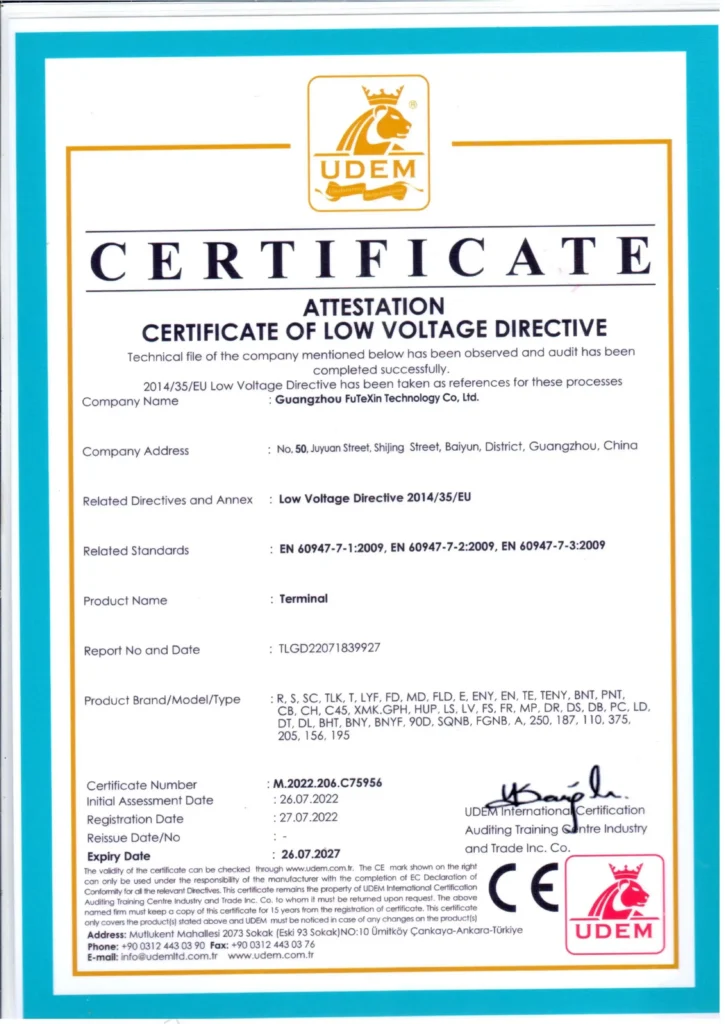
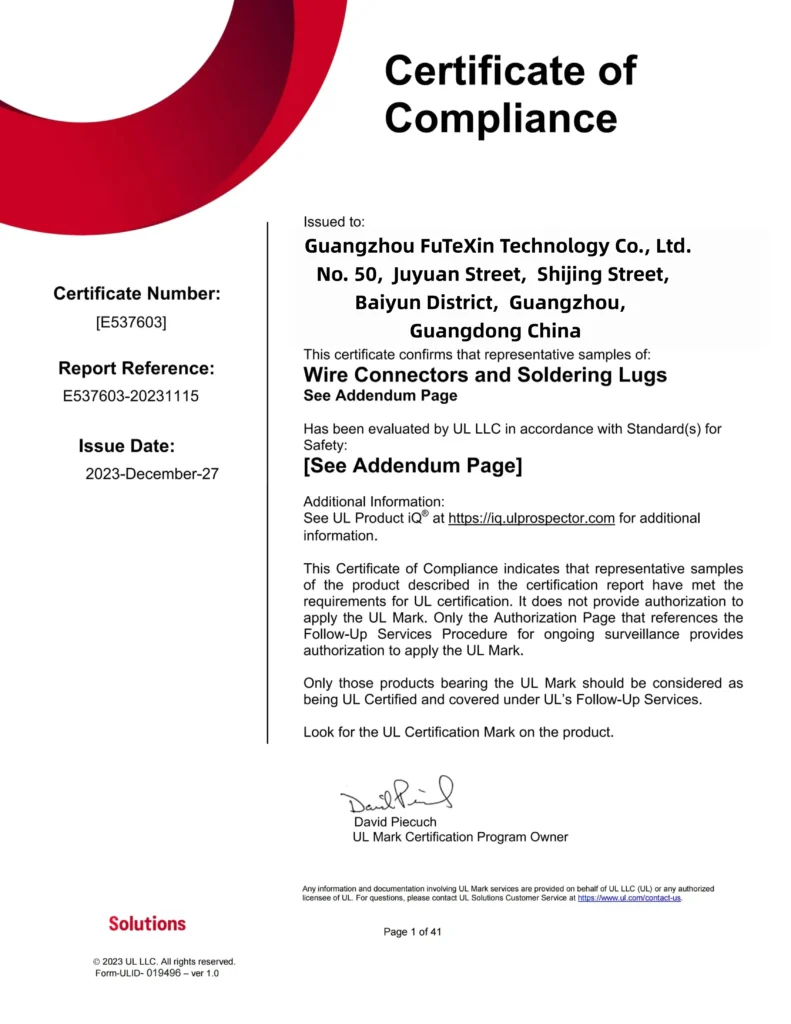
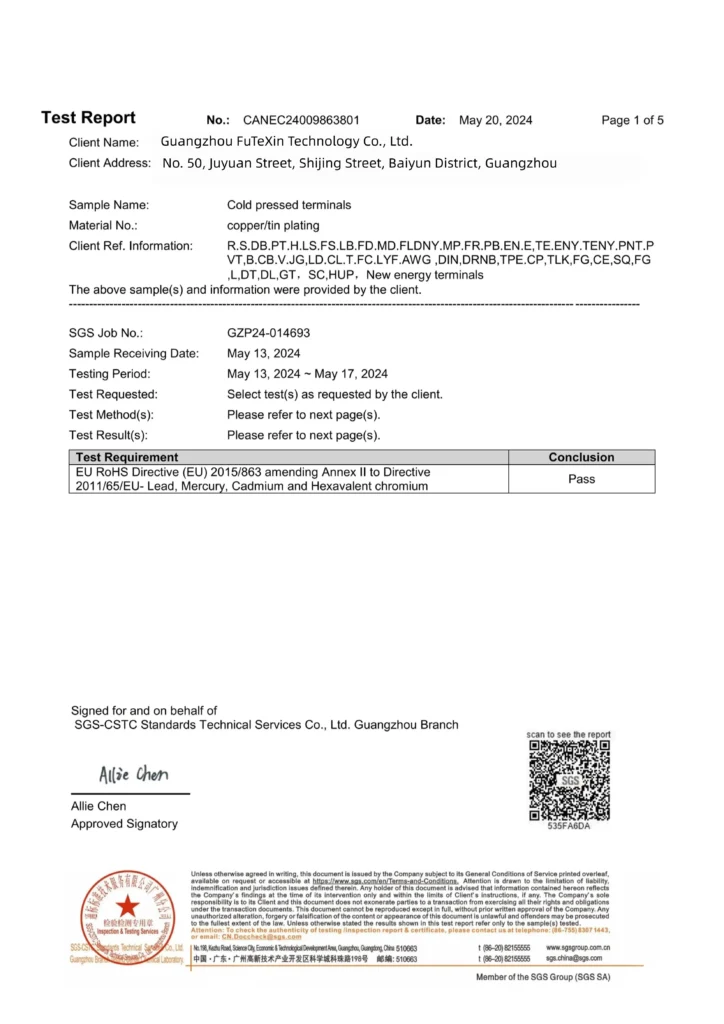
All three documents name Guangzhou FuTeXin Technology Co., Ltd., the company behind the VoltixC brand. UL Solutions lists ferrules among the connector types its certification services cover. That describes a service category and says nothing about a particular part, so a ferrule quotation should name the document and the item numbers it relates to.
Checks to settle before a ferrule order:
| Check | What the answer settles |
|---|---|
| Which ENY or EN items the UL certificate’s addendum page lists | Whether the UL document relates to your parts or to another product line |
| Which document the sleeve dimensions follow: DIN 46228-1, DIN 46228-4 or UL 486F | Whether your terminal maker’s instructions for ferruled wire apply |
| Pin length F or length L for each item against your clamp | Clamp fit; the sheet gives the length, the terminal maker gives the strip length |
| Copper grade and plating thickness for your order | Whether the sleeve matches the material line on your specification; the sheets name copper and tin only |
| Whether the SGS test report covers your RoHS requirement for the sleeve and the nylon collar | The report tests four substances on tin-plated copper terminals |
Equipment in the VoltixC workshop, shown as photographed:
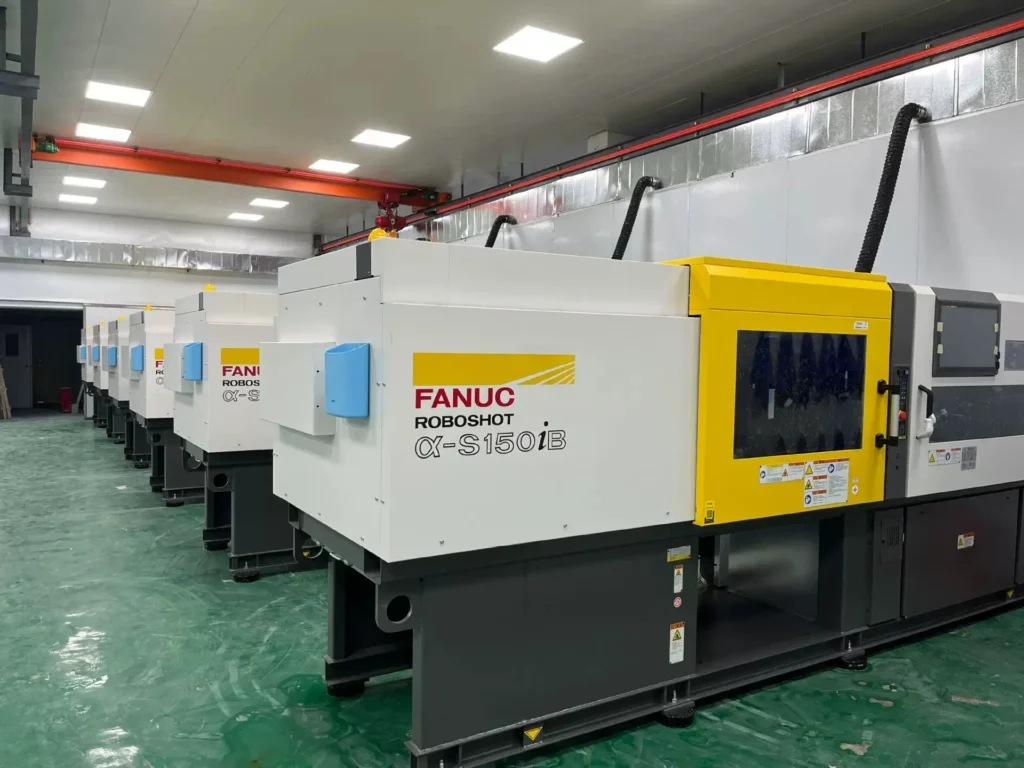
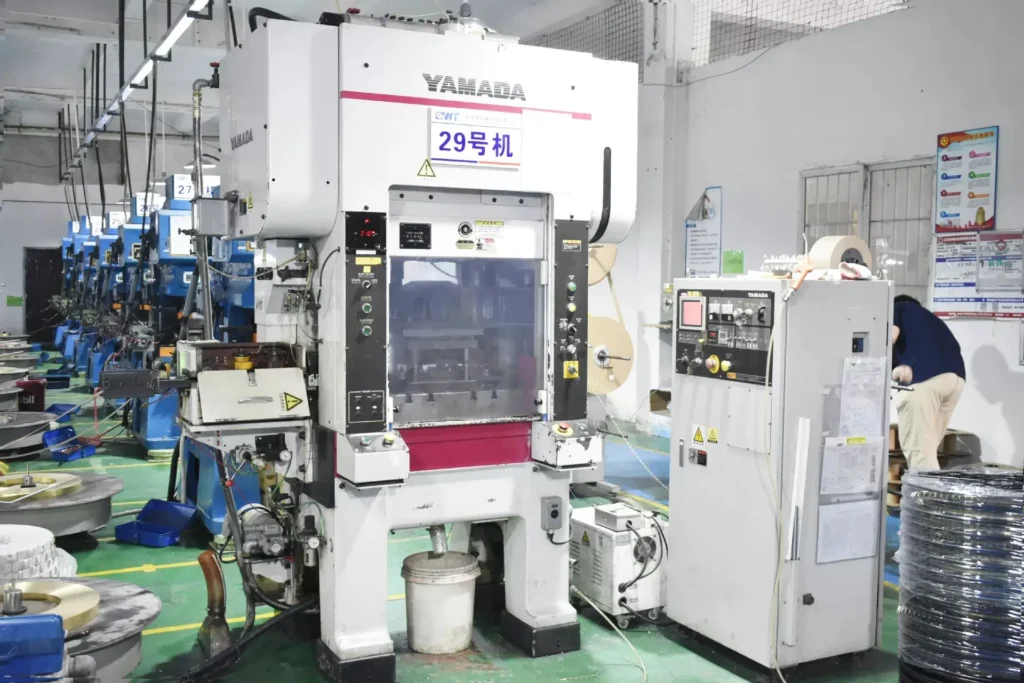
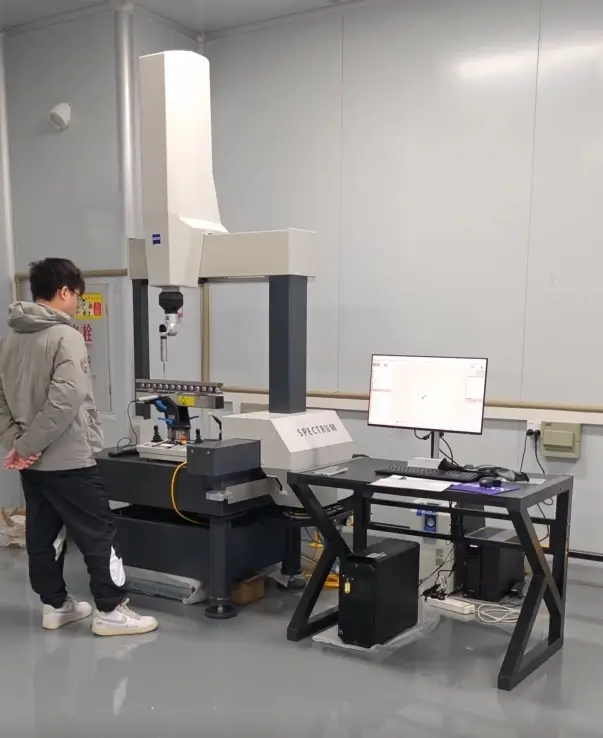
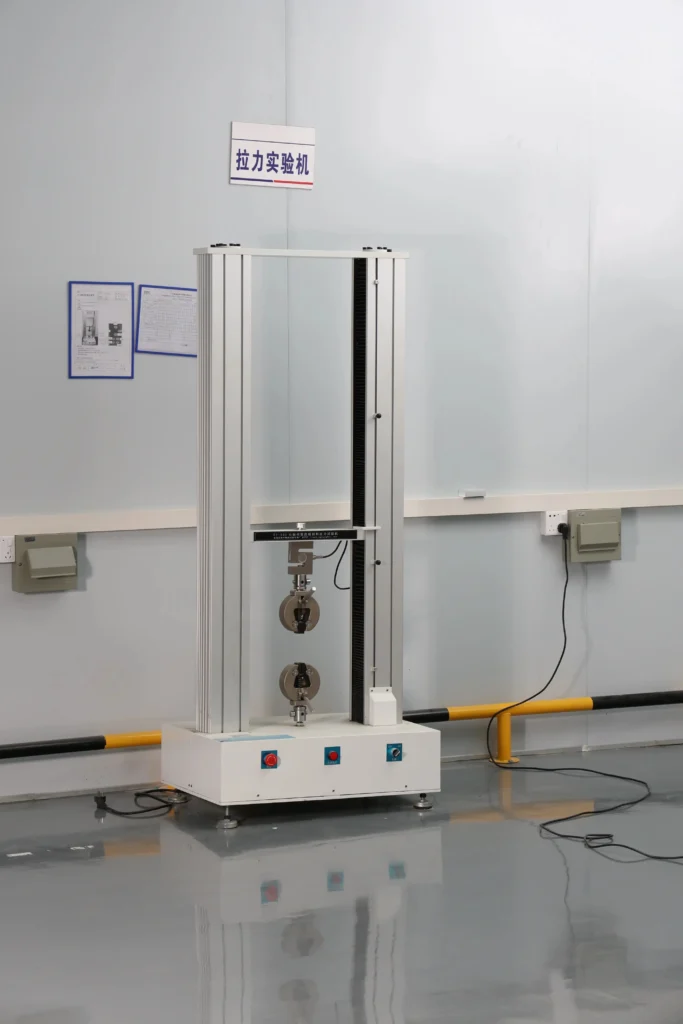
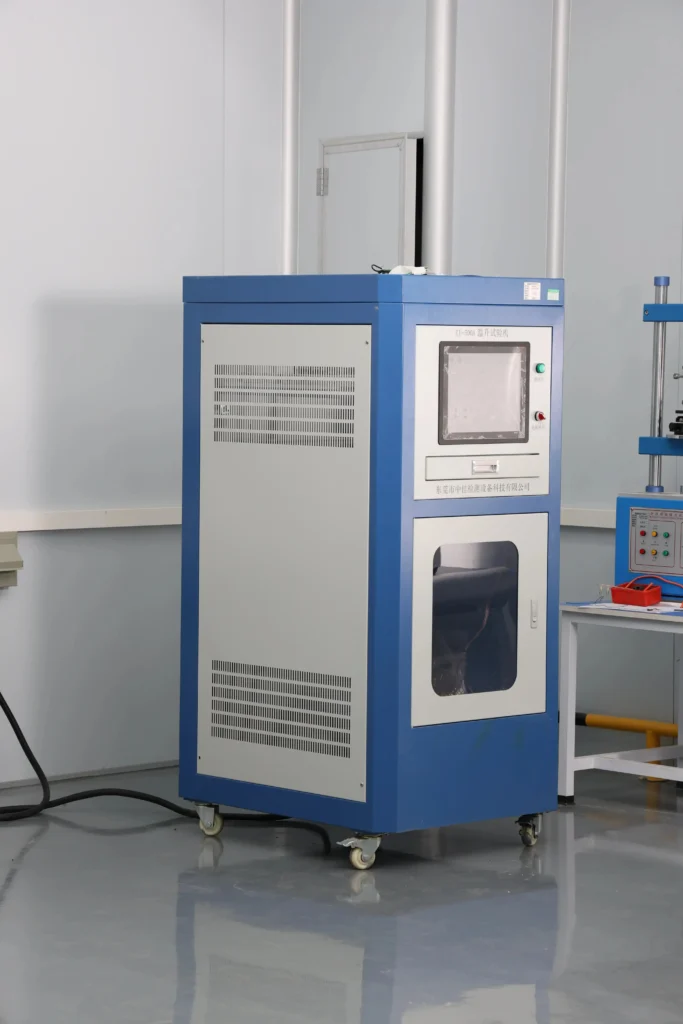
The photos record machines on site; they do not show which of them handle an ENY or EN order or which checks run on it.
A ferrule quotation turns on the piece count for each size first, then on the collar, finish, color and packing choices on your list. No prices are published; each line is quoted against your AWG list, so a long mixed list and a single-size order are both quoted line by line.
| Driver | Effect on cost | What you control |
|---|---|---|
| Pieces per size | Every AWG line is quoted on its own count | The quantity written against each size on your list |
| Collar or bare sleeve | An ENY part adds a nylon collar to the metal sleeve | ENY where a collar is needed, EN where the terminal housing covers the joint |
| Collar color | Colors follow your requirement rather than a fixed chart | Your panel color scheme, stated once for the whole list |
| Sleeve finish | Tin plating or bare copper, per customer requirement | The finish named on your specification |
| Sizes above 150 mm² (250/300 kcmil, see the table note) | Only EN covers them, and larger sleeves use more copper | Whether the conductor really needs the larger sleeve |
| Dimensions outside the listed data | A sleeve length or diameter of your own is set against a drawing | A dimensioned drawing sent by email |
| Packing | The ENY sheet gives 1,000 to 50 pieces per box by size; EN packing and labels are agreed per order | The pack size and label content your stores need |
| Assortment or kit requests | No assortment kit is on the sheets; each size is quoted as its own line | Full boxes of each size or a mixed kit, stated on your list |
| Documents requested | Declarations or certificate copies tied to your item numbers are agreed per order | The documents your customer or inspector will ask for |
Minimum order, payment and lead time are agreed on each quotation, by email or through the enquiry form.
Write the list the way the quotation is built. One line per item number, with the AWG size, ENY or EN, the collar color if it matters and the count, lets each line be priced without a follow-up question. Where you only know the terminal, give its maker and part number instead of guessing a ferrule size, and the sleeve is matched per order.
If you are replacing ferrules from another supplier, put their part numbers next to your AWG sizes. ENY and EN are supplier codes, so a cross-reference on your list shows which line maps to which item, and any size without a listed match stands out before pricing.
Samples take 7 days at the quickest. A sample run lets you try the sleeve in your own terminal before the order quantity is fixed, which is the check the listed data cannot replace.
Ferrule crimping has a guide of its own; the other pages cover general crimp steps, connector families and ring terminal sizes, and the crimp connector range lists every insulated terminal family.
The ferrule crimping guide walks through crimping wire ferrules step by step.
The general guide on crimping wire terminals covers die selection, stripping and a pull check across terminal types.
The overview of wire crimp connector types compares the main crimp terminal families.
The broader guide to electrical wire connector types sorts connectors by the joint they make.
The ring terminal stud chart matches stud sizes to ring terminals when the joint needs a stud instead of a clamp.
12 AWG is the 4 mm² size on both sheets: ENY4010, ENY4012 and ENY4018 (insulated) or EN4007 to EN4030 (non-insulated). 10 AWG is 6 mm²: ENY6010, ENY6012 and ENY6018, or EN6006 to EN6025. The last digits of each part number give the pin length in mm, so pick the one that suits your clamp.
So the screw clamps one metal sleeve instead of loose strands. According to Electrical Engineering Portal, a bare flexible conductor can lose strands to shearing when overtightened, and the wrong cross-section lets strands spread and make poor contact. A crimped sleeve removes both failure paths.
Pick ENY, the insulated type, when the collar helps guide the strands and cover the stripped edge in a row of clamps; they run from 0.25 to 150 mm² (26 AWG to 250/300 kcmil, see the table note). Use non-insulated EN ferrules where the terminal housing covers the joint or where the conductor is larger than 150 mm², since EN runs to 500 mm², the 800/1000 size.
Strip the wire, insert the strands into the sleeve and compress the metal part with a ferrule die sized to the same cross-section. According to TE Connectivity, the plastic entry sleeve of an insulated ferrule is not pressed during installation. The crimping guide for wire ferrules covers each step.
A size, but only inside one maker’s own scheme. As an example, a TE Connectivity listing shows orange for 20 AWG, while Hubbell/Burndy’s 20 AWG YF2012ID is gray. ENY collar colors follow your requirement and are confirmed per order.
A crimp is the joint made by compressing a metal barrel onto a wire; a ferrule is one part that receives such a crimp. According to Hubbell/Burndy, ferrules terminate stranded wire and give a reliable connection when each strand conducts current after proper crimping. Ring, spade and butt terminals are other crimped parts.
That’s the terminal maker’s call. The sources cited on this page describe ferrules for stranded or flexible conductors, and the ENY and EN listings are sized by AWG for that use. For a solid conductor, follow the terminal maker’s instruction on whether a sleeve is allowed. If the instruction calls for a sleeve, send the wire size and the terminal part number with your enquiry.
EN500 is the largest: a 40 mm sleeve for 500 mm², printed as 800/1000 kcmil (see the table note). The insulated series stops at 150 mm², where ENY150-38 has the longest pin at 38 mm. Between those two points, EN sleeves for 185, 240, 325 and 400 mm² cover the 300/350, 400, 500/600 and 600/750 sizes as printed.
Tinning is not a substitute. According to Electrical Engineering Portal, flexible conductors should not be tinned before connection because tin may cause fretting corrosion; cable ends, sleeves or lugs are preferable when conditions are difficult. A crimped ferrule holds the strands together without a solder layer.
Every row is copied from the supplier specification sheets as printed: part number, AWG, mm² and the drawn dimensions in mm. VoltixC has not re-tested the rows one by one. The page shows 60 of the 218 part numbers, and the full list comes with your quotation; where the two sheets print different AWG numbers for one mm² size, order by mm².
Send the list through the enquiry form or by email to hugo@voltixconnect.com, one line per AWG size with the ENY or EN choice and a count. The form takes name, company, email, country, product line, conductor size, quantity and a message. It has no upload field, so terminal drawings or panel photos go by email.
Ask a VoltixC Engineer