VOLTIXC / ENQUIRY
Request a Quote
Tell us what you need and we will review your enquiry.

Color-coded copper and aluminum compression lugs with one mounting hole, in straight, 45° and 90° forms, sized by AWG and kcmil.
Fast answer: Compression lugs are terminals whose barrel is pressed onto the conductor with a matched die; the color band on the barrel points to that die. VoltixC lists 1,860 one-hole part numbers from the supplier specification sheets: copper from 14–10 AWG to 1000 kcmil in three angles, and aluminum from 8 AWG to 700 kcmil. Pick metal, size and bolt, then send your list.
The copper series has 1,750 part numbers and the aluminum series has 110; every part has a single mounting hole, and the values below come from the supplier specification sheets.
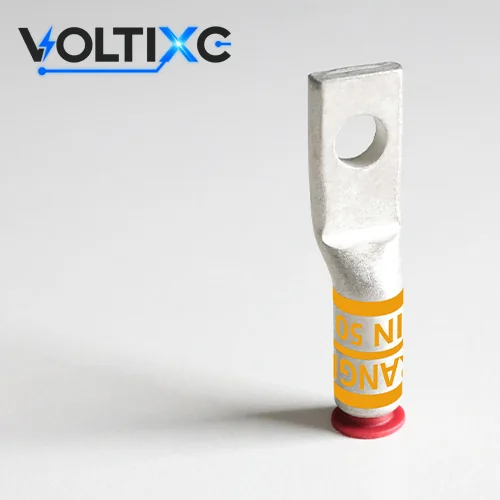
A compression lug holds the conductor because its tubular barrel is pressed and deformed onto the strands. Buyers also call them crimp lugs or compression terminals. The press gives a sound connection only when the barrel, the die and the conductor match, and the single mounting hole then bolts the flat palm to a stud, bus bar or ground bar.
Strip the conductor end first; TE Connectivity’s crimping guide says insulation should come off at the proper length without nicking or breaking strands.
If the conductor stops short of the bottom of the barrel, the crimp zone presses on insulation instead of bare metal, so push it in all the way.
For the crimp itself, the ILSCO installation guide says installers should use the compression die the connector maker specifies; colored bands, dots or stamped die codes identify it.
NASA researchers state that reliable crimped contacts need strict process controls and continuous pull-force verification. Keep checking after the crimp is made.
In two 400 A temperature-rise tests reported by Galliana et al., lugs with a crimp resistance near 5 μΩ at 20 °C showed a terminal rise of about 50 K, while one lug measured at 28.88 μΩ rose above 60 K. The same paper finds that the quality and electrical resistance of a crimped joint depend on the material, cable section, crimp method, crimp profile, and the location and shape of the indents (Galliana et al.). When one of these does not suit your conductor, the joint heats up.
Every thermal cycle in the Galliana et al. experiment pushed crimp resistance up, and the authors cite a thermal-shock study in which better-made crimps gained contact resistance more slowly than poor ones. Compression crimps made with the wrong die can look fine at handover and still run warmer under load. Before you order, check the lug, the die and the conductor class as one set.
VoltixC’s full specification table holds 1,750 copper and 110 aluminum one-hole compression lugs from the supplier sheets, and the two tables below show one straight (0°) catalog number for each wire size. Each row gives the bolt size, the barrel ID and the lettered drawing dimensions in mm; the last column names the other bolt sizes listed for that wire size. Lugs with two bolt holes are on the two-hole version of this page, and other lug families sit under copper cable lugs.
Copper compression lugs in this series are the only ones on this page with angled palms, which lets the cable leave the lug at 45° or 90° in a tight enclosure. The series runs from 14–10 AWG to 1000 kcmil: 1,750 part numbers in the full specification table — request the complete list with your quote.
| Cat. No. | Wire size | Bolt size | ID (mm) | A (mm) | B (mm) | C (mm) | Other bolt sizes listed |
|---|---|---|---|---|---|---|---|
| DA1414 | 14–10 AWG | 1/4 | 3.30 | 33.78 | 17.27 | 10.41 | #8, #10, 5/16, 3/8 |
| DA0838 | 8 AWG | 3/8 | 4.57 | 33.27 | 16.26 | 14.22 | #8, #10, 1/4, 5/16, 1/2 |
| DA0638 | 6 AWG | 3/8 | 5.59 | 34.80 | 17.02 | 15.24 | #10, #12, 1/4, 5/16, 1/2, 3/4 |
| DA0438 | 4 AWG | 3/8 | 6.86 | 35.81 | 16.76 | 15.49 | #10, #12, 1/4, 5/16, 1/2 |
| DA0238 | 2 AWG | 3/8 | 7.62 | 41.91 | 20.32 | 14.99 | #10, 1/4, 5/16, 1/2 |
| DA0156-252 | 1 AWG | 5/16 | 9.14 | 40.64 | 19.30 | 17.78 | 1/4, 3/8 |
| DA1038 | 1/0 AWG | 3/8 | 10.16 | 47.75 | 23.62 | 19.05 | #10, 1/4, 5/16, 1/2, 5/8 |
| DA2038 | 2/0 AWG | 3/8 | 11.18 | 49.02 | 23.62 | 21.08 | #10, 1/4, 5/16, 1/2, 5/8, 3/4 |
| Cat. No. | Wire size | Bolt size | ID (mm) | A (mm) | B (mm) | C (mm) | Other bolt sizes listed |
|---|---|---|---|---|---|---|---|
| DA3038 | 3/0 AWG | 3/8 | 12.95 | 49.53 | 23.62 | 23.37 | #10, 1/4, 5/16, 1/2 |
| DA4038 | 4/0 AWG | 3/8 | 14.22 | 55.88 | 23.62 | 26.16 | 1/4, 5/16, 1/2, 5/8, 3/4 |
| DA2538 | 250 kcmil | 3/8 | 16.00 | 59.18 | 23.62 | 28.70 | 1/4, 5/16, 1/2, 5/8, 3/4, 7/8 |
| DA3138 | 300 kcmil | 3/8 | 17.78 | 60.45 | 23.62 | 31.75 | 5/16, 1/2, 5/8, 3/4, 7/8 |
| DA3538 | 350 kcmil | 3/8 | 19.05 | 71.12 | 31.75 | 34.54 | 5/16, 1/2, 5/8, 7/8 |
| DA4112 | 400 kcmil | 1/2 | 20.07 | 81.28 | 31.75 | 35.81 | 3/8, 5/8, 7/8 |
| DA4512-251 | 450 kcmil | 1/2 | 23.37 | 89.41 | 38.61 | 43.18 | 3/8, 5/8 |
| DA5138 | 500 kcmil | 3/8 | 22.35 | 76.20 | 25.40 | 40.89 | 1/2, 5/8, 3/4, 7/8, 1 |
| DA6112 | 600 kcmil | 1/2 | 24.38 | 91.19 | 36.58 | 44.45 | 1/4, 3/8, 5/8, 7/8 |
| DA7158 | 700 kcmil | 5/8 | 24.64 | 101.09 | 40.13 | 46.74 | 3/8, 1/2 |
| DA7512 | 750 kcmil | 1/2 | 26.92 | 99.57 | 42.93 | 49.28 | 3/8, 5/8, 7/8, 1-1/4 |
| DA8158 | 800 kcmil | 5/8 | 28.19 | 101.09 | 40.13 | 51.05 | — |
| DA9112 | 900 kcmil | 1/2 | 30.23 | 106.93 | 45.97 | 55.12 | 5/8 |
| DA1158 | 1000 kcmil | 5/8 | 31.75 | 102.36 | 40.13 | 57.66 | 3/8, 1/2, 7/8, 1 |
Spec note: both tables follow the supplier specification sheets, with inch values converted to mm, and VoltixC has not re-tested them. A, B and C are the lettered dimensions on the supplier drawing for each series; ask for the drawing to see where each letter is measured. Copper parts come in standard packs of 100 pieces, and plating is not printed on either sheet, so it is confirmed per order.
Source: supplier specification sheets for the copper one-hole series (inch values converted to mm).
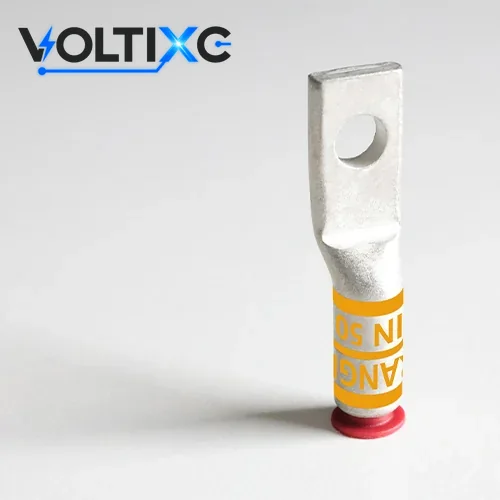
The aluminum series has an aluminum body and a straight palm only, from 8 AWG to 700 kcmil: 110 part numbers in the full specification table — request the complete list with your quote. Its color bands follow a different scheme from the copper series, so the same size carries a different color in each metal.
| Cat. No. | Wire size | Bolt size | ID (mm) | A (mm) | B (mm) | C (mm) | Other bolt sizes listed |
|---|---|---|---|---|---|---|---|
| AL0838 | 8 AWG | 3/8 | 4.32 | 41.91 | 23.62 | 15.24 | #10, 1/4, 5/16 |
| AL0638 | 6 AWG | 3/8 | 5.08 | 48.26 | 23.62 | 16.00 | #10, 1/4, 5/16 |
| AL0438 | 4 AWG | 3/8 | 6.86 | 53.85 | 23.62 | 16.26 | 1/4, 5/16 |
| AL0238 | 2 AWG | 3/8 | 7.87 | 53.09 | 23.62 | 18.29 | 1/4, 5/16, 1/2 |
| AL0138 | 1 AWG | 3/8 | 9.40 | 59.44 | 23.62 | 19.05 | 1/4, 5/16, 1/2 |
| AL1038 | 1/0 AWG | 3/8 | 10.41 | 62.74 | 24.64 | 22.35 | 1/4, 5/16, 1/2 |
| AL2038 | 2/0 AWG | 3/8 | 11.68 | 67.06 | 26.16 | 24.64 | 1/4, 5/16, 1/2, 5/8 |
| AL3038 | 3/0 AWG | 3/8 | 13.21 | 75.69 | 27.69 | 26.92 | 1/4, 5/16, 1/2 |
| Cat. No. | Wire size | Bolt size | ID (mm) | A (mm) | B (mm) | C (mm) | Other bolt sizes listed |
|---|---|---|---|---|---|---|---|
| AL4038 | 4/0 AWG | 3/8 | 15.24 | 83.82 | 23.62 | 30.73 | 5/16, 1/2, 5/8 |
| AL2538 | 250 kcmil | 3/8 | 16.51 | 87.88 | 23.62 | 32.77 | 1/2, 5/8 |
| AL3138 | 300 kcmil | 3/8 | 18.03 | 90.42 | 23.62 | 35.31 | 5/16, 1/2 |
| AL3512 | 350 kcmil | 1/2 | 19.05 | 116.08 | 31.75 | 38.61 | 5/8 |
| AL4112 | 400 kcmil | 1/2 | 20.57 | 119.89 | 31.75 | 41.91 | 5/8 |
| AL5112 | 500 kcmil | 1/2 | 22.86 | 122.94 | 31.75 | 45.47 | 5/8 |
| AL6158 | 600 kcmil | 5/8 | 25.15 | 139.45 | 50.80 | 48.77 | — |
| AL7158 | 700 kcmil | 5/8 | 26.92 | 147.57 | 50.80 | 51.82 | 1/2 |
Source: supplier specification sheets for the aluminum one-hole series (inch values converted to mm).
Choose compression lugs in six checks: the conductor metal, the conductor size and strand class, the die named by the color band, the palm angle and the bolt size of your stud. The tables above give one straight catalog number per size, and these checks narrow the choice before you send the list.
| Check | What to confirm | Where to look |
|---|---|---|
| Conductor metal | Copper conductor: copper one-hole series. Aluminum conductor: aluminum one-hole series. A mixed-metal joint has no stated rating; ask first. | Model tables above |
| Conductor size | Copper covers 14–10 AWG to 1000 kcmil; aluminum covers 8 AWG to 700 kcmil. | Size and color table below |
| Strand class | Fine-strand or flexible cable can need a larger lug than its gauge suggests. | Check 3 under the size table |
| Color band and die | Read the band together with the size; one color appears on several sizes. | Size and color table below |
| Palm angle | Copper is listed at 0°, 45° and 90°; aluminum at 0° only. | Size and color table below |
| Bolt size | Bolt sizes run from #8 to 1-1/4 in copper and from #10 to 5/8 in aluminum; match the bolt to your stud. | Model tables above, last column |
Angled copper lugs carry an F suffix (45°) or an A suffix (90°) on the catalog number, and the full specification table lists 587 of them at 45° and 528 at 90°.
| Conductor size | Copper color band | Copper angles listed | Aluminum color band |
|---|---|---|---|
| 14–10 AWG | Yellow | 0°, 45°, 90° | Not listed |
| 8 AWG | Red | 0°, 45°, 90° | Blue |
| 6 AWG | Blue | 0°, 45°, 90° | Gray |
| 4 AWG | Gray | 0°, 45°, 90° | Green |
| 2 AWG | Brown | 0°, 45°, 90° | Pink |
| 1 AWG | Green | 0°, 45°, 90° | Black |
| 1/0 AWG | Pink | 0°, 45°, 90° | Orange |
| 2/0 AWG | Black | 0°, 45°, 90° | Purple |
| 3/0 AWG | Orange | 0°, 45°, 90° | Ruby |
| 4/0 AWG | Purple | 0°, 45°, 90° | White |
| 250 kcmil | Yellow | 0°, 45°, 90° | Red |
| 300 kcmil | White | 0°, 45°, 90° | Blue |
| 350 kcmil | Red | 0°, 45°, 90° | Brown |
| 400 kcmil | Blue | 0°, 45°, 90° | Green |
| 450 kcmil | Brown | 0°, 45° | Not listed |
| 500 kcmil | Brown | 0°, 45°, 90° | Pink |
| 600 kcmil | Green | 0°, 45°, 90° | Black |
| 700 kcmil | Pink | 0°, 45°, 90° | Yellow |
| 750 kcmil | Black | 0°, 45°, 90° | Not listed |
| 800 kcmil | Orange | 0°, 45°, 90° | Not listed |
| 900 kcmil | Yellow | 0°, 45°, 90° | Not listed |
| 1000 kcmil | White | 0°, 45°, 90° | Not listed |
Source: color bands as listed in the supplier product titles; angles per supplier specification sheet.
Colors repeat inside a series. In the copper table, yellow marks 14–10 AWG, 250 kcmil and 900 kcmil, so the band only points to a die when you read it with the size.
The same size changes color between metals. A 250 kcmil lug is yellow in copper and red in aluminum, and 8 AWG is red in copper and blue in aluminum. Take the die from the chart for the metal you are crimping, not from the other table.
Fine strands can move you up a size. According to ILSCO’s copper charts, 250 kcmil Class B/C copper wire takes a yellow color code, and 4/0 AWG fine-strand wire also takes yellow. Treat that as one maker’s example and state the strand class of your cable when you ask for crimp cable lugs above 4/0.
Copper and aluminum compression lugs are both pressed onto the conductor with a die, but the body metal decides which conductor they suit, which die chart applies and which prep questions to settle. The table sets the two series side by side from the supplier data.
| Point | Copper series | Aluminum series |
|---|---|---|
| Body material | Copper | Aluminum |
| Sizes listed | 22 sizes, 14–10 AWG to 1000 kcmil | 16 sizes, 8 AWG to 700 kcmil |
| Angles listed | 0°, 45°, 90° | 0° |
| Part numbers | 1,750 | 110 |
| Drawing dimensions | ID, A, B, C | ID, A, B, C, D, F, H |
| Plating | Not printed on the sheet; tin-plated or bare to your requirement | Not printed on the sheet; set per order |
| Compound in the barrel | Not listed | Not listed; ask per order |
According to Klauke, the right crimp profile depends on conductor material, lug design and intended use. Klauke rates hexagonal crimping for both copper and aluminium conductors and limits notch crimping to copper.
Aluminum asks more of the conductor side. One study of twelve compression connectors on 240 mm² stranded aluminum conductors found soft annealed aluminum considerably harder to connect than hard-drawn conductor. The same study linked large deformations at the connector-conductor interface to better connector quality. So state the temper and stranding of an aluminum conductor with your size list.
According to 3M, lugs must be crimped with one of the approved die sets using the engineering information supplied with the lugs, and other tool and die pairs need the tool maker’s advice. Ask for that die information with either series before your installers set up.
A one-hole compression lug fits a single-bolt termination on an AWG or kcmil conductor that your team can crimp with a matched die. If the pad has two holes, another route fits better. The same goes for a site with no die for the size, a conductor sized in mm², and a tap instead of an end termination.
| Route | Pick it when | Move to another route when | Where to go |
|---|---|---|---|
| One hole compression lugs (this page) | One stud or bolt, an AWG or kcmil conductor, and a die for the color band | The palm must not turn, or the pad is drilled for two bolts | This page |
| Two-hole compression lugs | Two-bolt pads or a joint that must resist rotation | Only one stud is available | two-hole compression lugs |
| Mechanical lugs | The conductor is clamped by a screw set to a torque value, with no crimp die | You want a die-marked crimp on the barrel | mechanical lugs |
| DIN compression lugs | The conductor is sized in mm² and the drawing names DIN 46235 | Your conductor is sized in AWG or kcmil | DIN 46235 copper lugs |
| Narrow-palm lugs | The palm has to fit a narrow terminal or breaker lug seat | A standard palm width fits the seat | narrow-palm and narrow-tongue lugs |
| C-shaped tap connectors | A branch is taken off a run without cutting it | The conductor ends at a stud | C-shaped compression connectors |
Conductors sized in mm² belong to a separate standard family. According to Weidmüller, its range lists compression cable lugs to DIN 46235 and sheet-metal cable lugs to DIN 46234. According to Klauke, those DIN 46234 solderless terminals are made from copper sheet with a soldered joint, while compression lugs are made from tube. If your drawing names either DIN number, quote it with the enquiry so the right family is matched.
When you switch to another termination solution, your list changes as well as the part. For a two-hole lug, send the hole spacing of your pad; a mechanical lug quote needs the torque value from its maker, and a DIN lug is quoted from the size in mm². Add that detail to the line when you move a size to another page.
For the choice between a crimped barrel and a screw clamp, the guide on compression vs mechanical lugs sets the two side by side. The other copper families, from tube lugs to splices, sit on the cable lugs page.
One-hole compression lugs fit terminations where a single conductor ends on one stud or bolt: copper from 14–10 AWG to 1000 kcmil, or aluminum from 8 AWG to 700 kcmil. They are the wrong part for medium-voltage joints, two-bolt pads and conductor classes the die chart does not cover. Each card is inferred from the lug’s size range and single hole, not from a customer installation.
Fits: copper or aluminum electrical cables that land on one stud in a panelboard, switchboard or transformer enclosure, sized inside the ranges above.
Watch: each wire size is listed with several bolt sizes, so send the stud size with the conductor size.
Fits: a grounding or bonding conductor that ends on a ground bar, chassis stud or equipment frame with a single bolt.
Watch: pick the series by conductor metal, not by the metal of the ground bar; the supplier data gives no mixed-metal rating, so raise any such joint before you specify it.
Fits: battery banks, inverters and DC distribution where heavy copper cable ends on a single terminal post or stud.
Watch: flexible cable changes the size. According to ILSCO, its CSWS-2/0-38 lug takes 2/0 stranded copper, while its flexible range is 1/0 in classes G, H, I, K, M and DLO.
Fits: copper runs that must turn right after the lug, where the 45° or 90° copper entries save bending the cable at the barrel.
Watch: the aluminum series is listed straight only, so an angled aluminum termination is a custom request.
Fits: battery and charger cables on boats and in off-grid systems where a crimped copper lug ends on one stud.
Watch: According to West Marine, the ABYC rule calls for solderless crimp-on connectors to be attached with a tool designed for that connector.
IEC 61238-1-3 applies to compression and mechanical connectors for power cables above 1 kV up to 30 kV. The supplier data for this page lists no voltage rating, so a medium-voltage termination needs a connector type-tested for that range, not an entry from these tables. The same standard sets the type-test methods for copper and aluminium conductors.
A single hole lets the palm turn on its stud. When the pad is drilled for two bolts or the joint must hold its angle under vibration, use a two-hole compression lug instead.
NASA-STD-8739.4 requires stranded wire for crimping and prohibits crimping solid or solder-tinned stranded wire. That is a spaceflight workmanship rule, not a general one, so for solid conductors check the conductor classes on the lug maker’s die chart first.
VoltixC can show three compliance documents and photos of its Guangzhou factory: CE for the full terminal range, these lugs included; UL certified; and RoHS test report available (SGS). Naming a standard on this page is not a claim of certification.
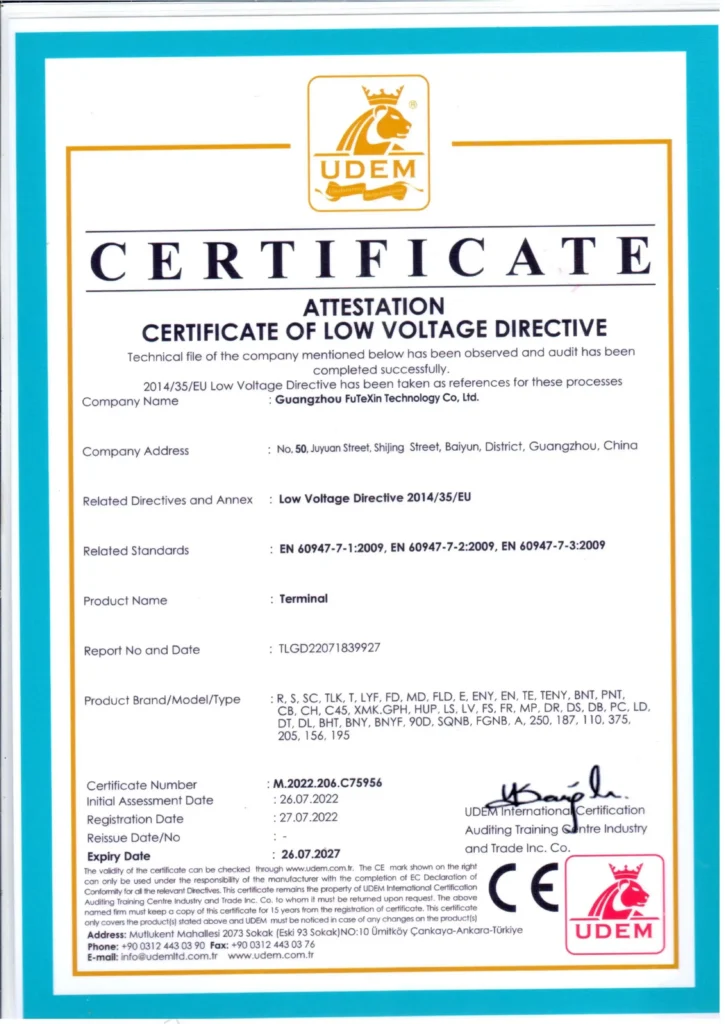
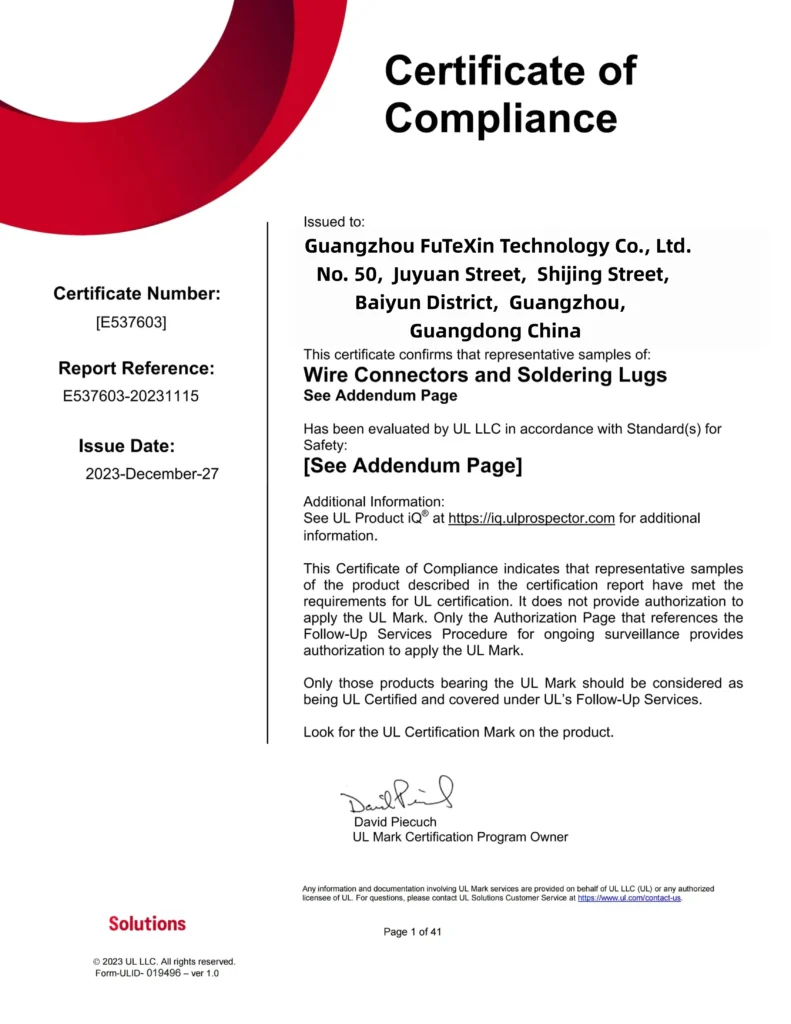
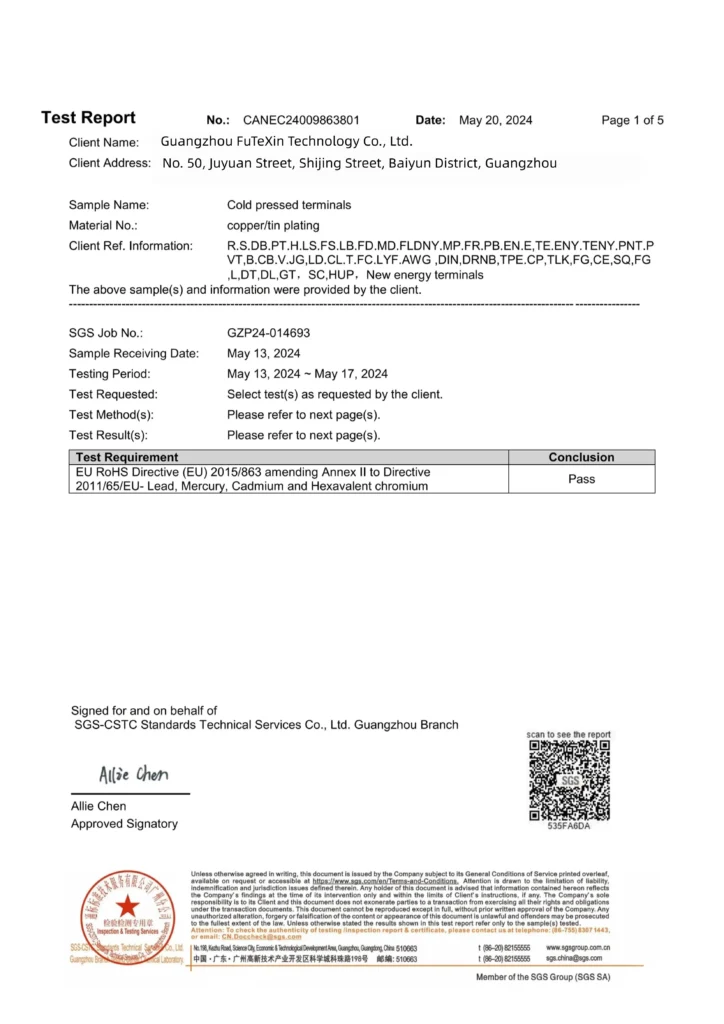
The images do not show which lug, die and conductor were evaluated. According to ILSCO, a UL listing sits with the connector, and connectors are listed together with their tools and dies where that applies.
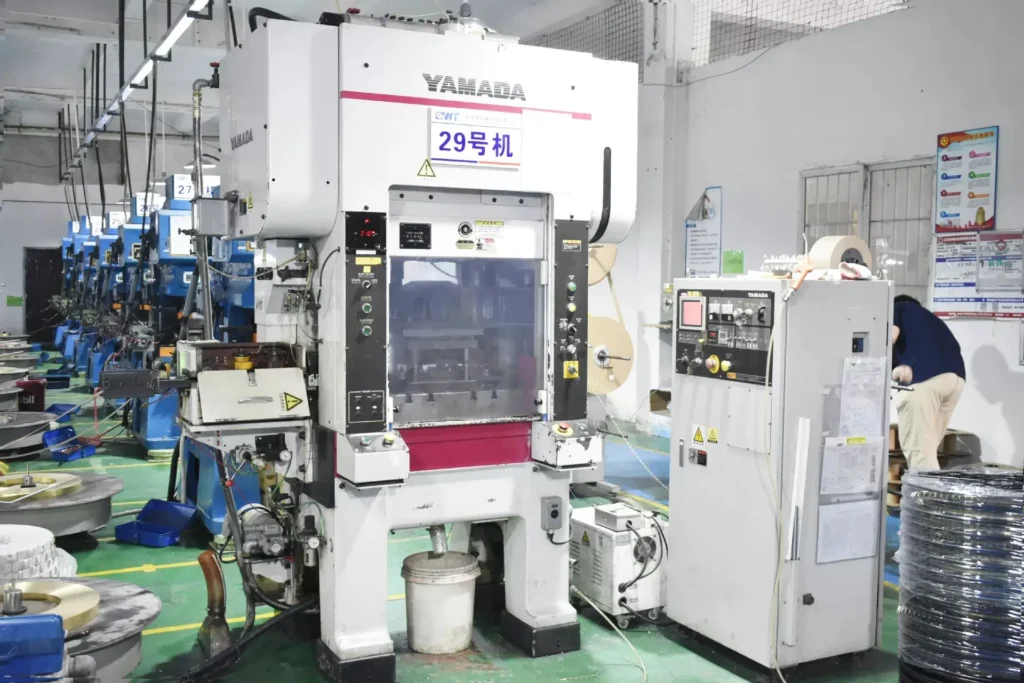
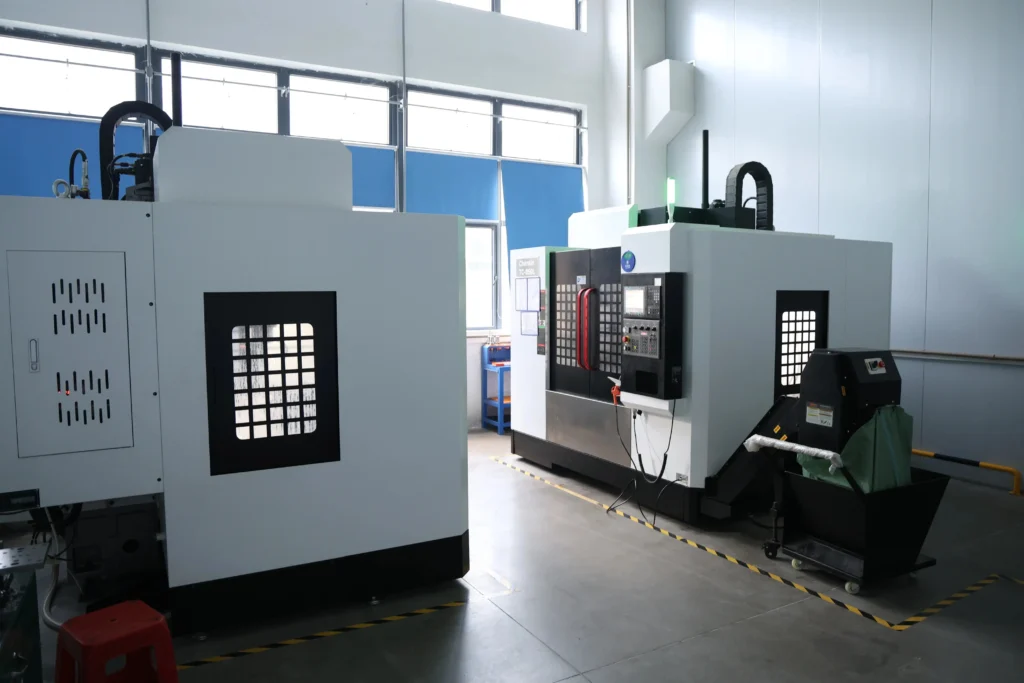
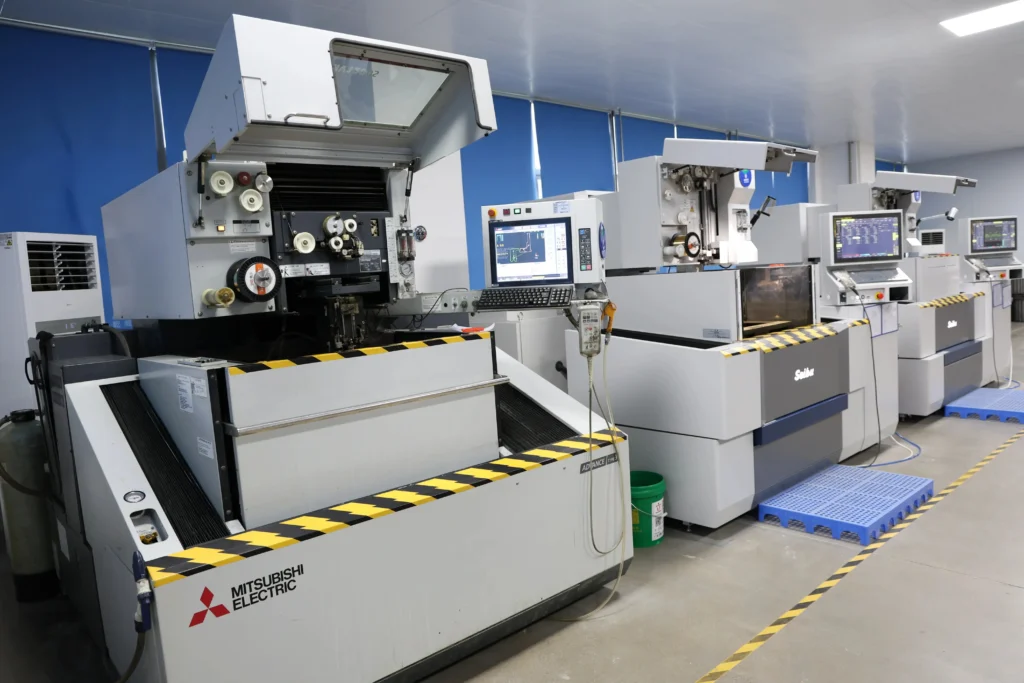
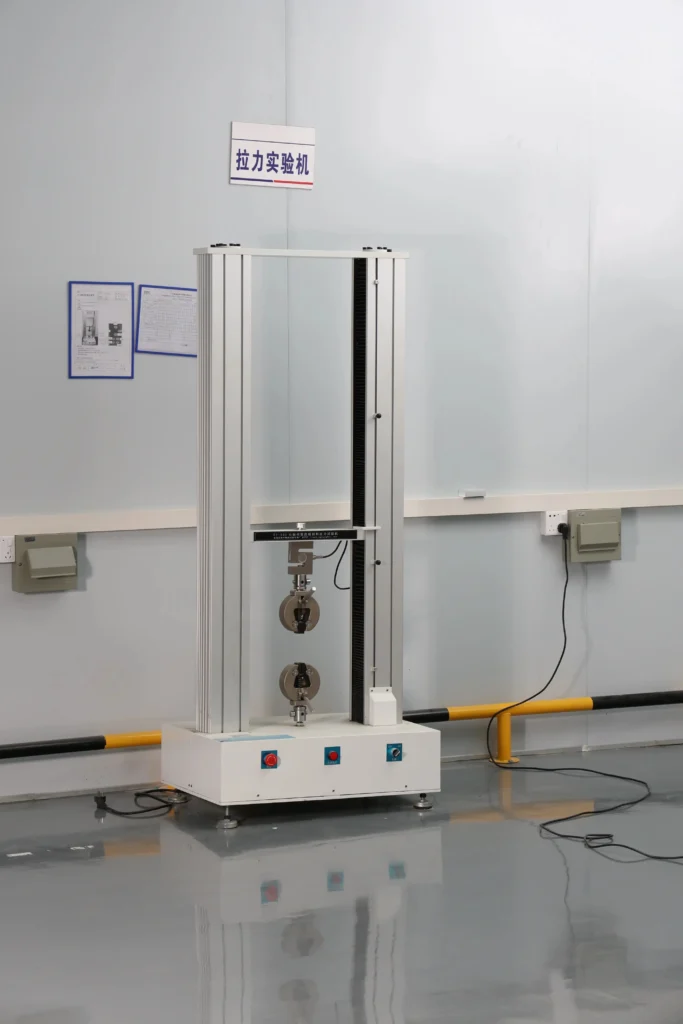
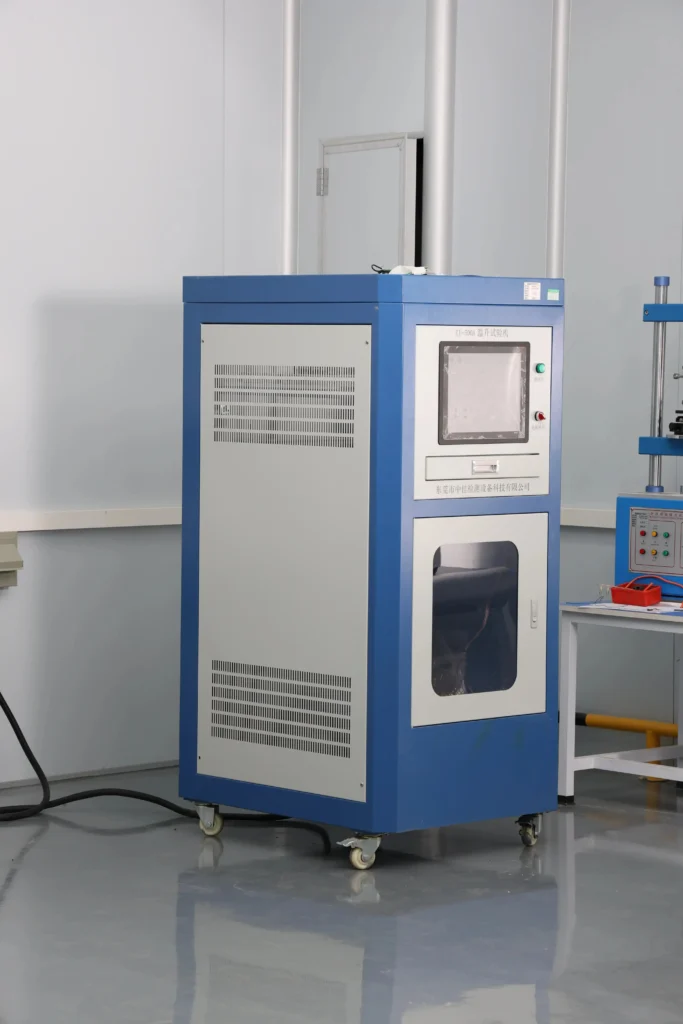
A compression lug quote follows the choices on your list: the metal and size mix, the angle forms, the finish, any change to the palm, and how the parts are packed and marked. Each row of the table is a driver you can set on the enquiry.
| Driver | Effect on cost | What you control |
|---|---|---|
| Conductor size mix | Larger barrels use more copper or aluminum per piece | Put every size on one list so each line is quoted once |
| Body metal | Copper and aluminum come from separate series with separate catalog numbers | State the conductor metal on every line |
| Angle form | The 45° and 90° copper parts have their own catalog numbers, apart from the straight ones | Give the angle per line and drop forms you do not need |
| Finish | Plating is not printed on the supplier sheets, so the finish is set per order | Name tin-plated or bare, or accept the supplier standard |
| Palm or stud hole change | A hole or palm outside the tables needs a drawing and may need new tooling | Send the drawing; tooling is confirmed per order |
| Quantity and packing | Quantity per size, bag counts and carton labels change handling | Give the quantity per size and your label text |
| Marking and documents | Private marking or extra paperwork adds work to the batch | List the marking and certificate copies you need |
Between your size list and the order there are four steps:
MOQ, lead time, payment terms and warranty are confirmed per order by email or the enquiry form. A sample lot needs 7 days at the fastest, which gives your installers a trial crimp on your own conductor before the batch is fixed.
A line with no table match stays on the quote as a custom line that needs a drawing; its tooling is confirmed per order. If the angle and finish stay the same across sizes, the list stays short and the quote is easier to compare.
Drawings and cable photos go by email to hugo@voltixconnect.com, because the enquiry form has no upload field.
Start with the size lookup when all you have is a conductor size; open a guide when the question is about lug dimensions, lug type or crimping method.
Enter a conductor size in AWG, kcmil or mm² and read the matching lug size, then carry that size into the tables above: cable lug size chart.
How barrel, palm and hole dimensions are read on a lug drawing, so you can compare a drawing with a stud: cable lug dimensions.
How the main lug types differ and which one a job calls for: guide to cable lug types.
Tool and die choice, strip length, crimping and a pull self-check: how to crimp wires.
The band names the die. According to the ILSCO installation guide, colored bands, dots or stamped codes identify the compression die the connector maker specifies. On this page the copper 8 AWG lug is red, 6 AWG is blue and 250 kcmil is yellow, and ILSCO’s copper compression chart gives the same colors for those sizes. Colors repeat across sizes and differ between the copper and aluminum series, so read the band together with the size.
Do not assume either. The copper series is matched to copper conductors and the aluminum series to aluminum conductors. The supplier sheets state no rating for a joint of two metals, so ask before you specify either series for one.
They have their own page. Two-hole parts suit two-bolt pads and joints that must not rotate; see two-hole copper and aluminum compression lugs.
Use a compression lug when your installers have the die for the color band and want a crimped barrel. According to TE Connectivity, a quality crimp needs the correct tooling for the terminal and wire, the correct terminal, properly prepared wire and a trained operator. If those are not on site, a screw-clamp mechanical lug is the other route. The comparison guide linked in the routes table above covers both in more depth.
The specification sheets list 131 copper 4/0 AWG part numbers across 0°, 45° and 90°, all with a purple band; the straight part with a 3/8 bolt is DA4038. Aluminum 4/0 is white and straight only, in 9 part numbers; AL4038 takes a 3/8 bolt. Ask for the full 4/0 list with your quote.
Copper runs from 14–10 AWG (yellow band) to 1000 kcmil (white) in 22 wire sizes; every size comes straight and at 45°, and all but 450 kcmil also come at 90°. Aluminum runs from 8 AWG (blue) to 700 kcmil (yellow) in 16 sizes, straight only.
It can need a larger lug. According to ILSCO’s fine-strand chart, 4/0 AWG fine-strand wire takes the yellow color code, the band ILSCO’s standard chart gives 250 kcmil Class B/C copper. State the strand class of your cable, for example DLO or Class K, and the lug size is confirmed per order.
The supplier data here does not list crimp counts, so follow the die chart for the lug. According to 3M, lugs are crimped with approved die sets using the engineering information supplied with them. Ask for that chart with your quote.
Yes. Each catalog number has its bolt size, barrel ID and drawing dimensions on the supplier specification sheet, and the tables above show one straight part per wire size with the other bolt sizes listed for it. VoltixC has not re-tested these values. Send your stud or bolt size with each line.
The aluminum series is listed straight (0°) only, in 16 sizes from 8 AWG to 700 kcmil. An angled aluminum lug is a custom request that needs a drawing. Send the angle, the stud size and the conductor size, and the part is confirmed per order.
Send one line per size and VoltixC replies with matched catalog numbers or a drawing request.
Ask a VoltixC Engineer