VOLTIXC / ENQUIRY
Request a Quote
Tell us what you need and we will review your enquiry.

By VoltixC Engineering Team · Last updated: 2026-09-28
Fast answer: Battery cable lug size is set by two inputs: the cable gauge, for example 8 AWG to 4/0, and the stud or post size the palm must fit. Match the barrel to the actual cable, since SAE battery cable can be smaller than marine AWG cable, then choose straight or 90-degree form and tin plating for the environment.
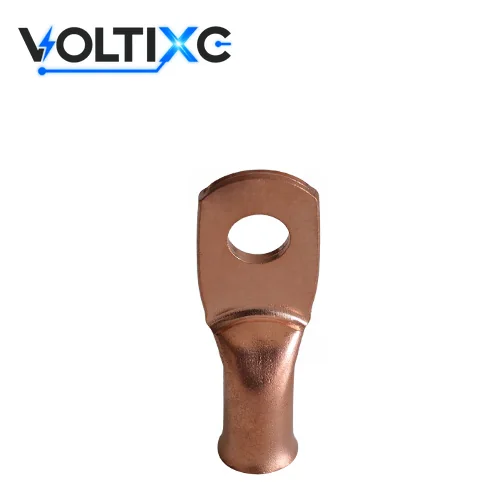
A battery cable lug is a copper tube terminal crimped onto the cable end, with a flat palm that bolts to a battery stud, a starter terminal or a busbar. Buyers also call it a battery lug, a battery terminal lug or a battery cable end, and a battery lug size always means two sizes at once: the barrel and the hole. VoltixC lists its heavy-duty copper lugs for this job in nine gauges from 8 AWG to 4/0 AWG, with stud holes from 5.1 mm to 13.1 mm, on the battery lugs page.
The barrel and the ring end are picked separately. A 2/0 AWG cable can land on a 5/16 in stud on one battery and a 3/8 in stud on the next, so one cable gauge can need two different lugs. Write both numbers down for every lead before you compare parts. Clamp terminals that grip a tapered battery post are a different product, and VoltixC does not make them.
Write down three numbers before you look at any lug: the cable gauge, the cable type and the stud size. Barrel length, angle, finish and the crimp die follow from those three.
| Battery-lug check | Value to record | Where this guide covers it |
|---|---|---|
| Cable gauge and area | The gauge printed on the jacket; VoltixC lists 8 AWG to 4/0 AWG, which the conversion table puts at 8.37 mm² to 107.2 mm² | Gauge and stud section |
| Cable type | SAE battery cable, AWG boat cable, welding cable or OFC; West Marine puts SAE wire at up to 12% smaller than AWG boat cable | Cable type section |
| Stud or post size | The stud name from the equipment drawing, in inch (1/4, 5/16, 3/8 or 1/2 in) or metric (M6, M8, M10 or M12) | Gauge and stud section |
| Hole size | The same nominal size as the stud, per West Marine’s summary of ABYC E-11.14.4.1.11 | Gauge and stud section |
| Stud holes listed | 5.1, 6.8, 8.3, 10.4 and 13.1 mm on the AWG series, per supplier specification sheet | VoltixC size table |
| Barrel size and length | Barrel ID from 4.8 mm (8 AWG) to 14.2 mm (4/0 AWG) and overall length from 33.3 mm to 60.5 mm, per supplier specification sheet | VoltixC size table |
| Angle | Straight, 45-degree or 90-degree, set by the routing space at the stud | Straight or 90-degree section |
| Lug body and finish | Copper body with tin plating on all 36 AWG-series part numbers, per supplier specification sheet; the sheet prints no conductivity value; bare copper on request, confirmed per order | Tinned and sealed lug section |
| Cable insertion depth | Strip to the barrel depth for full wire insertion | Crimp or solder section |
| Crimp tool and die | A tool and die matched to the lug size | Crimp or solder section |
| Pull check | A pull test after crimping, with the pass value taken from ABYC as West Marine reports it | Crimp or solder section |
| Heat-shrink allowance | Barrel and jacket length for the heat-shrink tube you plan to fit | Mistakes section |
| Common names for this check | battery terminal lug size; battery ring terminal size; what size ring terminal for battery | Gauge and stud section: all three ask for gauge and stud |
Source: VoltixC supplier data as listed; not individually re-tested; other rows from the sources cited below.
Hole, barrel and length figures are the supplier’s printed values for the AWG series; other series and special finishes are confirmed per order. If a cable or stud on your list is missing from this table, send what the jacket and the drawing say.
A battery cable lug is a copper tube terminal crimped onto a battery cable and bolted to a threaded stud, a starter terminal or a busbar; a clamp that grips a tapered battery post is a separate part.
| Problem | What to do | Check |
|---|---|---|
| The battery has a tapered post, not a threaded stud | Fit a post clamp, one of the clamp-style battery terminal connectors, at that end; a lug needs a stud or a bolt to land on | The palm sits flat under a nut on a threaded stud |
| Both ends of the cable bolt to equipment, such as battery to starter or battery to bus bar | Put a lug on each end and record the stud size for each end separately | The list shows two stud sizes, one per end |
| The cable must turn as soon as it leaves the stud | Specify a 90-degree lug for that end | The cable runs clear of the lid, the case and the next terminal |
| The battery sits on a boat, a dock or outdoors | Order tin-plated lugs and check the wire type too. According to West Marine, SAE J378, J1127 and J1128 wires are intended for surface vehicles and meet minimum boat standards only in limited circumstances | The wire type is checked against the boat rules before the lugs are ordered |
| The electrical connections have to hold under vibration | Crimp the lug with a die made for its size, and add solder only where the lug maker allows it | The crimp passes a hand pull and the pull test your standard sets |
| Several cables share one battery stud | Count the lugs on that stud before you order | Each lug seats flat against the one below it |
| You are unsure whether a part is a lug | Look for a tube barrel and a flat palm with one bolt hole | The part crimps onto cable and bolts down |
Battery lugs sit on starter motors, battery switches, inverters, chargers and bus bars, wherever a cable ends on a bolt. The whole copper lug family is on the cable lugs page, and the heavy-duty series for battery cable is on the heavy-duty battery cable lugs page.
Start with the battery cable gauge, since it fixes the barrel, then read the stud size, which fixes the hole; neither number predicts the other.
| Input | Where to read it | Rule to apply |
|---|---|---|
| Cable gauge | The cable jacket or the cable specification | Engineering ToolBox notes that for longer distances, reducing the AWG number (increasing wire diameter) may be necessary to limit voltage drop |
| Stud size | The equipment drawing, or a measurement of the stud itself | According to West Marine, ring and captive-spade terminal connectors should be the same nominal size as the stud under ABYC E-11.14.4.1.11 |
On a long battery run, fix the gauge before you look at lugs at all. The stud names below come in inch and metric pairs that sit close together.
| Inch stud | Nominal size (mm) | Nearest metric stud | Gap between the pair |
|---|---|---|---|
| 1/4 in | 6.350 | M6 (6 mm) | 0.350 mm |
| 5/16 in | 7.938 | M8 (8 mm) | 0.062 mm |
| 3/8 in | 9.525 | M10 (10 mm) | 0.475 mm |
| 1/2 in | 12.700 | M12 (12 mm) | 0.700 mm |
Source: nominal sizes from the stud table in the VoltixC cable lug size chart; each gap is the difference between the two nominal sizes.
The closest pair, 5/16 in and M8, is 0.062 mm apart. Copy the stud name from the drawing in inch or metric, as written there, and ask for the hole in that system. The stud table in the cable lug size chart also lists 5/8 in, 3/4 in and M16.
Worked example: 2/0 AWG cable (67.4 mm²) on a 3/8 in stud takes a 2/0 barrel with a 3/8 in hole. An M10 stud on the drawing takes an M10 hole; 3/8 in is 9.525 mm and M10 is 10 mm.
VoltixC lists its AWG heavy-duty copper cable lugs in nine sizes from 8 AWG to 4/0 AWG, and the supplier specification sheet gives the stud hole, barrel and length for each part.
| Cable gauge | Area, conversion table (mm²) | Solid conductor Ø (mm) | mm² printed on the sheet | Stud hole Ø listed (mm) | Barrel ID d (mm) | Barrel OD D (mm) | Overall length L (mm) |
|---|---|---|---|---|---|---|---|
| 8 AWG | 8.37 | 3.264 | 10 | 5.1, 6.8, 8.3, 10.4, 13.1 | 4.8 | 7.1 | 33.3 |
| 6 AWG | 13.3 | 4.115 | 16 | 5.1, 6.8, 8.3, 10.4, 13.1 | 5.9 | 8.1 | 37.3 |
| 4 AWG | 21.2 | 5.189 | 25 | 6.8, 8.3, 10.4, 13.1 | 7.3 | 9.5 | 38.9 |
| 2 AWG | 33.6 | 6.544 | 35 | 6.8, 8.3, 10.4, 13.1 | 8.5 | 11.1 | 41.1 |
| 1 AWG | 42.4 | 7.348 | 50 | 6.8, 8.3, 10.4, 13.1 | 9.1 | 11.7 | 43.6 |
| 1/0 AWG | 53.5 | 8.251 | 60 | 6.8, 8.3, 10.4, 13.1 | 10.4 | 13 | 46.8 |
| 2/0 AWG | 67.4 | 9.266 | 70 | 6.8, 8.3, 10.4, 13.1 | 11.7 | 14.2 | 52.4 |
| 3/0 AWG | 85.0 | 10.405 | 95 | 8.3, 10.4, 13.1 | 13 | 15.7 | 55.9 |
| 4/0 AWG | 107.2 | 11.684 | 120 | 8.3, 10.4, 13.1 | 14.2 | 17.2 | 60.5 |
Source: wire sizes, stud holes, barrel ID / OD and overall length per supplier specification sheet for the AWG heavy-duty series (36 part numbers, copper body with tin plating; not individually re-tested); conversion area and solid diameter: the conversion table in the VoltixC cable lug size chart, calculated for a solid round conductor.
Each gauge comes with three to five stud holes, and its barrel and length stay the same across those holes. The mm² figure printed beside each gauge on the sheet differs from the conversion table, 50 against 42.4 for 1 AWG, so order by the AWG number. The 1/0 size is also written as 0 AWG and 2/0 as 00 on some jackets, so copy the gauge exactly as printed. Stranded battery cable measures larger than the solid figure in the diameter column, so compare a caliper reading with the barrel ID before you order. The sheet lists 36 part numbers; ask for the full list with your quote.
Gauges outside 8 AWG to 4/0 AWG are not on the current list for this series. The AWG size chart tool shows which other VoltixC lug series list them; otherwise, ask before you specify.
Two cables printed with the same gauge can carry different amounts of copper and measure differently across the strands, so size the barrel from the cable in your hand.
| Problem | What to do | Check |
|---|---|---|
| SAE battery cable is going into a lug sized for AWG boat cable | Measure the stripped conductor before you order the barrel. According to West Marine, SAE wire can be up to 12% smaller than AWG boat cable, so a larger gauge may be needed to meet voltage-drop limits | The barrel closes on the strands with no gap at the mouth |
| SAE cable is planned for a boat | Check the wire rule before the lug. West Marine lists SAE J378, J1127 and J1128 wires as intended for surface vehicles, meeting minimum boat standards only in limited circumstances | The cable spec names boat cable, or the location is one the rules allow |
| The SAE run passes a bilge, an engine space or a vibrating mount | Move that run to boat cable. On West Marine’s reading, ABYC restricts SAE wire in bilge or spray areas, engine spaces without oil-resistant 75°C marking, vibration/flexing applications, and 110-volt applications | The run avoids every restricted location |
| Fine-strand welding cable or flexible battery cable will not enter the barrel | Measure the stranded conductor and pick the barrel from that figure. For the same AWG, a stranded wire has a larger diameter than a solid wire (Engineering ToolBox) | The strands go in without trimming or folding back |
| OFC (oxygen-free, pure copper wire) power cable is sold by gauge only | Measure the stripped conductor diameter and send it with the gauge | The quote lists both the gauge and the measured diameter |
| Fine strands splay as they enter the barrel | Twist the strands lightly and feed them in straight; ask whether a flared barrel mouth (flare) is available before you specify | No strand folds back at the mouth |
| The size table gives only a solid-conductor diameter | Read it as the smallest diameter for that gauge | Your caliper reading is at or above the table figure |
A caliper reading of the stripped conductor settles any doubt about cable type. Send it with the gauge and the cable maker’s name, and the barrel is checked against the reading before the quote.

Use a straight lug when the cable can leave the stud in line with the palm, and a 90-degree lug when the cable has to turn at the stud, for example at a starter terminal or in a tight battery box.
The angle is formed in the lug, so the barrel and the crimp stay straight while the palm turns. Order the angle you need from the start: bending a crimped straight lug on the bench puts the load on the barrel you just crimped.
| Lug form | Cable leaves the stud | Fits | Listed by VoltixC | Watch |
|---|---|---|---|---|
| Straight | In line with the palm | Open battery boxes, bus bars and switch studs with room in front | T, LYF and TLK tube terminals; copper one-hole compression lugs | Room for the cable to run past the next terminal |
| 45-degree | At a slant between in-line and square | Terminals set at an angle to the cable run | T and LYF tube terminals; copper one-hole compression lugs | The palm turns toward the side the cable must go |
| 90-degree | Square to the palm | Starter terminals, tight battery boxes and crowded studs | TLK tube terminals; copper one-hole compression lugs | Which way the barrel points once the nut is tight |
Source: angles from the supplier data (angle field) of the T, LYF, TLK and copper one-hole compression series, as listed.
The AWG heavy-duty series has no angle in its supplier data, so ask before you specify a bent version of it. The angled tube terminals are on the tinned copper lugs page, and the angled one-hole parts are on the compression lugs page. When one cable gets a 90-degree lug at each end, say which way each palm faces, because the two ends can point in different directions.
Tip: Count the lugs on each stud before you settle the angle. West Marine reports that no more than four terminals should be secured to one terminal stud under ABYC E-11.14.4.1.10, and extra connections need additional studs joined by jumpers or copper straps.
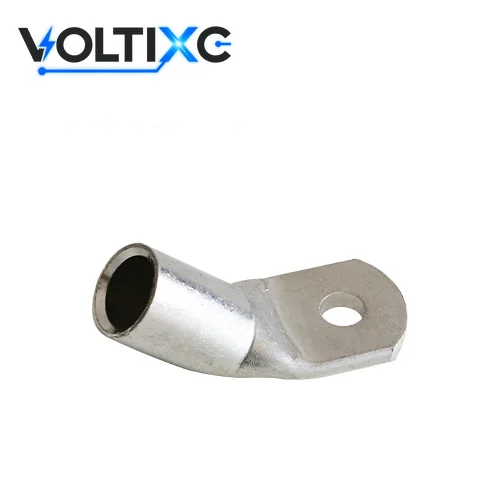
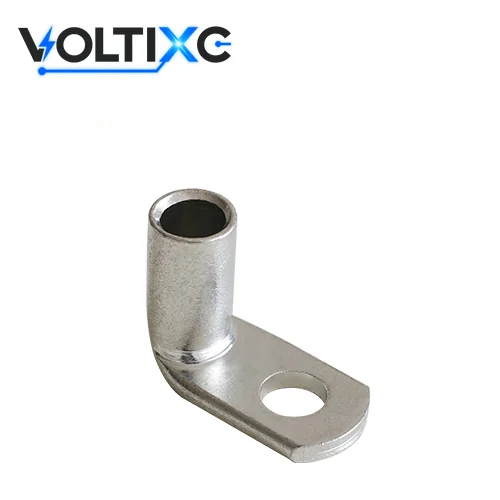
Choose tin-plated copper lugs for batteries in damp, salty or outdoor air, and ask about a closed-end barrel when moisture could reach the crimp from the palm side; a dry, closed battery box can take bare copper.
| Problem | What to do | Check |
|---|---|---|
| The battery bank sits on a boat, a dock or outdoors | Use tin-plated lugs, which the AWG series has per supplier specification sheet; tin plating helps the copper resist corrosion in damp, salty air | The finish is written next to each size on the order |
| Water could run down the cable into the barrel | Seal the barrel and the jacket with heat-shrink tubing after crimping | The tubing covers the whole barrel and overlaps the jacket |
| Moisture could enter the barrel from the palm end | Ask about a closed-end barrel; no VoltixC series lists one yet, so ask before you specify | The quote names the barrel type |
| Bare and tinned lugs are mixed on one battery bank | Pick one finish for the whole list | Every line on the order carries the same finish |
| The battery lives in a dry, closed compartment | Bare copper is a special request on the AWG series; ask before you specify | The order says bare copper for each size |
| The marine battery lug size is in doubt | Size it like any battery lug, by gauge and stud; the marine choices are the finish and the wire type | Gauge, stud, finish and wire type all appear on the list |
Tin plating changes the surface of the lug and leaves the gauge and the die as they were. The supplier specification sheet lists tin plating on all 36 AWG-series parts, so a bare finish has to be asked for. Tube lugs described with tin plating are on the tinned copper tube lugs page.

Crimp the battery lug with a tool and die made for its size, then pull-test it; add solder only when the lug maker marks the part for it, and never as the only mechanical hold on a boat.
Cut the cable square and strip it to the depth of the lug barrel.
Held side by side, the bare copper and the barrel should be the same length.
Push the conductor into the barrel until it bottoms out.
No strand stays outside, and the jacket stops at the barrel mouth.
Close the tool through its full stroke with the die marked for the lug size.
Even flats all around the barrel show that the die fitted.
Pull hard on the lug by hand, then run the pull test your standard calls for.
If anything moves, cut the lug off and start again with a new one.
Shrink tubing over the barrel and the end of the jacket.
Once it cools, no copper shows between the palm and the jacket.
| Question | What West Marine reports | For a battery lug |
|---|---|---|
| Which tool? | According to West Marine, solderless crimp-on connectors must be attached with a crimping tool designed for the connector under ABYC E-11.14.3.8 | Use the tool and die made for the lug size; a hammer crimp does not meet this |
| Solder alone? | West Marine states that solder shall not be the sole means of mechanical connection in a marine circuit under ABYC E-11.16.3.7 | Crimp first; solder only where the lug maker’s data allows it |
| Pull test? | West Marine’s summary of ABYC sets out pull-test ratings for connectors and battery-cable terminals | Take the pass value from ABYC or from the lug maker |
Buyers on solar and battery forums ask whether a hammer crimp tool will do. For boat wiring, the first row answers it. Heat-shrink goes on after any soldered joint has cooled.
In all three systems, record the cable gauge and the stud first, then let the environment set the finish and the routing space set the angle.
| Application | Cable to expect | Environment risk | Lug features to specify | Where to look |
|---|---|---|---|---|
| Car and truck starting | SAE copper battery cable, or welding cable on custom builds | Engine heat, vibration and road spray | Gauge and stud for each end, including the chassis grounding lead; a 90-degree lug at a tight starter terminal | AWG copper cable lugs |
| Solar and battery storage | Flexible or fine-strand battery and inverter cable | Several lugs on one power distribution bus bar; outdoor enclosures | A barrel sized to the measured conductor; a hole matched to the bus bar or inverter stud | AWG and mm² size chart |
| Marine start and house banks | AWG boat cable | Damp, salty air; bilge and engine spaces | Tin-plated lugs, with heat-shrink over every barrel | tinned copper tube lugs |
| Industrial power systems and backup power | Welding cable or flexible power cable | Cabinets with several leads per stud | A stud count for each terminal; straight lugs where there is room | copper cable lugs |
A car or truck starting circuit ends at the battery, the starter and the chassis ground, and each of those ends can take a different stud. Measure all three before the order goes out. Solar storage banks put several lugs on one bus bar, so the stud count matters as much as the gauge there. As a worked case, 4/0 AWG inverter leads on M10 studs need a 4/0 barrel with an M10 hole at both ends, and tin plating goes on the line when the bank sits outdoors.
On boats, the wire type is the first check, before any lug size; the cable type section covers the SAE limits. After that, a marine battery lug is sized by gauge and stud like the others, with tin plating and heat-shrink on every barrel.
A battery lug goes back for rework when its barrel or its hole was ordered from a label instead of a measurement. The table lists seven such mistakes, each with its fix and a check.
| Problem | What to do | Check |
|---|---|---|
| The barrel matches the gauge, but the welding or OFC cable will not go in | Measure the stranded conductor, since for the same AWG a stranded wire has a larger diameter than a solid wire, as Engineering ToolBox notes | The measured diameter is on the order next to the gauge |
| An AWG-sized barrel sits loose on SAE cable | Measure first; West Marine reports that SAE wire can be up to 12% smaller than AWG boat cable, so a larger gauge may be needed to meet voltage-drop limits | The barrel grips the strands with no gap after crimping |
| The hole was ordered as 5/16 in, but the stud is M8 | Copy the stud name from the drawing; 5/16 in is 7.938 mm and M8 is 8 mm | The bolt passes through the hole without forcing |
| No length was left for heat-shrink | Allow barrel and jacket length for the tube before you cut the cable; on an outdoor battery the tube adds corrosion resistance at the barrel mouth | The tube covers the barrel and overlaps the jacket |
| The crimp went into service without a pull check | Pull by hand, then run the pull test your standard sets | Nothing moves, and the result is written down |
| Five lugs were stacked on one battery stud | Move the extra leads to another stud. According to West Marine, no more than four terminals should be secured to one terminal stud under ABYC E-11.14.4.1.10; extra connections need additional studs joined by jumpers or copper straps | Four lugs or fewer on each stud |
| The lug was chosen to fit the battery post | Choose by cable gauge and stud; a tapered post takes a clamp terminal | The order lists gauge and stud for every lug |
Every fix in the table starts with a new lug. A second squeeze on a bad crimp leaves the cause in place. Write the measured diameter, the stud name and the heat-shrink length on the order before the next batch.
Caution: Do not re-crimp a battery lug that failed its pull check or went through the wrong die. Cut it off, strip fresh cable and crimp a new lug once, in the matched die.
Send the gauge, cable type, stud size, angle, finish and quantity for each lead; whether a dimension drawing comes with the quote is confirmed per order.
The list is checked row by row against the nine gauges on the AWG copper cable lugs page, and any row outside them is marked as a question before the quote. If the fit on your equipment is unproven, ask for one or two sizes as samples first; fastest sampling is 7 days. MOQ, packing and lead time are confirmed per order.
The cable lug size chart converts AWG and mm² before you fill in the list, and the cable lug dimensions guide explains the fields on a lug drawing. For the crimp itself, how to crimp wires covers the matching tool and die. Send cable gauge, stud size and installation environment for a battery-lug drawing review.
The cable gauge comes first, because it sets the barrel; the stud size comes second and sets the hole. On a long run, settle the gauge before either. Engineering ToolBox notes that for longer distances, reducing the AWG number (increasing wire diameter) may be necessary to limit voltage drop.
Copy the stud name from the drawing and order the hole in the same system. Inch and metric studs sit close together without matching: 3/8 in is 9.525 mm, and M10 is 10 mm. West Marine, summarizing ABYC E-11.14.4.1.11, says ring terminals should be the same nominal size as the stud.
The copper inside them differs even when the gauge printed on the jacket is the same. West Marine puts SAE wire at up to 12% smaller than AWG boat cable. For the same AWG, a stranded wire has a larger diameter than a solid wire, according to Engineering ToolBox. Measure the stripped conductor and send that figure with the gauge.
When the cable has to turn right at the stud, as at a starter terminal or inside a tight battery box. The bend is formed in the lug, so the cable and the crimp stay straight. Say which way each palm faces.
A protective tin surface on the copper, which is the reason to choose it for damp, salty or outdoor battery banks. It changes neither the gauge nor the die. Pair it with heat-shrink over the barrel, and ask about a closed-end barrel if water could reach the crimp from the palm side.
Look at it, pull it by hand, then run the pull test your standard sets. A good crimp shows even flats, no strands outside the barrel and no movement under the pull. On a boat, do not rely on solder to hold it; according to West Marine, solder shall not be the sole means of mechanical connection in a marine circuit under ABYC E-11.16.3.7.
2/0 is bigger. The conversion table puts 1/0 AWG at 53.5 mm² and 2/0 AWG at 67.4 mm², and each extra zero in the name means a larger cable. Order the lug for the gauge printed on the jacket, since a 1/0 barrel and a 2/0 barrel are not interchangeable.
How this guide was written: the gauges, stud holes, barrel sizes and lengths come from the supplier specification sheet for the AWG heavy-duty series, and the conversion mm² and stud figures from the conversion tables in the VoltixC cable lug size chart. The wire and terminal rules come from West Marine’s summary of ABYC E-11 and from Engineering ToolBox. VoltixC ran no tests for this guide, so it gives no pull-force, voltage-drop or temperature values of its own. The supplier rows have not each been re-tested.
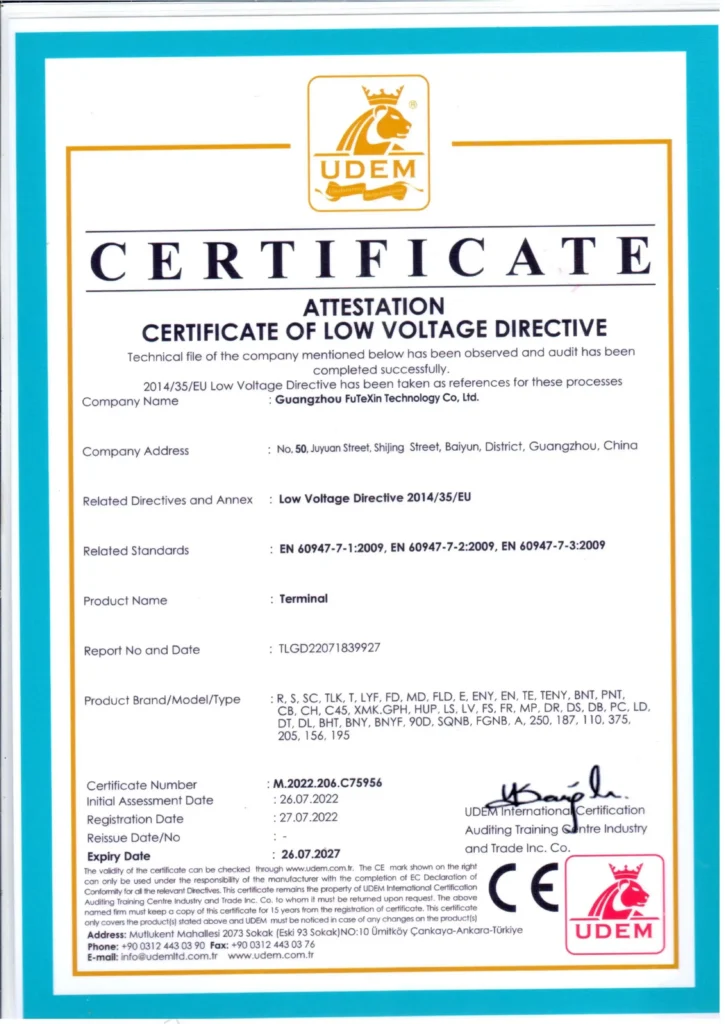
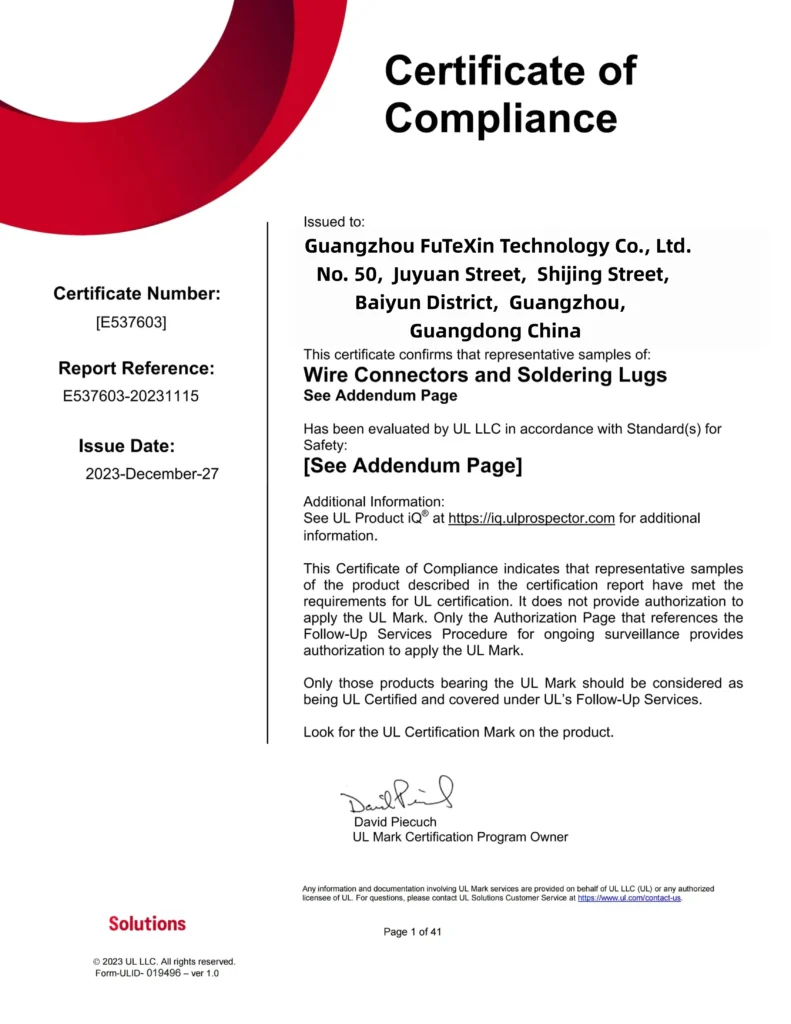
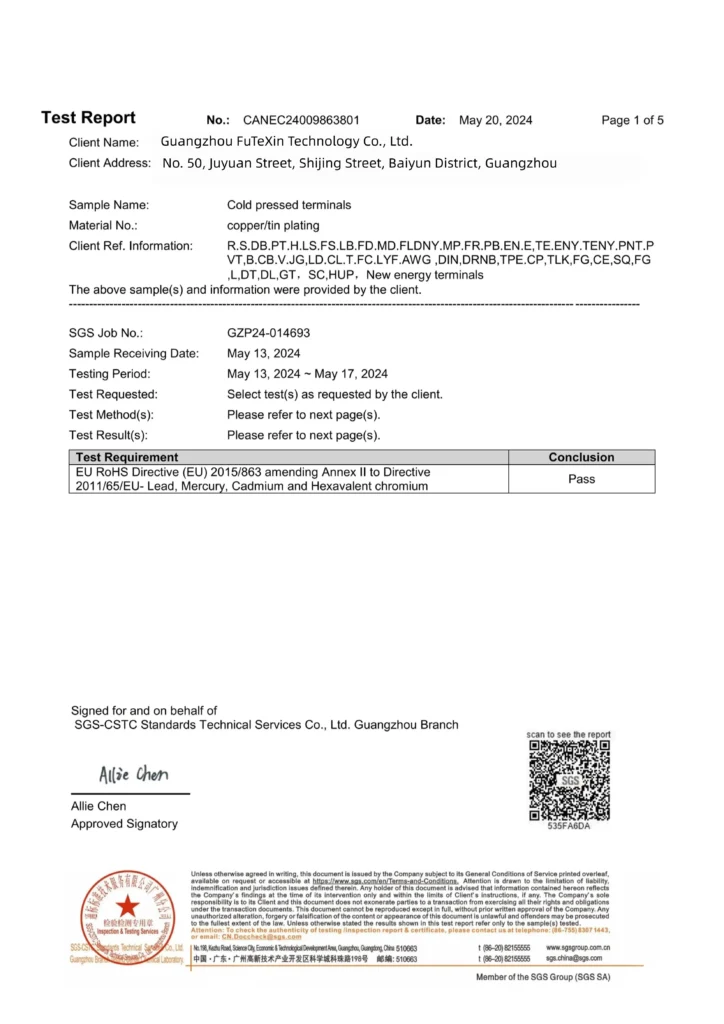
VoltixC is the brand of Guangzhou FuTeXin Technology Co., Ltd. It makes the copper cable lugs this guide describes, including the AWG heavy-duty series for battery cable, and it does not make battery post clamps.