VOLTIXC / ENQUIRY
Request a Quote
Tell us what you need and we will review your enquiry.

By VoltixC Engineering Team · Last updated: 2026-09-28
Fast answer: DIN 46235 is the German standard for copper compression cable lugs of the cover-plate type; it defines their application, dimensions and marking. A DIN lug is identified by its conductor cross-section in mm², its bolt-hole size and the hexagonal die it is designed for, so give all three when you send an enquiry.
A panel builder in Europe gets a switchgear drawing that says “cable lugs to DIN 46235” and has a 120 mm² copper cable and an M12 stud on the bench. The two numbers go on the order first, and the die comes right after them, since the lug has to fit the cable, the stud and the crimp tool at once. VoltixC lists 18 cross-sections, DIN6 to DIN1000, in 68 tin-plated copper part numbers on its DIN 46235 cable lugs page; that page carries the part numbers, and this guide covers the standard and the choice of size.
Figures for the standard come from DIN Media’s catalogue entry and from Klauke, Weidmüller, LAPP and Phoenix Contact pages, and each one names its source where it appears. The VoltixC supplier specification sheet prints a cross-section, stud hole, barrel size and length for each part number; crimp count, die code and plating thickness are not on it, so an order confirms those.
On a DIN 46235 lug, the stamped numbers give the cross-section in mm² and the bolt size, and a separate code number points to the crimp tool.
| Spec | What to record | Working value |
|---|---|---|
| Standard identity | The standard named on the drawing | DIN Media lists DIN 46235 as cable lugs for compression connections, cover plate type, for copper conductors |
| Cross-section range | mm² printed on the lug | Klauke gives the standard’s range as 6 mm² to 1000 mm², with connecting-bolt holes from M5 to M20 |
| One maker’s catalogue | The sizes a supplier actually lists | Klauke’s listed DIN cable lugs cover 10–800 mm² with IEC testing |
| Bolt hole for a given M size | Hole diameter checked against the stud | Phoenix Contact’s RBO 16 data pairs an M16 bolt with a 17 mm hole for DIN 46235 cable lugs |
| Conductor class | Class from the cable data sheet | Klauke lists the lugs for round conductors of EN 60228 classes 1, 2, 5 and 6 |
| Crimp die | Die family and code | Klauke says the standard recommends hexagonal crimping dies according to DIN 48083-4 |
| Tool code on the lug | The code stamped next to the size | According to Klauke, a code number provides clear tool assignment for the DIN cable lugs |
| Crimp count | Number of crimps for that size | Taken from the maker’s data sheet for the lug; for VoltixC items it is confirmed per order |
| Material and finish | Copper grade and surface | Klauke’s lugs are copper under EN 13600 and tin plated to protect against corrosion |
| Sheet-metal cousin, DIN 46234 | Only if the drawing names it | Klauke gives 0.5 mm² to 240 mm² and bolt holes from M2 to M16 for DIN solderless terminals |
| VoltixC range | Part number on your order | 18 cross-sections, DIN6 to DIN1000 (4.0-6.0 to 1000 mm²), in 68 part numbers with stud holes from 5.3 to 21 mm; tin-plated copper, per supplier specification sheet |
Source: VoltixC row per supplier specification sheet, not individually re-tested; other rows from the sources cited below.
Copy both numbers onto the order line exactly as stamped, then add the die code; the rows below give the ranges and one maker’s examples to check them against.
| Also asked as | Short answer | Covered in |
|---|---|---|
| DIN 46235 standard | The German standard for copper compression cable lugs; read it for the lug form, the dimensions and the marking information | What DIN 46235 defines |
| DIN 46235 cable lug sizes | A cross-section in mm² paired with a bolt hole; stud holes available on the VoltixC sheet run from 5.3 to 21 mm | Sizes by mm² and bolt hole |
| Cable lug standards | DIN 46235 for lugs pressed from copper tube, DIN 46234 for sheet-metal terminals; a plain tube lug follows its maker’s own design | The three copper lug types |
| IEC standard for cable lugs | The sources used here name no single international (IEC) standard for DIN lugs; ask which IEC test document applies to the lot | FAQ |
| DIN-compliant cable lug | A catalogue label alone does not show it; ask for the DIN 46235 designation and the die code in writing | Ordering mistakes |
| DIN 46235 lug marking | Markings that provide the mm², the bolt size and a tool code | Reading the marking |
| DIN copper tube terminal | The title printed on the VoltixC supplier sheet for the same 68 part numbers | Sizes by mm² and bolt hole |
DIN 46235 sets the applications, dimensions and designation of compression cable lugs, according to Klauke’s summary of the standard.
| Problem | What to do | Check |
|---|---|---|
| The drawing only says “DIN 46235” | Read the DIN 46235 standard as a request for a lug form, then add the mm², bolt size and conductor class yourself | DIN Media’s entry covers cable lugs for compression connections, cover plate type, for copper conductors |
| You need test evidence for the lot | Ask the maker for its own test documents, since the dimension standard does not list results | Klauke, as one example, lists its DIN cable lugs at 10–800 mm² with IEC testing |
| The conductor is aluminium | Look outside DIN 46235 for the lug or connector | The cable data sheet names copper before a DIN lug is quoted |
| The drawing says DIN 46234 | Treat it as a different part, the sheet-metal terminal covered in the next section | Klauke notes that DIN 46234 solderless terminals have standard requirements for application, dimensions and designation |
| Finish is missing from the drawing | Add tin-plated or bright to the order line | The quotation repeats the finish you wrote |
| A catalogue calls a plain tube lug “DIN type” | Ask for the DIN 46235 designation and the die code in writing | Both appear on the quotation and on the sample |
| The drawing asks for crimp count or crimp spacing | Treat both as design details the maker sets at manufacture, and ask for them on its data sheet | The quotation states each one in accord with that data sheet |
For crimp count, test results and packing, read the maker’s own data sheet for the lot; none of the three is on that list. The DIN Media catalogue entry is where the title itself can be checked.
A DIN 46235 lug is made from copper tube, a DIN 46234 solderless terminal is formed from copper sheet with a soldered joint, and a standard tubular lug follows its maker’s own catalogue.
A buyer who opens a mixed carton on site can sort the three by the barrel and by the drawing reference, before any size is read.
| Type | Made from | Size range in the source | Conductor classes | Where it is used | On the VoltixC list |
|---|---|---|---|---|---|
| DIN 46235 compression lug | Electrolyte copper tube, tin plated as standard in Klauke’s range | 6 mm² to 1000 mm², bolt holes M5 to M20, per Klauke | EN 60228 classes 1, 2, 5 and 6 in Klauke’s listing | Copper power cable onto a bolted stud or busbar | VoltixC DIN copper lugs, 18 cross-sections in 68 part numbers |
| DIN 46234 solderless sheet terminal | Copper sheets with a soldered joint, unlike lugs made from tubes, per Klauke | 0.5 mm² to 240 mm², bolt holes M2 to M16, per Klauke | EN 60228 classes 2, 5 and 6 in Klauke’s listing | Control cabinet construction and rail-vehicle construction, per Klauke | Not on the current list; ask before you specify |
| Standard tubular lug | Copper tube to the maker’s own drawing | Set by each maker’s catalogue | Set by each maker’s catalogue | General cable termination where no DIN reference is given | tinned copper tube lugs |
| Sheet-terminal detail | What the maker says | Source |
|---|---|---|
| Conductors | DIN 46234 solderless terminals are crimped with several, fine and super-fine stranded conductors | Klauke |
| Crimp area | The terminals are to DIN 46234, with a brazing process in the crimp area | Klauke |
| Joint quality | Soldered-joint quality is key to the crimping result, and poor joints may open during crimping | Klauke |
| Press zone | The hard-soldered press zone is intended to achieve maximum conductor pull-out values | Phoenix Contact |
| Build | The product is designed according to DIN 46234, brazed and tin plated | Phoenix Contact |
| Copper grade | KB products are uninsulated cable lugs / solderless terminals according to DIN 46234, made from electrolytic copper | LAPP |
| Applications | Cables with category 2, 5 and 6 conductors, control cabinets / equipment, and trains / buses | LAPP |
| Catalogue split | The accessory range lists compression cable lugs to DIN 46235 and sheet-metal cable lugs to DIN 46234 | Weidmüller |
Source: Klauke, LAPP, Phoenix Contact and Weidmüller product pages; VoltixC column per supplier specification sheet.
If the drawing names neither standard, the choice turns on the busbar and the die already on site; the cable lugs range shows both tube families side by side.
Tip: Look along the barrel before you read any size. A seam or brazed line points to a sheet terminal, while a closed round tube points to a pressed-tube lug such as DIN 46235.
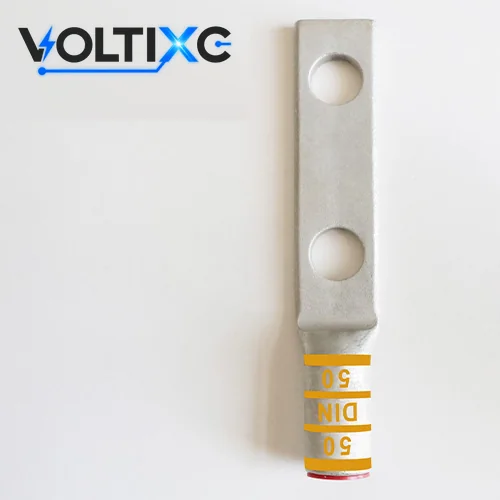
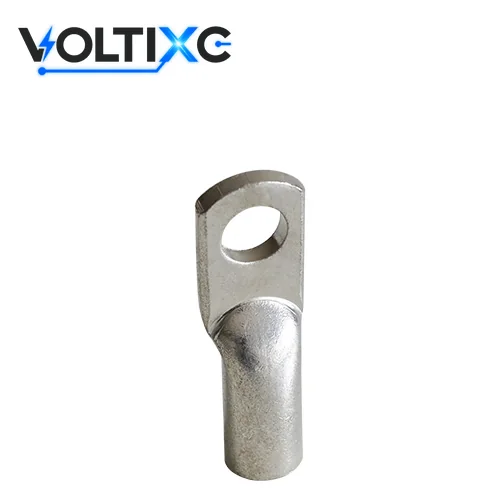
Start with the mm² figure, which decides the cable, then read the M size and the tool code.
A made-up stamp of “120 / M12 / code” stands for a 120 mm² barrel, an M12 hole and the die code for that size. With no code on the part, an installer picks the die by barrel size alone, so ask for the code on the quotation. File a photo of the first sample’s marking with the order. The cable lug dimensions guide has the barrel and palm measurements.
| Mark on the lug | Purpose of the mark | How to check it | On a VoltixC lug |
|---|---|---|---|
| Cross-section (mm²) | The conductor size the barrel is made for | Compare it with the mm² on the cable data sheet, not with an AWG label | Shown on the part; confirmed per order |
| Bolt size (M) | The stud or bolt the palm hole is drilled for | Hold the lug against the stud or read the hole on the busbar drawing | Shown on the part; confirmed per order |
| Tool or die code | The crimp tool and die set for that lug; Klauke says the code number provides clear tool assignment | Match the code with the die code printed on the tool | Confirmed per order |
| Maker’s mark | Who made the lug and where to find its data sheet | Ask for the data sheet that belongs to that mark | VoltixC marking content confirmed per order |
| Crimp position marks | Where the die closes on the barrel, when the maker prints them | Follow the maker’s data sheet if the barrel carries no marks | Confirmed per order |
| Point | What the data says | Source |
|---|---|---|
| What the standard sets | DIN 46235 defines the applications, dimensions and designation of compression cable lugs | Klauke |
| Scales the marks fall on | Conductor nominal cross-sections from 6 mm² to 1000 mm² and connecting-bolt holes from M5 to M20 | Klauke |
| Hole behind an M16 mark | The RBO 16 connection for DIN 46235 cable lugs specifies a 17 mm hole with an M16 bolt / thread | Phoenix Contact |
Source: Klauke and Phoenix Contact pages listed under References; the VoltixC column follows the supplier specification sheet, which does not print marking content, so it is confirmed per order.
Pair each cross-section with a bolt hole; Klauke puts the standard’s range at 6 mm² to 1000 mm² and M5 to M20.
Take the mm² from the cable data sheet and the M size from the busbar or stud drawing, then find the row where both appear. When the drawing gives only a stud size, measure the hole on a sample before the first order. The copper lug size chart covers the AWG and kcmil side of the same lookup.
| Point | What the data says | Source |
|---|---|---|
| Range of the standard | Conductor nominal cross-sections from 6 mm² to 1000 mm² and connecting-bolt holes from M5 to M20 | Klauke |
| One maker’s listed range | DIN cable lugs covering 10–800 mm² with IEC testing | Klauke |
| A worked hole size | The RBO 16 connection for DIN 46235 cable lugs specifies a 17 mm hole with an M16 bolt / thread | Phoenix Contact |
| Sheet terminals for contrast | 0.5 mm² to 240 mm² with bolt holes from M2 to M16 under DIN 46234 | Klauke |
Source: Klauke DIN 46235 and DIN 46234 pages and the Phoenix Contact RBO 16 data sheet; the tightening torque on that sheet is not carried over here.
| Item code | mm² | AWG / kcmil label | Stud holes on the sheet, Ø mm |
|---|---|---|---|
| DIN6 | 4.0-6.0 | 12-10 | 5.3, 6.4, 8.4 |
| DIN10 | 10 | 8 | 5.3, 6.4, 8.4, 10.5 |
| DIN16 | 16 | 6 | 6.4, 8.4, 10.5, 13 |
| DIN25 | 25 | 4 | 6.4, 8.4, 10.5, 13 |
| DIN35 | 35 | 2 | 6.4, 8.4, 10.5, 13, 15 |
| DIN50 | 50 | 1/0 | 8.4, 10.5, 13, 15 |
| DIN70 | 70 | 2/0 | 8.4, 10.5, 13, 15, 17 |
| DIN95 | 95 | 3/0 | 8.4, 10.5, 13, 15, 17 |
| DIN120 | 120 | 4/0 | 10.5, 13, 15, 17, 21 |
| DIN150 | 150 | 250/300 | 10.5, 13, 15, 17, 21 |
| DIN185 | 185 | 300/350 | 10.5, 13, 15, 17, 21 |
| DIN240 | 240 | 400/450 | 13, 15, 17, 21 |
| DIN300 | 300 | 500 | 13, 15, 17, 21 |
| DIN400 | 400 | 600/750 | 15, 17, 21 |
| DIN500 | 500 | 800/1000 | 17, 21 |
| DIN625 | 600 | 1000/1250 | 17, 21 |
| DIN800 | 800 | — | 17, 21 |
| DIN1000 | 1000 | — | 17, 21 |
Source: per supplier specification sheet (DIN Copper Tube Terminal), values as printed, not individually re-tested; labels from 250/300 upward are kcmil as printed; — = no value printed; DIN625 is printed against 600 mm². 68 part numbers in the full specification table — request the complete list with your quote.
Spec note: Put the mm² and the M size on the same order line, for example “120 mm², M12”; a cross-section with no bolt size leaves the palm hole open to guesswork.
Klauke lists DIN compression lugs for round conductors of EN 60228 classes 1, 2, 5 and 6, and notes that the standard recommends hexagonal crimping dies according to DIN 48083-4.
| Problem | What to do | Check |
|---|---|---|
| The cable is fine or super-fine stranded | Keep the DIN lug; Klauke says these lugs may be used for one, several, fine and super-fine stranded conductors | The class on the cable data sheet is 1, 2, 5 or 6 |
| The cable has sector-shaped conductors | Pre-round each sector before the lug goes on; Klauke names pre-rounded multi-stranded sector conductors among the uses | The conductor end is round and enters the barrel without force |
| The cable carries mechanical tension | Choose a tension-rated fitting instead, since Klauke limits the lugs to non-tension copper cables such as DIN 48201-1 | The cable is supported before it reaches the lug |
| The die on site is a round or indent die | Change to a hexagonal die according to DIN 48083-4, which the standard recommends per Klauke | The die code on the tool matches the code on the lug |
| Nobody knows how many crimps the size needs | Crimp the number of times the maker’s data sheet gives for that cross-section | Count the hexagon impressions on the finished barrel |
| The crimp tool shows no die code | Ask the tool supplier for the die table before the job starts | The code on the lug appears in that table |
Crimp count and crimp spacing belong to the lug maker’s data, and for VoltixC items both are confirmed per order. The general crimp sequence, from strip length to pull check, is written up in the wire crimping guide.
Write electrolytic copper and tin-plated on the enquiry, or bright if your drawing asks for bare copper.
Tin plating is the default in the maker data below, and bright copper is a choice to state in words on the order line. The VoltixC supplier sheet prints tin-plated copper for all 68 part numbers, and bright copper is not on the current list, so ask before you specify it. The temperature figures in the last two rows come from DIN 46234 sheet terminals and are not ratings for DIN 46235 lugs.
| Point | What the data says | Source |
|---|---|---|
| DIN lug material | Compression cable lugs made from electrolyte copper and tin plated as standard for corrosion protection | Klauke |
| Copper standard, DIN lugs | Cable lugs of copper under EN 13600, tin plated to protect against corrosion | Klauke |
| Copper standard, sheet terminals | Copper under EN 13599 with a tin-plated surface for corrosion protection | Klauke |
| Sheet terminal, one example | Electrolytic copper with a temperature range up to +120°C | LAPP |
| Ring lug to DIN 46234, one example | Copper with a tin-plated coating and an operating ambient temperature of 110°C | Phoenix Contact |
Source: Klauke, LAPP and Phoenix Contact product pages listed under References; none of them describes VoltixC parts.
Check seven fields before a DIN order goes out, starting with the DIN 46235 designation and the mm² figure.
| Problem | What to do | Check |
|---|---|---|
| A plain tube lug arrives where the drawing says DIN 46235 | Ask for the DIN 46235 designation and the die code on the quotation | Klauke notes that a code number provides clear tool assignment for DIN cable lugs |
| The order gives AWG while the drawing gives mm² | Order by the mm² on the drawing and keep the AWG label only as a cross-reference | Each order line carries a mm² figure |
| The installer uses whatever die is on the tool | Specify hexagonal dies according to DIN 48083-4 | The die code matches the lug code |
| The bolt hole is bought by the M number alone | Check the hole diameter against the stud; Phoenix Contact’s RBO 16 data gives a 17 mm hole for an M16 bolt | A sample lug drops over the stud without reaming |
| Sector conductors go into the barrel as they are | Pre-round them first; Klauke says sector conductors should be pre-rounded with the corresponding tool before processing | The strand bundle is round at the cut end |
| Finish is left off the order | Write tin-plated or bright on each line | The quotation and the carton label show the same finish |
| Conductor class is left off | Add the EN 60228 class from the cable data sheet | Class 1, 2, 5 or 6 is written next to the mm² |
The table covers ordering errors only. Row four’s 17 mm hole comes from one Phoenix Contact data sheet, so hold a sample against your own M16 stud before a full order.
Caution: Pre-round sector conductors with the tool for that size before they go into the barrel, and crimp with the die the lug code names.
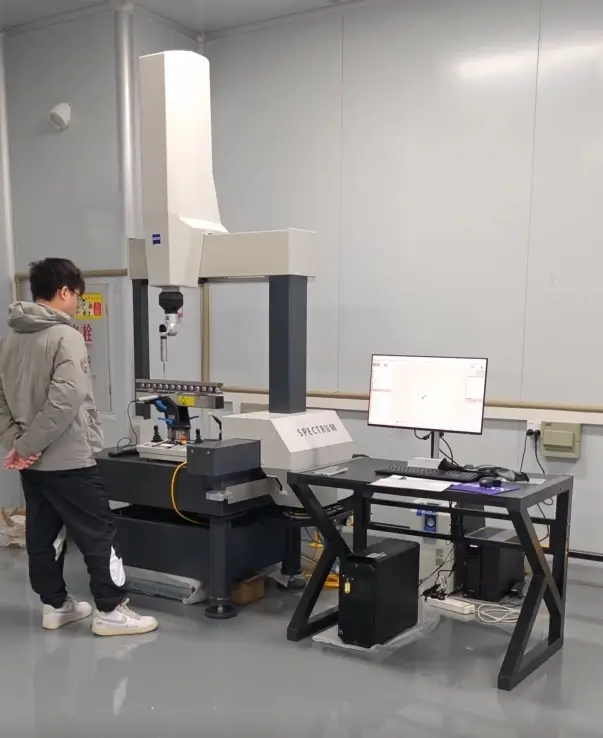
Send the mm², the bolt size, tin-plated or bright, the quantity per size and a note if you need the CE or RoHS certificate images.
| Field | What to write | Why it is needed |
|---|---|---|
| Cross-section | mm² from the cable data sheet, one per line | Picks the item code |
| Bolt size | M size of the stud, plus the hole diameter if the drawing gives one | Sets the palm hole |
| Conductor class | EN 60228 class 1, 2, 5 or 6 | Confirms the barrel is suitable for the strands |
| Finish | Tin-plated, or bright if the drawing calls for bare copper | Tin is printed on every VoltixC part number; bright is not on the current list |
| Die in use | Die code or tool model on site | Lets the lug code be matched to it |
| Quantity | Pieces per size | Sets the packing per line |
| Documents | Certificate images or data sheets you need with the quotation | Shows what is attached to the reply |
| Drawing | Drawing number and version | Ties the quotation to the right revision |
VoltixC lists the DIN range from DIN6 to DIN1000 on its DIN copper lug page, and each size is checked against your drawing before a quotation goes out. Samples can be arranged, with fastest sampling from 7 days, confirmed per order. If the job mixes DIN lugs with other lug families, the cable lug type guide helps sort the rest of the list first.
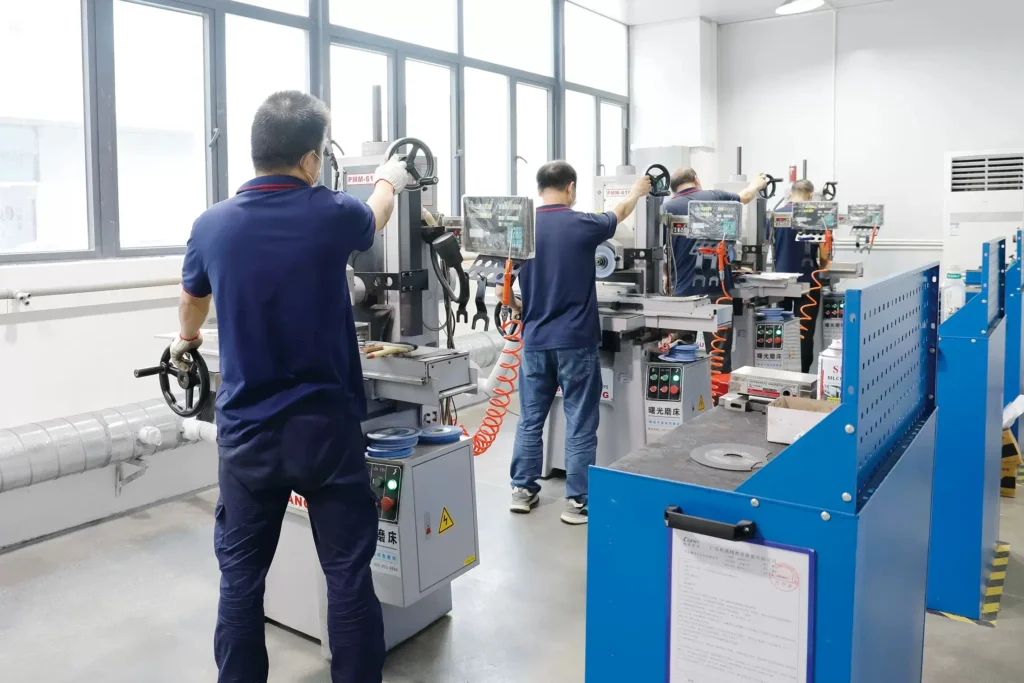
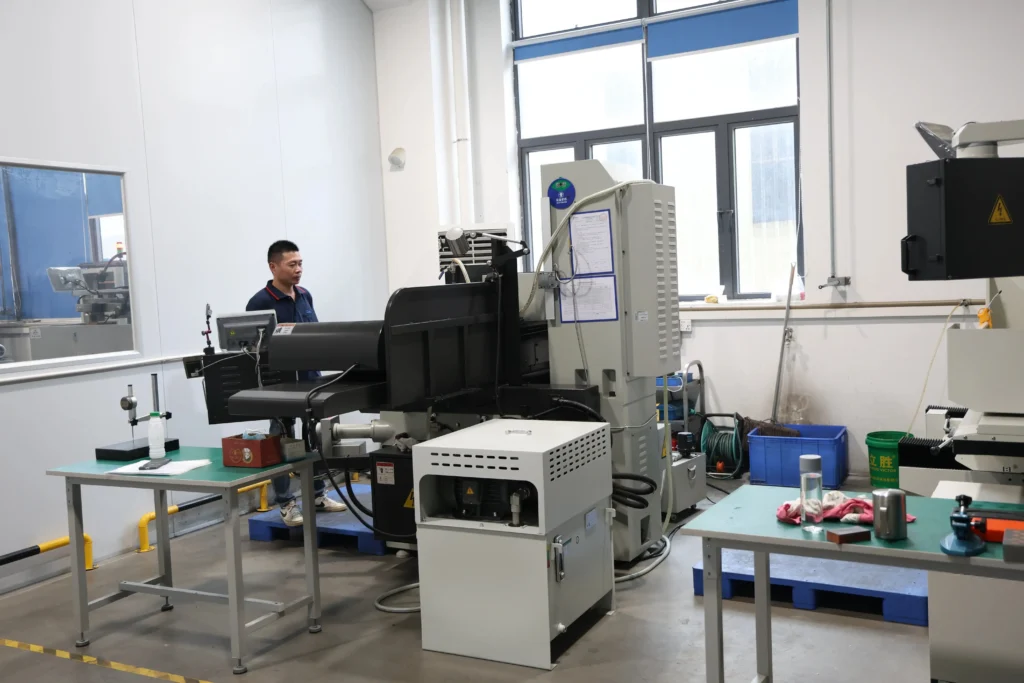
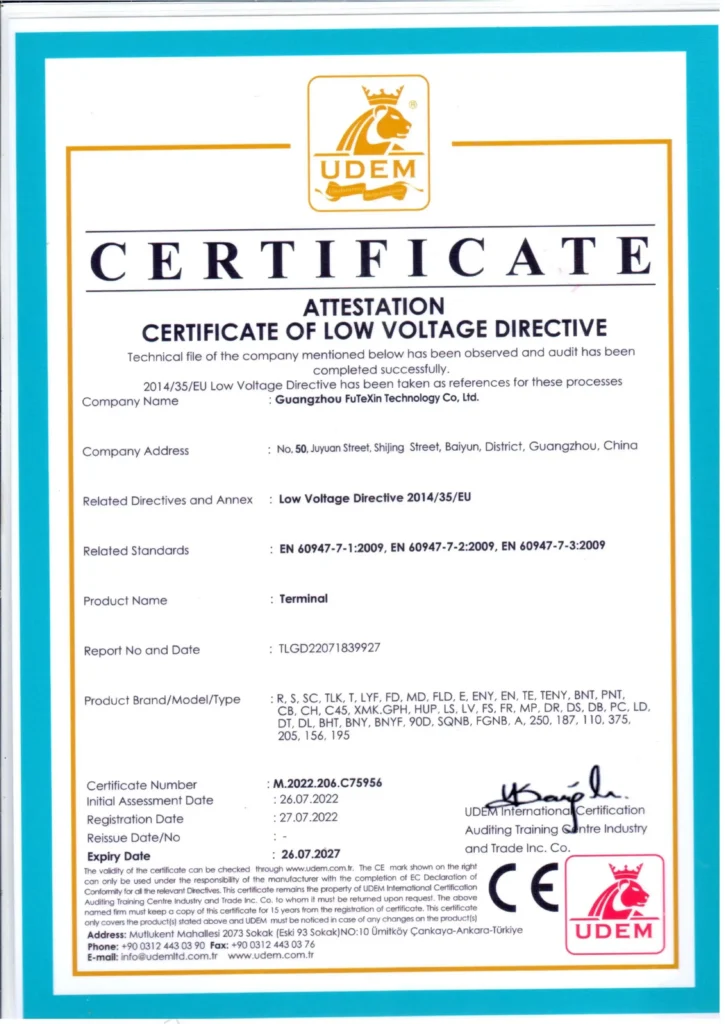
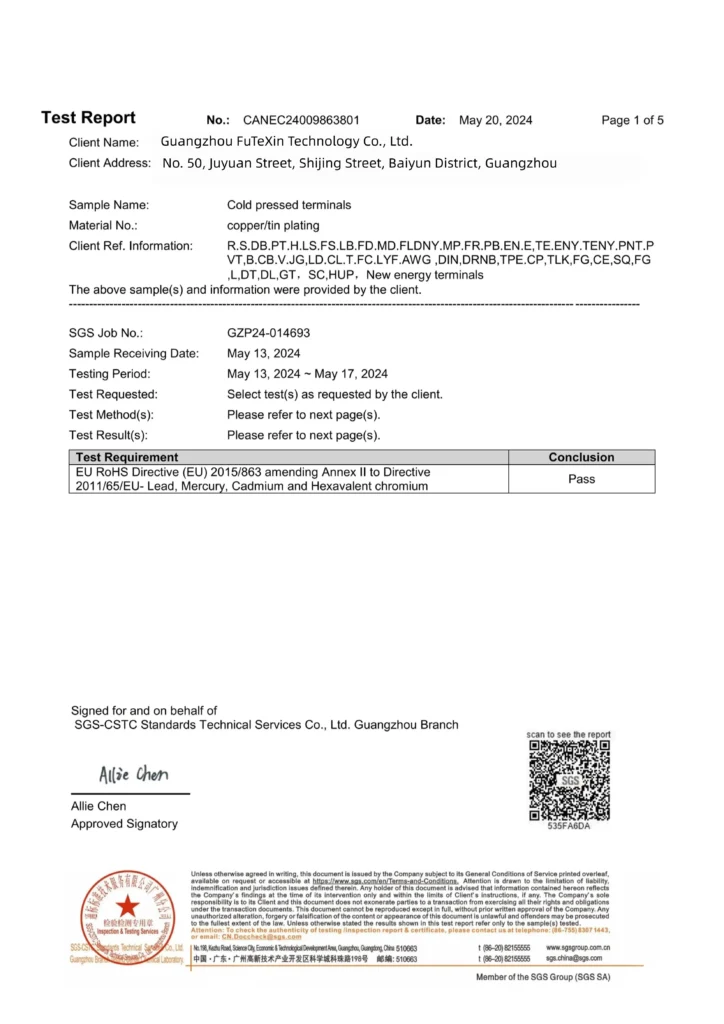
VoltixC is also UL certified; certificate numbers and dates are not published on this page.
No. Klauke’s summary gives the standard’s scope as the applications, dimensions and designation of compression cable lugs, so electrical test results come from the maker’s own report for the lot.
The marking carries the cross-section, the bolt size and a code number that, according to Klauke, provides clear tool assignment; a name such as “copper tube lug” leaves the size and the die open.
Only as a cross-reference. DIN 46235 sizes run in mm², from 6 mm² to 1000 mm² in Klauke’s summary of the standard, so the mm² and the conductor class belong on the order line next to any AWG label. On the VoltixC list the AWG labels come from the supplier table, and the cross-section behind each item code is printed beside them.
The barrel has to take the conductor and the palm has to fit the stud, and the two are chosen separately. Phoenix Contact’s RBO 16 data, as one example, pairs an M16 bolt with a 17 mm hole on DIN 46235 cable lugs.
Whenever the cable has sector-shaped conductors, since Klauke says sector conductors should be pre-rounded with the corresponding tool before processing.
A tube shape says nothing about the dimensions and designation that the standard sets, so ask for the DIN 46235 designation and the die code on the quotation and check both on the sample. Weidmüller’s accessory range, for one, lists compression cable lugs to DIN 46235 as a separate line from sheet-metal cable lugs to DIN 46234. A plain tubular lug from the tinned copper lugs range is quoted to its own drawing instead.
The sources behind this guide do not name one IEC standard for DIN lugs; Klauke describes its listed DIN cable lugs, 10–800 mm², as covered with IEC testing. Ask the supplier which IEC test document comes with the lot, and write that document name on your enquiry.
How this guide was written: the scope of DIN 46235 comes from DIN Media’s catalogue entry and Klauke’s summary of the standard. Size ranges, conductor classes, dies and finishes follow Klauke product pages, the DIN 46234 comparison uses Klauke, LAPP, Phoenix Contact and Weidmüller pages, and the M16 hole example is from a Phoenix Contact data sheet. VoltixC ran no tests for this guide. The 68 VoltixC part numbers come from the supplier specification sheet as printed and have not each been re-tested; crimp count, die code and plating thickness stay open until an order confirms them. Naming DIN 46235 here describes the lug form and its marking; it is not a certification claim.
VoltixC is the brand of Guangzhou FuTeXin Technology Co., Ltd. It makes the DIN 46235 copper lugs this guide uses as examples; crimp tools and dies are outside its range.